Black Comedy ★★★★

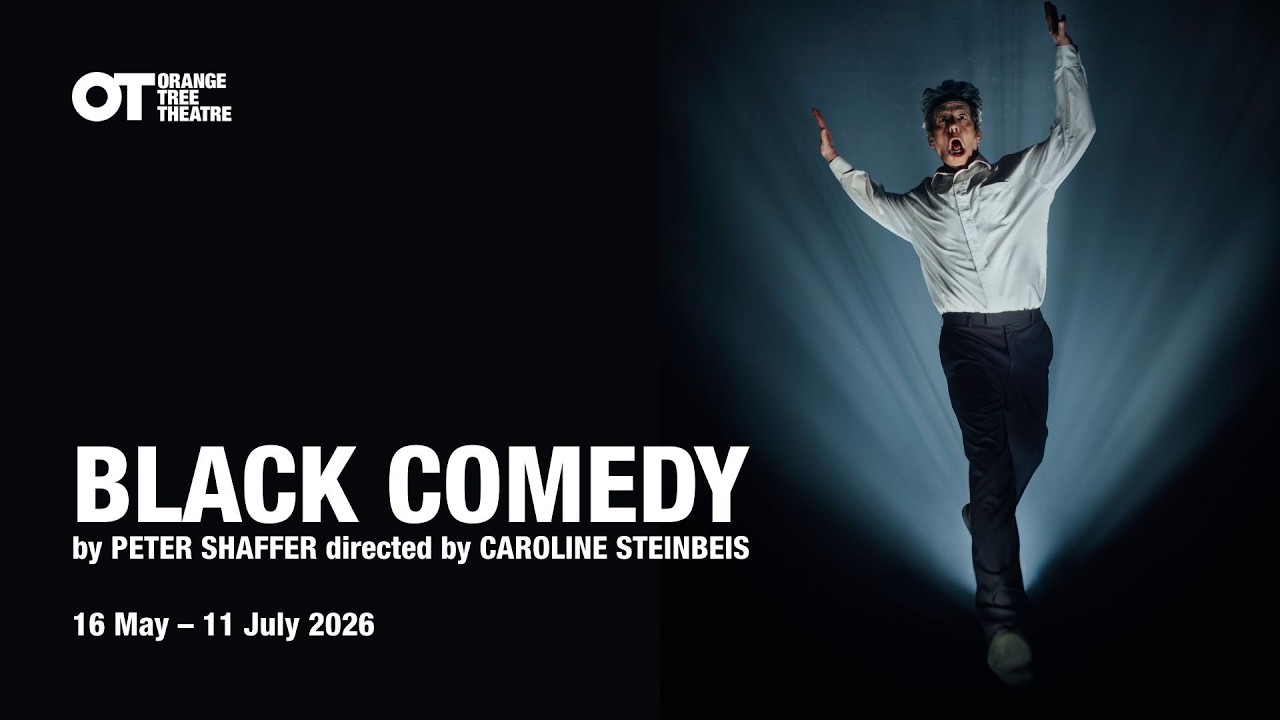
Renowned playwright Peter Shaffer engages funny mode in this revival of Black Comedy at the delightfully intimate Orange Tree Theatre in Richmond.

Peter Shaffer wrote Black Comedy in 1965, long before he conceived his seminal works Equus and Amadeus. Inspired by a Chinese play he had seen in London a decade earlier (in which two characters were supposedly fighting in the dark, while the audience watched in full light), he set out to create an English farce using the same device: characters plunged into darkness, yet fully visible to the audience, this time in the context of a chaotic drinks party where light itself becomes crucial, in this case for showing off an artwork. Commissioned for the fledgling National Theatre’s summer residency at that year’s Chichester Summer Festival, the play was written and rehearsed under tight deadlines, and there was scepticism within the company (including leads Derek Jacobi and Maggie Smith) about whether the conceit could possibly work. But it did, triumphantly, leading to a run at the Old Vic, a transfer to Broadway and a number of revivals since.

But, sixty years on, how will it fare in a small venue with a modern audience that’s steeped in special effects, contemporary sensibilities and multimedia theatre performances?

The short answer is: remarkably well. But before getting into that, it’s worth a quick plot summary… because, in farce, a complex plot is essential.

Images by Sam Taylor

When a power cut plunges Brindsley Miller’s flat into darkness on an important night, his carefully crafted plans begin to unravel. The evening opens in darkness (for the audience) as Brindsley and his fiancée Carol prepare to impress two crucial visitors: her fearsome father, Colonel Melkett, and an elusive German millionaire art collector called Georg Bamberger. To elevate his social standing, Brindsley has secretly “borrowed” his neighbour Harold’s expensive furniture. But, just as his guests are due to arrive, his lights fail, the stage lights come on, and a number of visitors blunder into the flat in the “darkness”.

First to arrive is Miss Furnival, a nervy, teetotal neighbour, seeking comfort in the blackout. Colonel Melkett follows, in full bluster, unimpressed by everything he can’t see and everyone he can hear, while Brindsley’s attempts to impress him backfire spectacularly as he trips, spills things and misidentifies people. Then, Harold, whose furniture Brindsley has stolen, returns early!

Desperate to stop Harold discovering that his prized possessions are scattered around his flat, Brindsley and Carol scramble to distract him, before Brindsley decides he must swap everything back before the lights are restored. As suspicion mounts, the flat becomes a frantic crossroads of bodies brushing past each other, whispered asides overheard by the wrong person, objects narrowly missing vital body parts and Brindsley’s lies piling up faster than he can track them.

Just as the furniture problem seems solvable, Brindley’s ex-girlfriend Clea arrives, unaware of Carol and intent on rekindling things, shifting the chaos from misplaced furniture to misplaced affections.

The joke, of course, is that the audience sees everything the characters cannot, so every misstep, collision, whispered aside, and panicked improvisation lands with delicious inevitability in a full-throttle farce of mistaken identities, stolen furniture and mounting panic, ending when the lights come back on. 

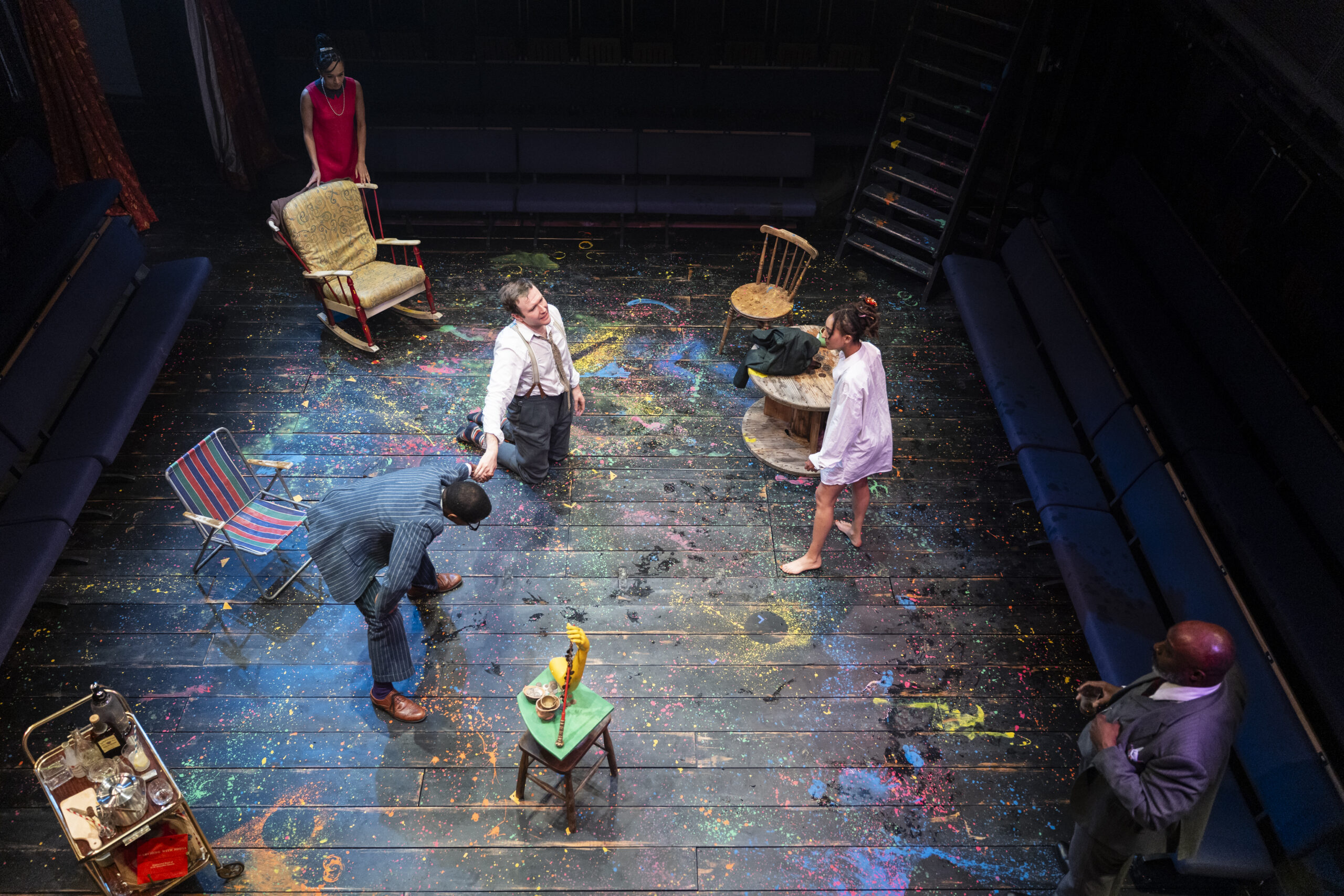
The action is staged in the round, reflecting the theatre’s layout. Most of the adjustments made to Shaffer’s original stage directions to accommodate this work so well that you’d think they’d been written for this configuration. But, in such an intimate space, cast members inevitably block sightlines on occasion, meaning that Lower Floor audiences may miss the odd moment. It’s a minor complaint, but frustrating in a play so dependent on physical action.
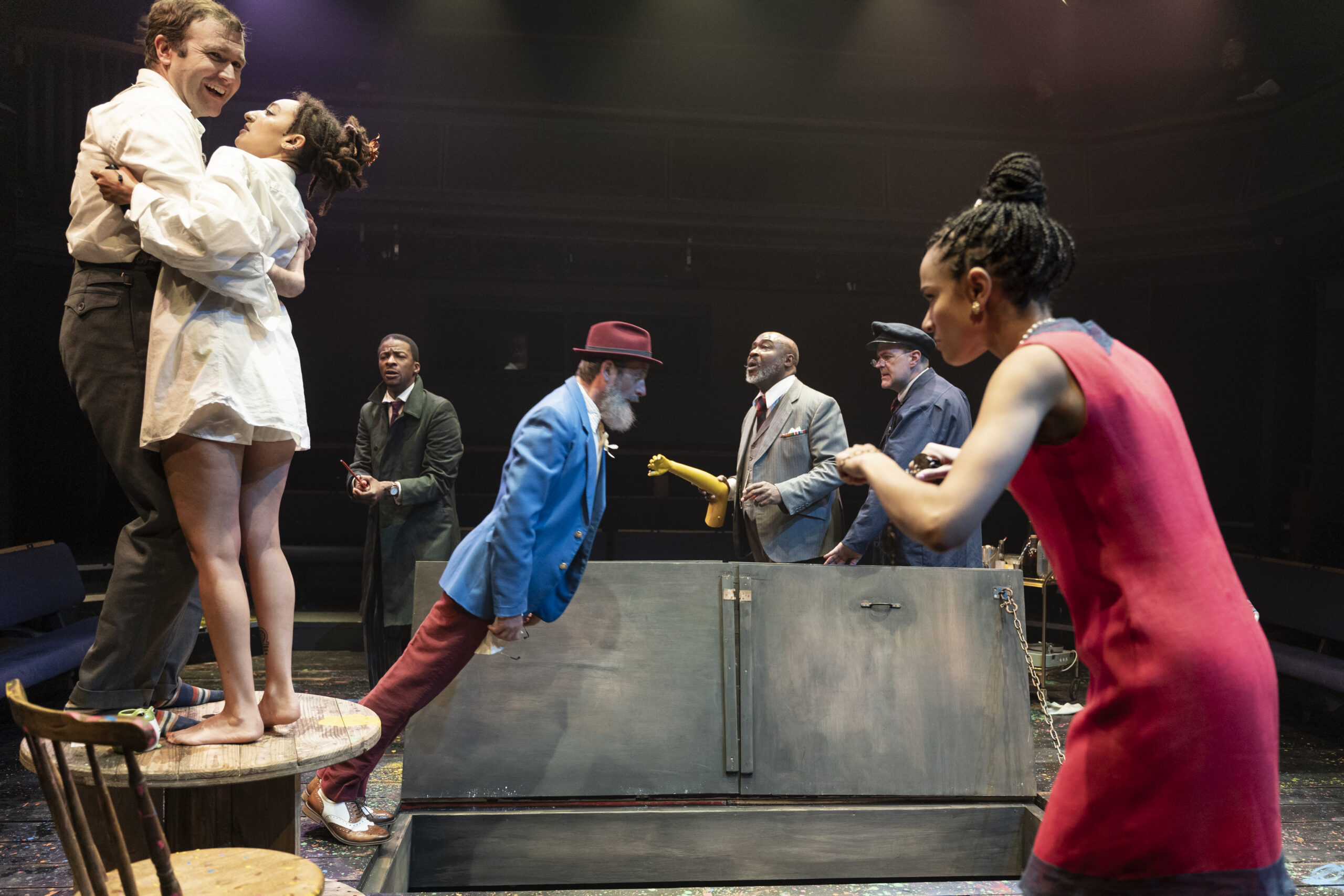
Designer Simon Daw gives Brindsley a simple, tellingly under-funded apartment, complete with garden chair as the main seating, some lovely 1960s touches and that all important, if utterly bizarre, artwork. He also delivers an intriguing opening coup: during the initial audience blackout (when the characters can “see” but the audience can’t) the furniture that had been on stage as the audience entered is somehow swapped so that, when the power fails for the characters (and the stage lights come up), it is Harold’s furniture on stage, not Brindsley’s. Still not sure how they pulled that off!

The real star of the staging, though, is the lighting. With only three modes – on (audience sees, characters don’t), dim (both see a little), and off (characters see, audience doesn’t) – designer Elliot Griggs and his team have been able to achieve precise timing, and it’s this exactness that makes the play’s central inversion of light and darkness feel coherent, playful and theatrically satisfying.

In a space where the audience is practically on top of the action and the margin for error is non-existent, the cast is not only word-perfect, but also movement-perfect.

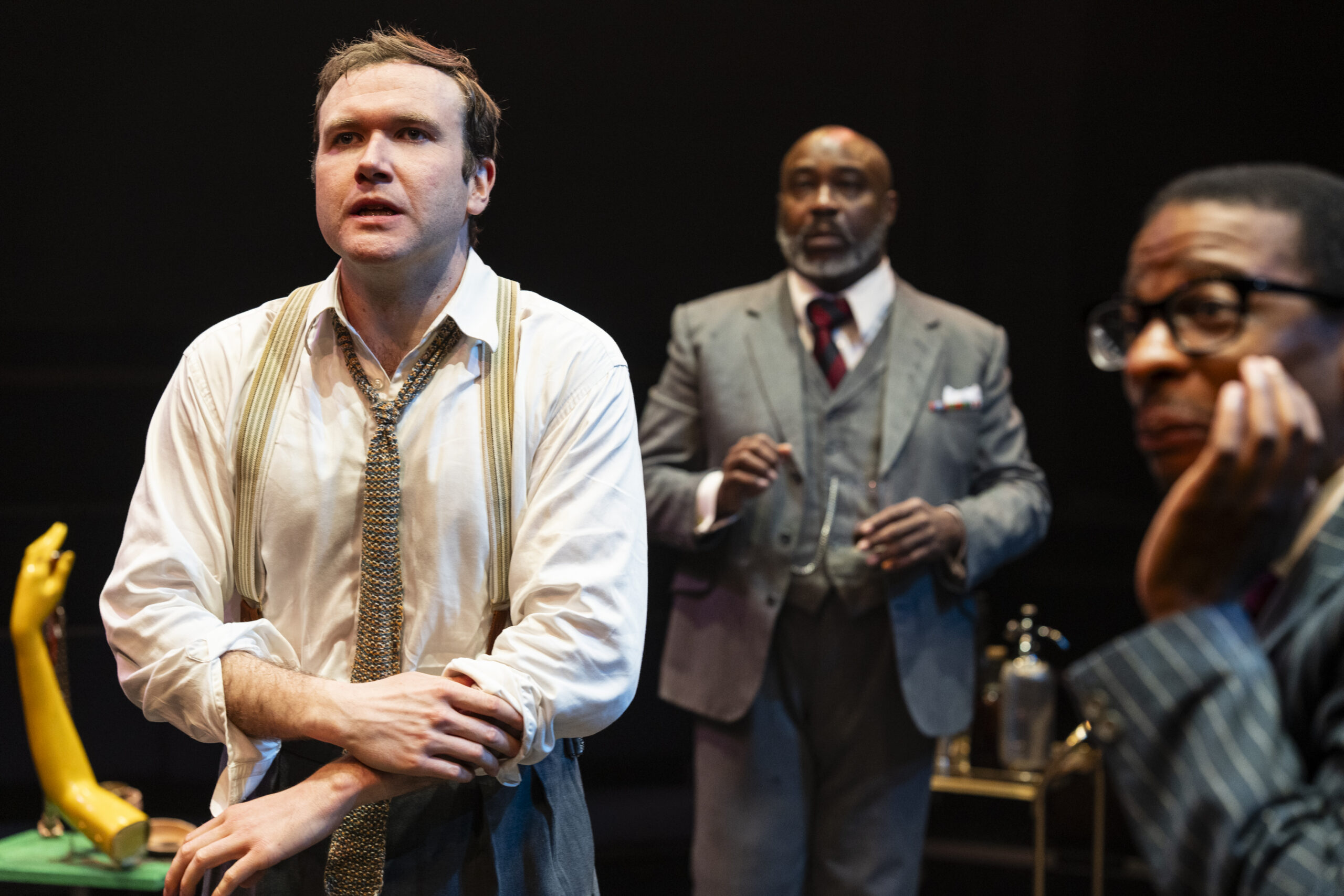
Joe Bannister (Trouble in Mind, As You Like It for the NT) is masterful as Brindsley. He nails the physical stuff, but it’s his facial expressions and vocal shifts that truly chart Brindsley’s rising torment, desperation and frantic ingenuity. It feels like a role made for him, and he commits with total, magnetic finesse.  

As his fiancée, Leah Haile (The Winter’s Tale, Pericles at the RSC), gives Carol the full “mid-20th century party-hostess” treatment as she remains determinedly upbeat despite Brindley’s shenanigans. Her energy borders on the shrill in exactly the right way, and her arsenal of facial contortions matches her character beautifully. She must be exhausted by the end!

Julia Hills (best known as Rona in 2.4 Children for the BBC) gives a gently funny turn as Mrs Furnival, a lifelong teetotaller who becomes slowly, and hilariously, inebriated after being handed alcohol by accident in the blackout. She’s a welcome, light-hearted counterpoint to Brindley’s mounting panic.

Jason Barnett (The Tempest, Theatre Royal Drury Lane) revels in Colonel Melkett’s prim, disapproving bluster, all the while tracing the Colonel’s gradual loosening-up in the “darkness” with nuance and restraint. Thanks to his instinct for physical comedy, his near misses with props, fellow characters and audience members are a delight.

While Simon Manyonda (Midsummer Night’s Dream, Lyric Hammersmith) brings touching poignancy to Harold Gorringe, the bombastic art collector harbouring a secret crush on Brindsley, something he can’t express in daylight but allows to surface in the “dark”. The emotional ache he conveys within the comedy is striking, a reminder of the social commentary threaded through Shaffer’s script, even if some of those 1960s observations land differently for a modern audience.


Faring less well, sadly, is Patricia Allison (Private View, Soho Theatre), who feels slightly miscast as Clea. Her acting is strong (her “impression” of Mrs Punnet, the cleaner that Brindsley invents to explain Clea’s presence, is beautifully done), but the physical comedy seems to elude her. The amused expression she wears throughout, even as Clea is listens to the other characters disparaging her behind her back, suggests she’s perhaps enjoying herself too much fun to summon the necessary emotional responses. And who can blame her? It must be enormous fun to perform.

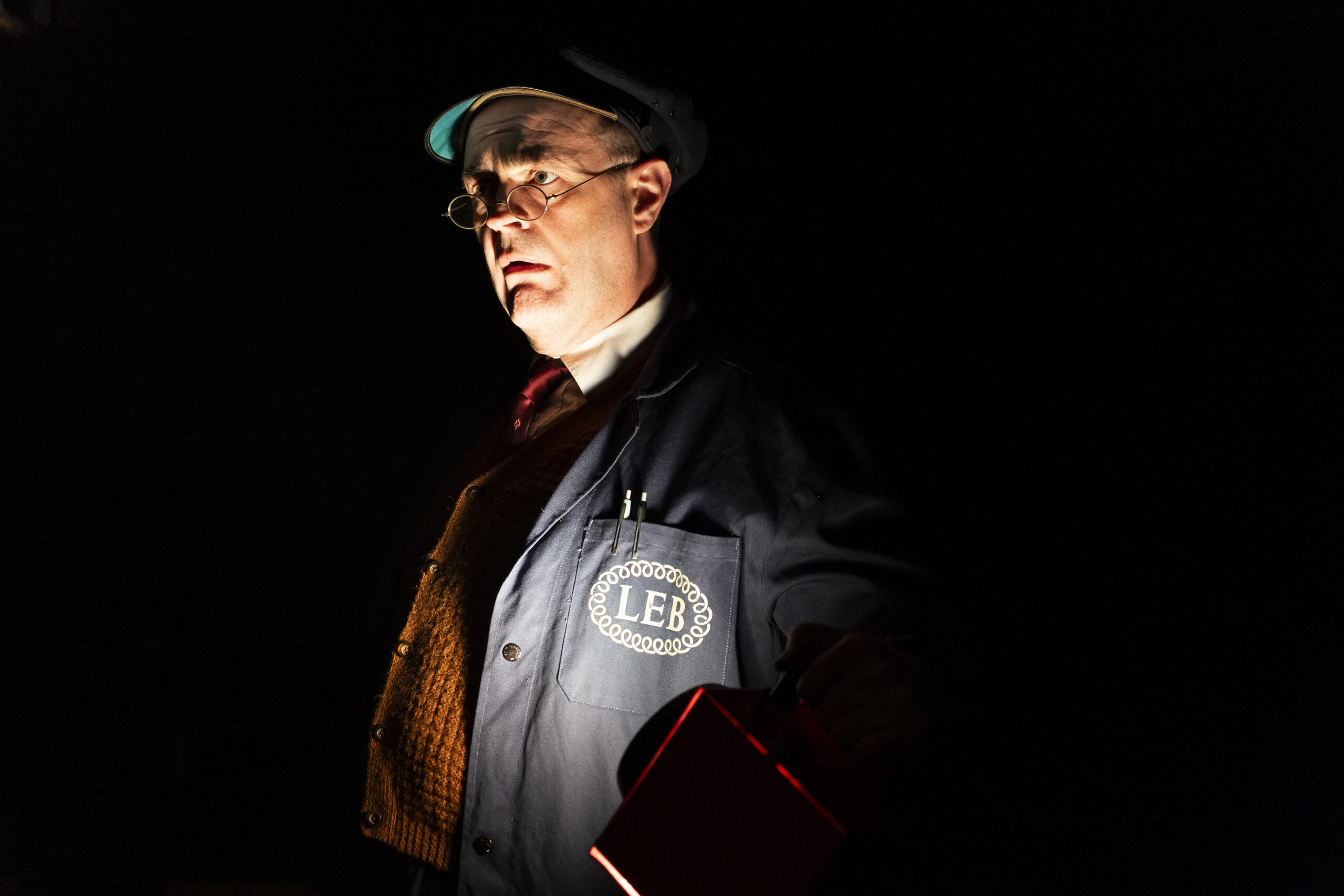
It’s also worth mentioning the other two minor supports: Chris Chilton as Schuppanzigh, the (German) engineer from the London Electricity Board who eventually restores the power, and Javier Marzan as Georg Banberger, the German art dealer, who is also deaf. The impending comic payoff is obvious a mile off, but it’s no less funny (or well executed) for that. Del-boy would be proud!            

Ultimately, though, this piece lives or dies on its physical comedy and, here, the production excels. Director Caroline Steinbeis, comedy consultant John Nicholson, and the whole team at the Orange Tree have succeeded in making Shaffer’s already meticulous stage directions their own so that it works in this place with this audience. The movement is tightly choreographed, fast and fearless, delivering maximum comic impact, and the “darkness” is used brilliantly to blur the line between stage and audience through inadvertent interactions. There’s even a cheeky twist on the old “chair‑whipped‑away” gag. But how Jason Barnett (as Colonel Melkett) gets so close to a giggling audience without breaking remains a mystery.

In summary, this slick romp is silly, immersive and enormous fun. It’s impossible not to laugh and impossible not to leave re-energised. Even farce-sceptics should find something to enjoy, proof that physical comedy never goes out of fashion when it’s done well. A fabulous way to spend 75 minutes. And, honestly, who wouldn’t want to imagine what might have happened at Abigail’s Party had the lights gone out?

A deliciously daft evening that proves farce shines brightest when everyone’s in the dark!

★★★★ 4 stars

Black Coffee Tickets


Black Coffee runs at the Orange Tree Theatre until 11 July 2026

Book Now

Author Profile

The Recs SW