Time to get reacquainted with ‘Jack and Sarah’ in this new adaptation at The Mill at Sonning.
Nestled on the River Thames, just outside Reading is a converted 18th-century watermill, which is home to an intimate, family-run theatre and restaurant. This is The Mill at Sonning, where a two-course, pre-theatre meal is included in the ticket price, and the 215-seat auditorium hosts productions of impressive quality.
Their latest offering is a new stage adaptation of the much-loved 1995 film Jack and Sarah, which starred Richard E. Grant and Dame Judi Dench. Moving a story from screen to stage is never straightforward; sentiment, pacing and tone don’t always travel well. So, the question is: how does this new version hold up?
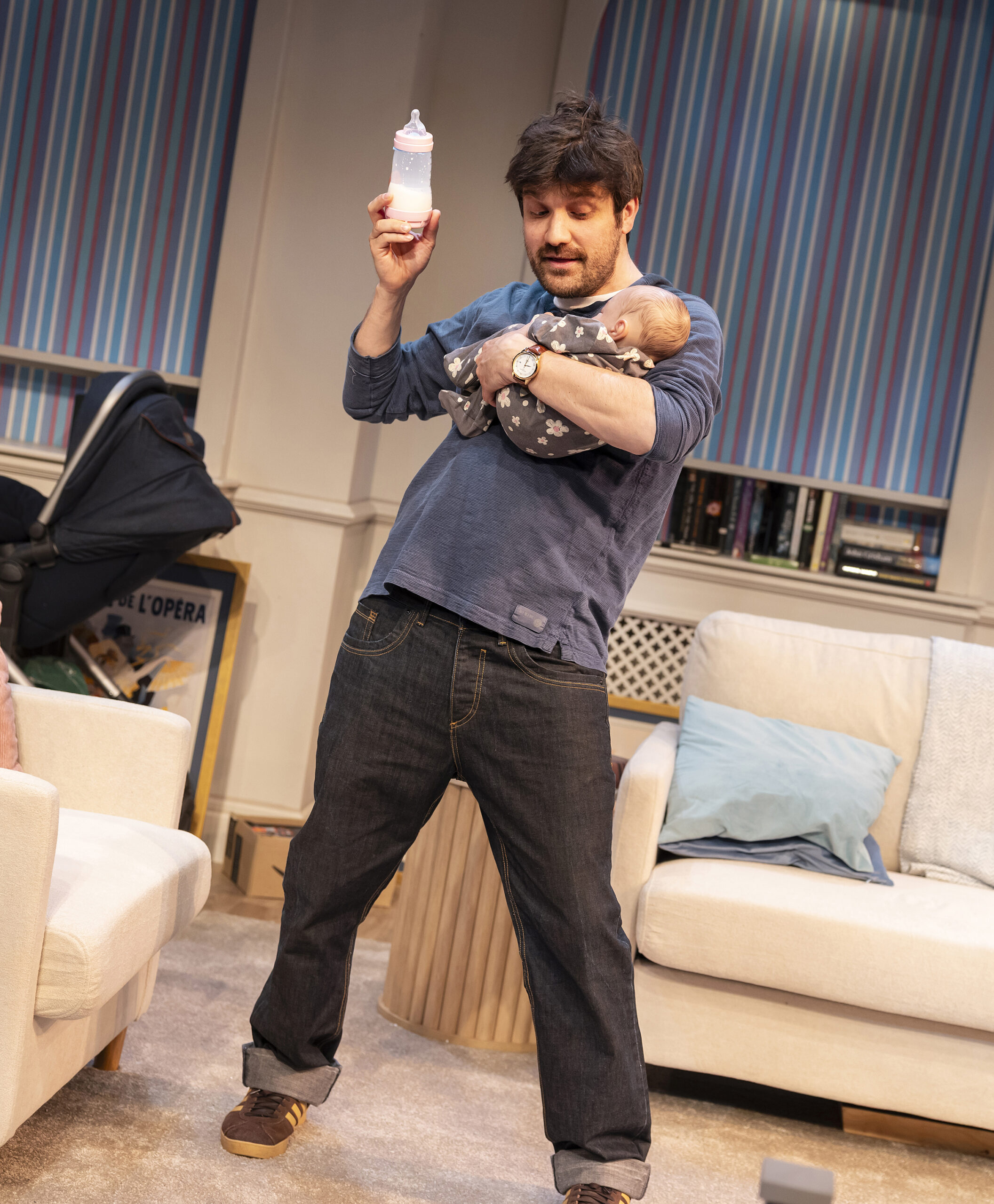
The subject matter is not easy, even in film form. It charts the emotional journey of Jack, a successful lawyer whose world collapses when his wife, Sarah, dies suddenly in childbirth while their home is mid-renovation. Grief-stricken and overwhelmed, Jack is left to raise his newborn daughter alone. Struggling to cope, Jack turns to alcohol and strikes up an unlikely friendship with William, a homeless man living in the builders’ skip outside. Living off takeaway deliveries, Jack meets Amy, an American working at the local restaurant, who bonds instantly with the baby, also named Sarah in honour of Jack’s late wife. Encouraged by his mother-in-law and father, Jack persuades Amy to become the baby’s nanny despite her total lack of experience. Amy agrees and moves in. Surrounded by this eclectic and unexpected support system, Jack begins the slow work of rebuilding his life.
Images by Pamela Raith
Hard enough to capture on film, this emotional journey proves even tougher to present on a live stage. Despite writer Duncan Abel’s thoughtful attempts to reshape the material for theatre, the production never quite finds its feet. Too often it feels as though it should amount to more than it ultimately does.
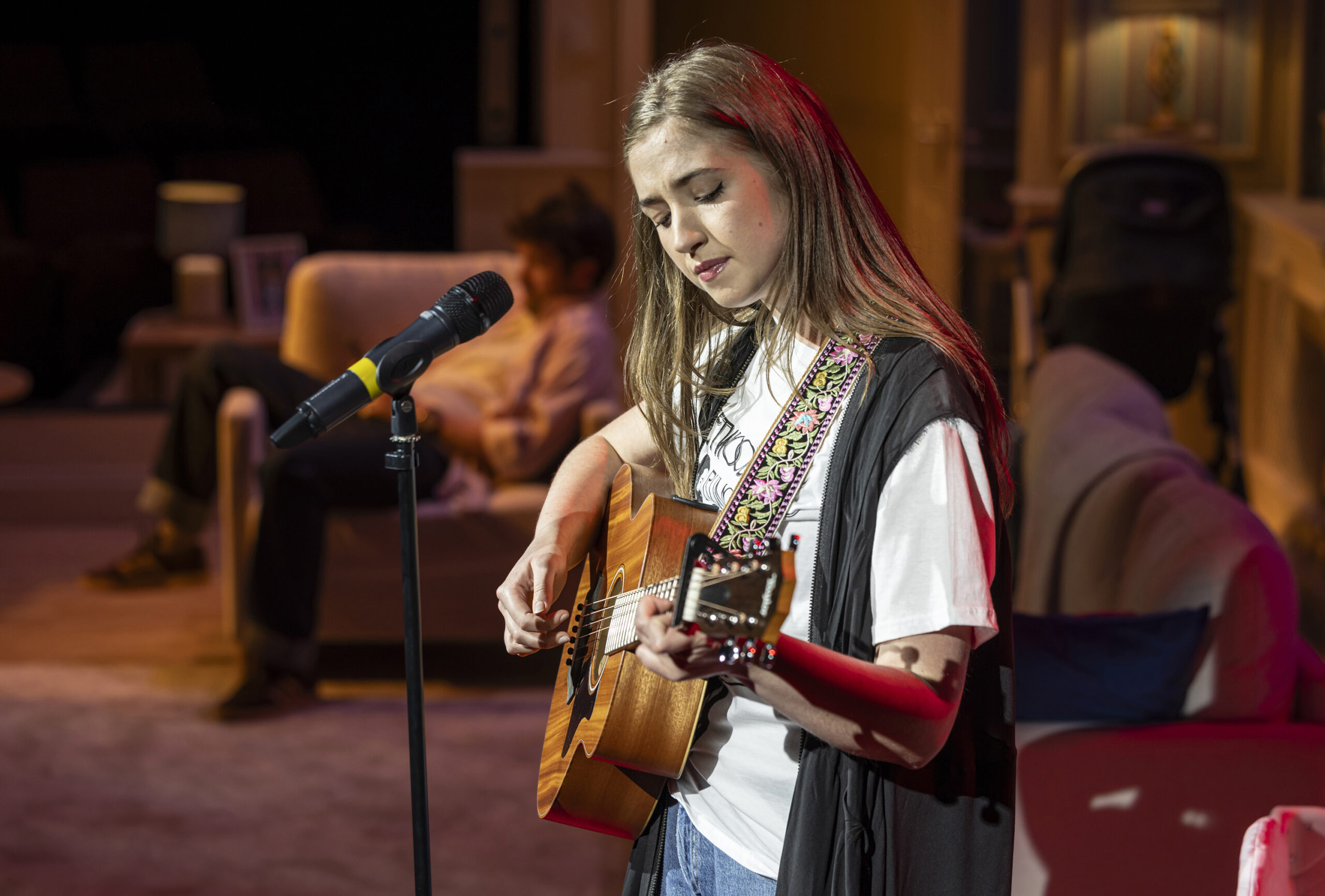
Firstly, the positives. The characters are genuinely likeable, the tone is warm and everyone is unfailingly kind (which is more than most people would probably manage if they found a homeless man asleep on the sofa!). The humour is well-judged and suits the cast. There are some charming, quietly poignant songs, sung with clarity and feeling by Anya de Villiers as Amy (who also wrote the music). And the supporting characters bring some much-needed outside interest.
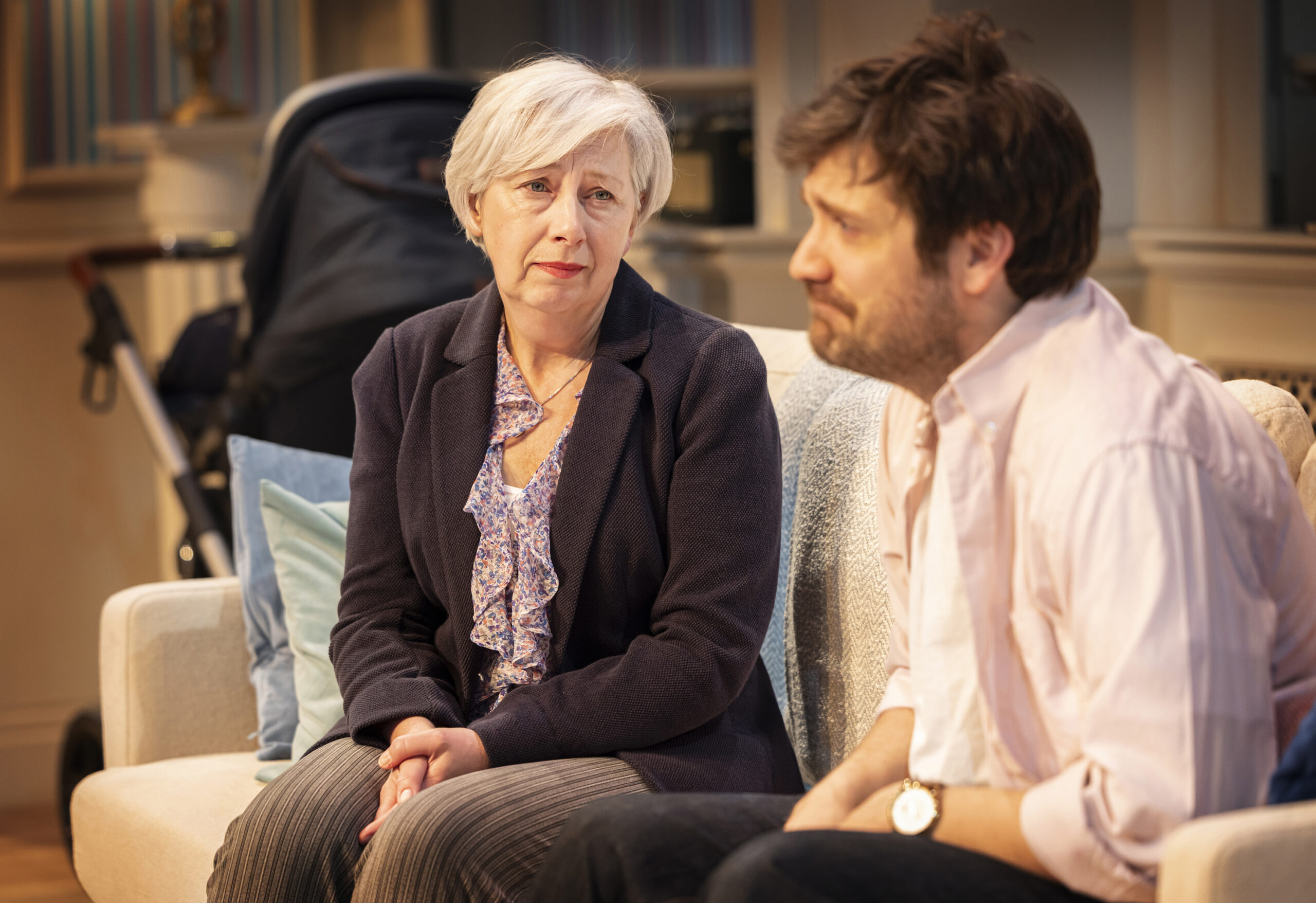
Much of the play, however, lacks the nuanced emotion of the songs, and it often feels in a hurry to reach its next plot point. George Banks’ (The Mousetrap, West End; Dial M for Murder, Theatre Royal, Windsor) portrayal of Jack’s grief tends towards the heavy-handed, relying on melodramatic outbursts rather than the quiet, insidious, almost physical ache that anyone who’s experienced profound loss might recognise. Jack’s mother-in-law, played by Sarah Moyle (Inside No. 9 at the Apollo Theatre, She Stops to Conquer at the NT) seems oddly untouched by the death of her daughter, focussing instead on nudging Jack back into his life, while trying to befriend William. Rufus Hound feels underused as William, whose significance to the story seems to have been diluted in the transition from screen to stage. And when Amy makes an accidental, deeply insensitive slip, it’s handled so matter-of-factly that what should have been a moment of excruciating tension between the two main characters simply evaporates.
The cast do what they can, especially Lucy Doyle (The Mousetrap and The Play That Goes Wrong in the West End) who clearly relishes her turn as Anna, Jack’s overbearing and inappropriate boss more than her brief appearance as Sarah in the opening scene. But they seem far more at ease with the humorous elements than the emotional ones, and are perhaps better suited to a comedy than a production centred on tragedy. The larger issue is that the central characters feel underexplored and oddly two-dimensional, perhaps a consequence of the adjustments required to compress the original story for an intimate stage setting.
In this respect, however, the play works extremely well. Set designer Terry Parsons has crafted a space which evolves almost seamlessly from chaotic building site to finished home, allowing Jack’s emotional reconstruction to echo the physical transformation around him. Director Abigail Packard Price uses this space with sensitivity, drawing the audience into the action in a way that simply wouldn’t be possible in a larger venue.
Ultimately, though, this is a story born of a film, so a saccharine ending is what the audience expects – and is exactly what they get. The narrative ties itself up with the happiest of outcomes, and everyone steps neatly into their new lives. Yet, real life rarely resolves itself so tidily, and the result therefore feels a little too neat and unsatisfying.
That said, the overall experience delivered by the team at The Mill is wonderful and, despite the shortcomings of this particular production, a visit to this fabulous destination remains highly recommended.
Jack and Sarah is more “sit by the river” than “cry me a river”, but the view alone makes it worth the trip!
More comfort than catharsis on the menu – ★★★ 3 stars