
Indian Ink (touring) ★★★★★

Hampstead Theatre reunites Felicity Kendal with Tom Stoppard’s Indian Ink in this top-quality revival of ‘Indian Ink’, now playing at Bath.
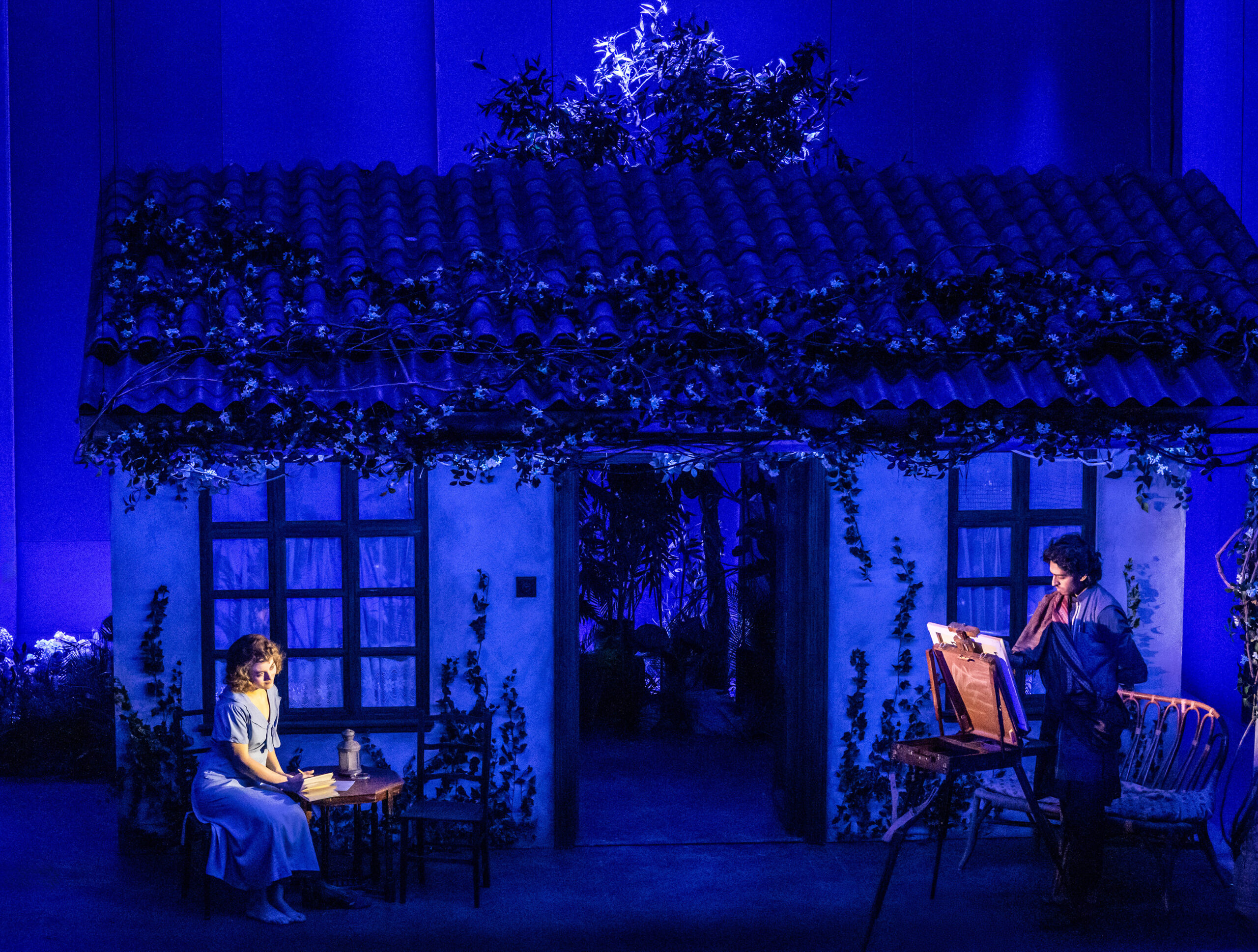
Originally premiered in 1995 (following an earlier incarnation as a radio play), Indian Ink tells the story of the relationship between a bohemian poet and a local artist, alternating between two timelines: 1930s India and 1980s England.

In 1930, after some success (and controversy) as a poet, Flora Crewe (Ruby Ashbourne Serkis) travels to India “for her health”. There she meets artist Nirad Das (Gavi Singh Chera), who knows her work and asks to paint her portrait as a gift. As the sittings progress, their relationship deepens and becomes more intimate, although the extent of this intimacy is only ever suggested, rather than explicitly shown. Flora writes letters to her younger sister, Eleanor, about her experiences, and these letters frame and narrate her time in India.  

Images by Johan Persson

In mid-1980s England, the focus shifts to piecing together an accurate account of Flora’s life in India. Flora’s younger sister, Eleanor Swan (Felicity Kendal), now in her seventies, has unearthed the letters and a picture Flora sent to her in order to help American academic Eldon Pike (Donald Sage MacKay) to compile Flora’s letters for publication. After Eldon leaves to conduct further research in India, Nirad’s son, Anish (Aaron Gill), arrives with his own information, in particular a different perspective on the relationship between Flora and his father.  

And thus, the story of Flora’s short stay in India is gradually reconstructed through a combination of Flora’s letters (embodied in the 1930s segments) and Eleanor’s encounters with her visitors in the 1980s.

If it sounds complicated, it is. And deliberately so. Stoppard uses the interaction between Flora and Nirad, with their contrasting backgrounds, perspectives and sensibilities, to open up big questions about the nature of art, the impact of empire and the subjectivity of historical “truth”. He also echoes the action across the two timelines by having different characters speak the same words in each. Yet, despite its storytelling complexities, this production is effortless to watch, drawing the audience in with what initially looks like a simple love story before eventually revealing the themes beneath. 

Director Jonathan Kent’s production engages from the outset, thanks to set designer Leslie Travers. A verdant garden scene forms the backdrop, with the 1980s action on the left-hand side and the 1930s (mostly) on the slightly larger right-hand part, with lighting director Peter Mumford shedding light in all the right places and guiding the audience seamlessly through the story.  

But this isn’t really a play about action or even setting. It’s a play about words: dialogue, conversations, context and debate. It’s an exchange of ideas, opinions and beliefs between the characters… and between the playwright and the audience. And it works beautifully because the dialogue is, as you would expect from Stoppard, both sublime and razor-sharp. It’s a testament to Stoppard’s genius that he manages to weave so many themes, perspectives and questions into something so coherent. And the cast respond with strong performances all round, clearly delighting in the language and in their part in the debate.

Ruby Ashbourne Serkis as Flora is outstanding, particularly once the play settles into its rhythm and the ear has tuned into Flora’s cut-glass accent. Ruby inhabits the role completely. However, what really makes the difference here isn’t just her acting skill – impressive though that is – but the energy and presence she brings to the stage. She’s the cornerstone of the production, the centre around which everything else revolves, and she nails it throughout, never overdoing it yet always commanding attention.

Gavi Singh Chera captures well the internal conflict of a man who isn’t showing his full, genuine self because he “knows his place” and wants to fit in. For the most part, this meekness doesn’t come at the expense of his own stage presence or performance, although, at times, he’s perhaps a little too withdrawn, which makes some of his quiet dialogue a little hard to catch.

And a special mention for Felicity Kendal, for whom Stoppard originally wrote the part of Flora. Her presence somehow underlined the connection between the two timelines, while her talent for delivering sarcasm and bite with charm and wit meant that the best laughs rightly belonged to her.

This excellent revival of Indian Ink really leaves its mark!

★★★★★ 5 stars

Indian Ink Tickets

Indian Ink runs at the Theatre Royal Bath until 14 February

Book Now

Author Profile

The Recs SW