Hamlet Hail To The Thief – Barbican ★★★★★

‘Hamlet Hail to the Thief’ is Shakespeare + Radiohead = electrifying

More than two decades in the making, Hamlet Hail to the Thief grew from director and co-creator Christine Jones’ realisation that Shakespeare’s tragedy and Radiohead’s 2003 album were haunted by similar themes. Both grapple with political corruption, surveillance, distrust, distorted perceptions of reality and the challenge of acting ethically in a compromised world. The parallels eventually proved too compelling to ignore. What began as an artistic hunch evolved into a collaboration with Radiohead frontman Thom Yorke and fellow director and co-creator Steve Hoggett (whose choreographic credits include NT productions Nye, The Ocean at the End of the Lane and The Curious Incident of the Dog in the Night-Time). The result is a radical adaptation that attempts to fuse play and album into a single theatrical experience.

But what do you actually get if you cross one of Shakespeare’s most famous plays with a Grammy Award-winning album from one of the most experimental rock bands of this century?

Images by Manuel Harlan

Jones has distilled a work that would ordinarily occupy an entire evening to less than half the original length, using music, movement and visual storytelling to communicate material that would previously be expressed through lengthy speeches and dialogue.  Her pared-back script preserves Shakespeare’s cadence, while modernising and energising it. The language retains the lyrical quality but, despite the machine-gun-like pace at which it’s often delivered, feels clearer and more accessible to a contemporary audience. There are even occasional forays into modern vernacular, some of them a little colourful.

Radiohead’s music is woven throughout. Yorke has deconstructed the original album, breaking songs into fragments and motifs before reassembling them in a new way. The result both complements and amplifies the action, creating an eerie, at times almost oppressive atmosphere punctuated by bursts of anarchic energy.  Some tracks are barely recognisable from their original form, yet they fit the drama perfectly, slotting into place like pieces of an intricately constructed jigsaw.

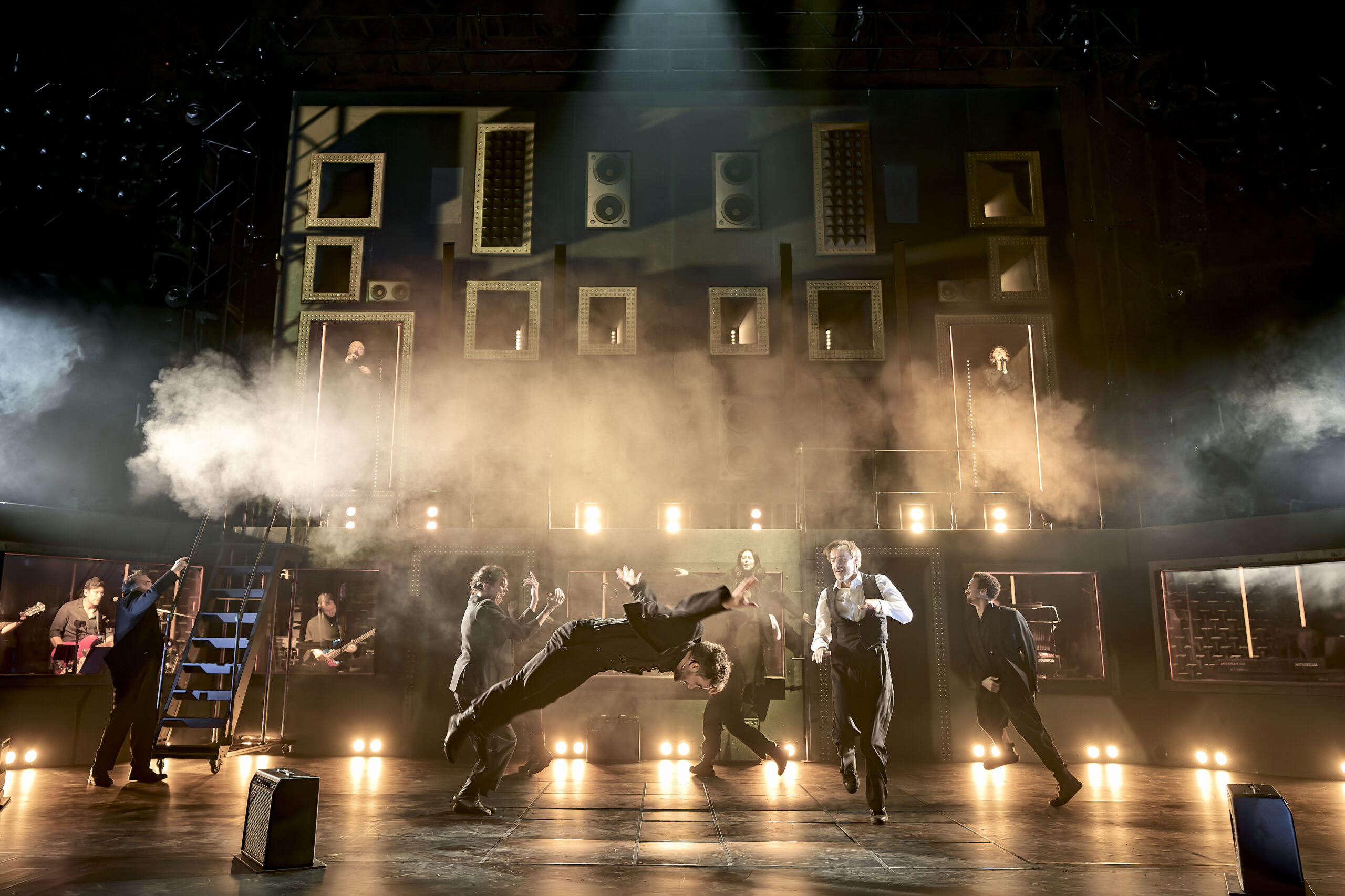
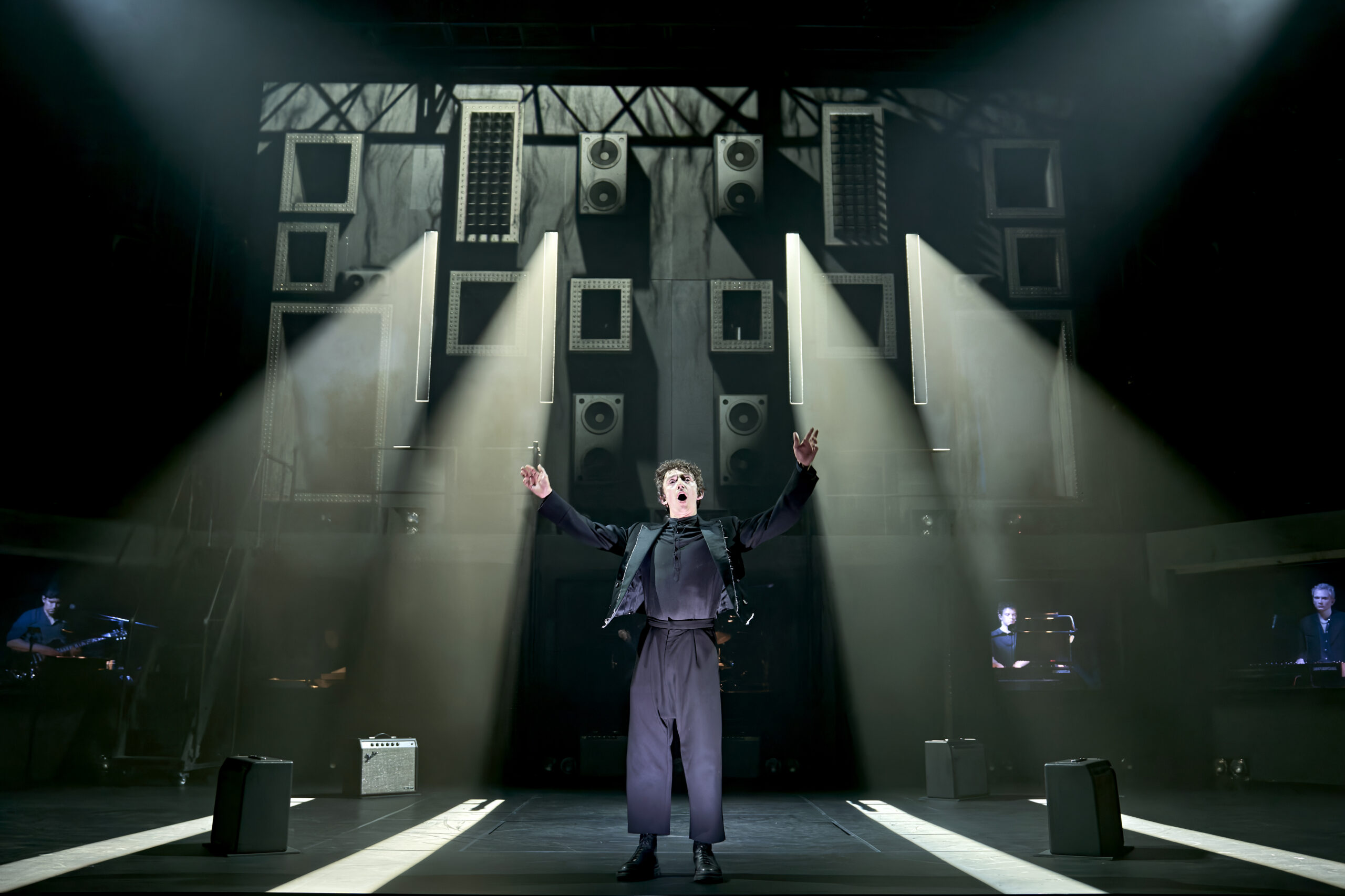
Elsinore Castle awaits the audience as they arrive at their seats. Minimalist and brutalist, it feels entirely at home within the Barbican’s own design aesthetic. The stage is dark, but shafts of spotlight give the impression of moonlight, albeit emanating from many different points. In front of the castle, sinister-looking scarecrows foster a sense of unease.

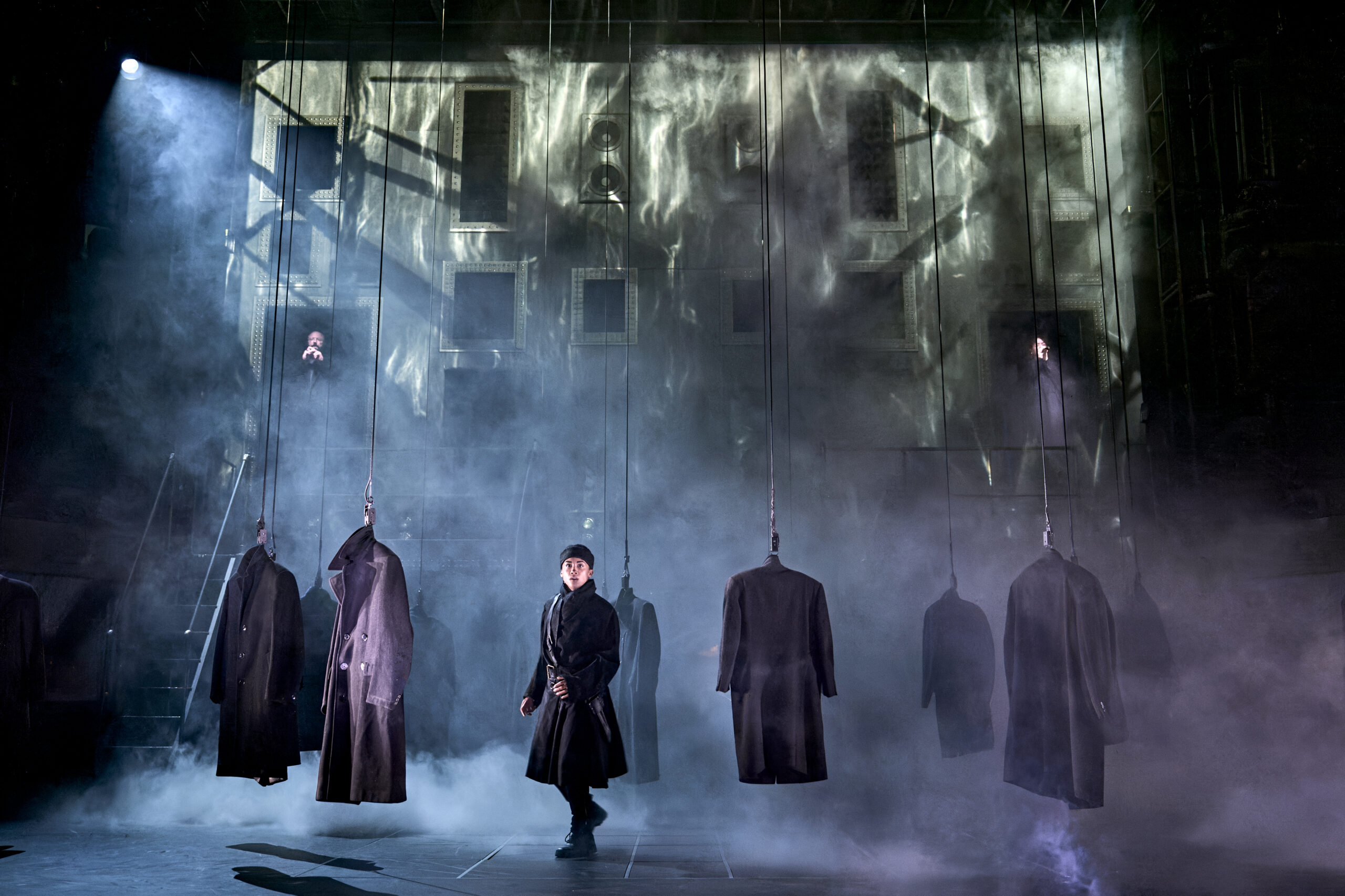
Once seated, however, it becomes apparent that all is not quite as it first appeared. The setting feels more industrial than medieval. The scarecrows have been decapitated, leaving just their coats hanging from the roof. They look like druids or, glimpsed briefly from the corner of the eye, gravestones.  It’s eerie and deeply unsettling, a fitting portent of things to come.

With the nerves already beginning to jangle, a lone figure arrives on stage. This ride is about to begin.

Nearly everything is monochrome. The costumes are androgynous and period-agnostic. Combined with Jessica Hung Han Yun’s lighting effects, the action feels untethered from any specific place or time, isolated both geographically and temporally as nobility might be isolated from their subjects or ghosts from the earthly realm.  

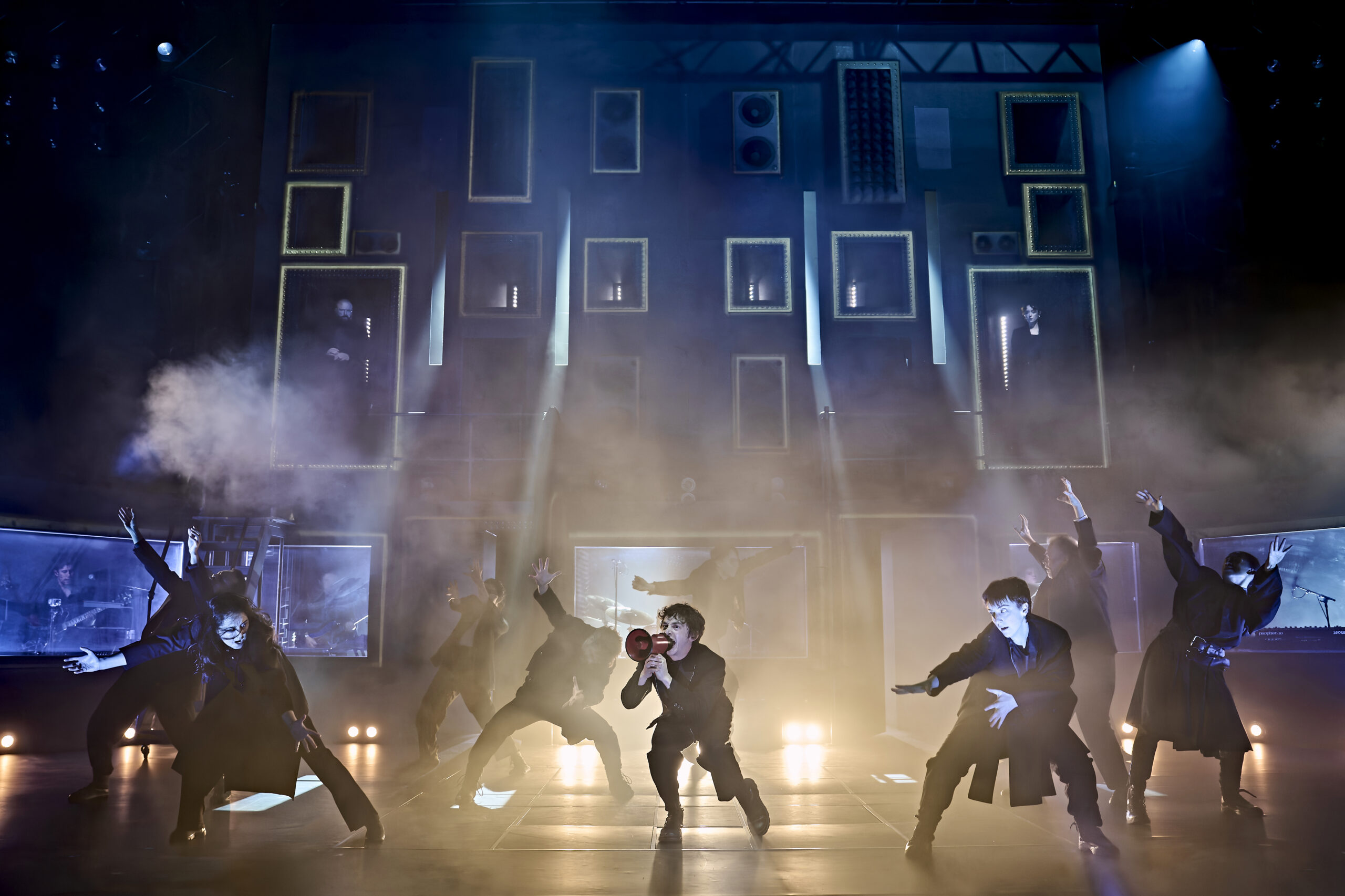
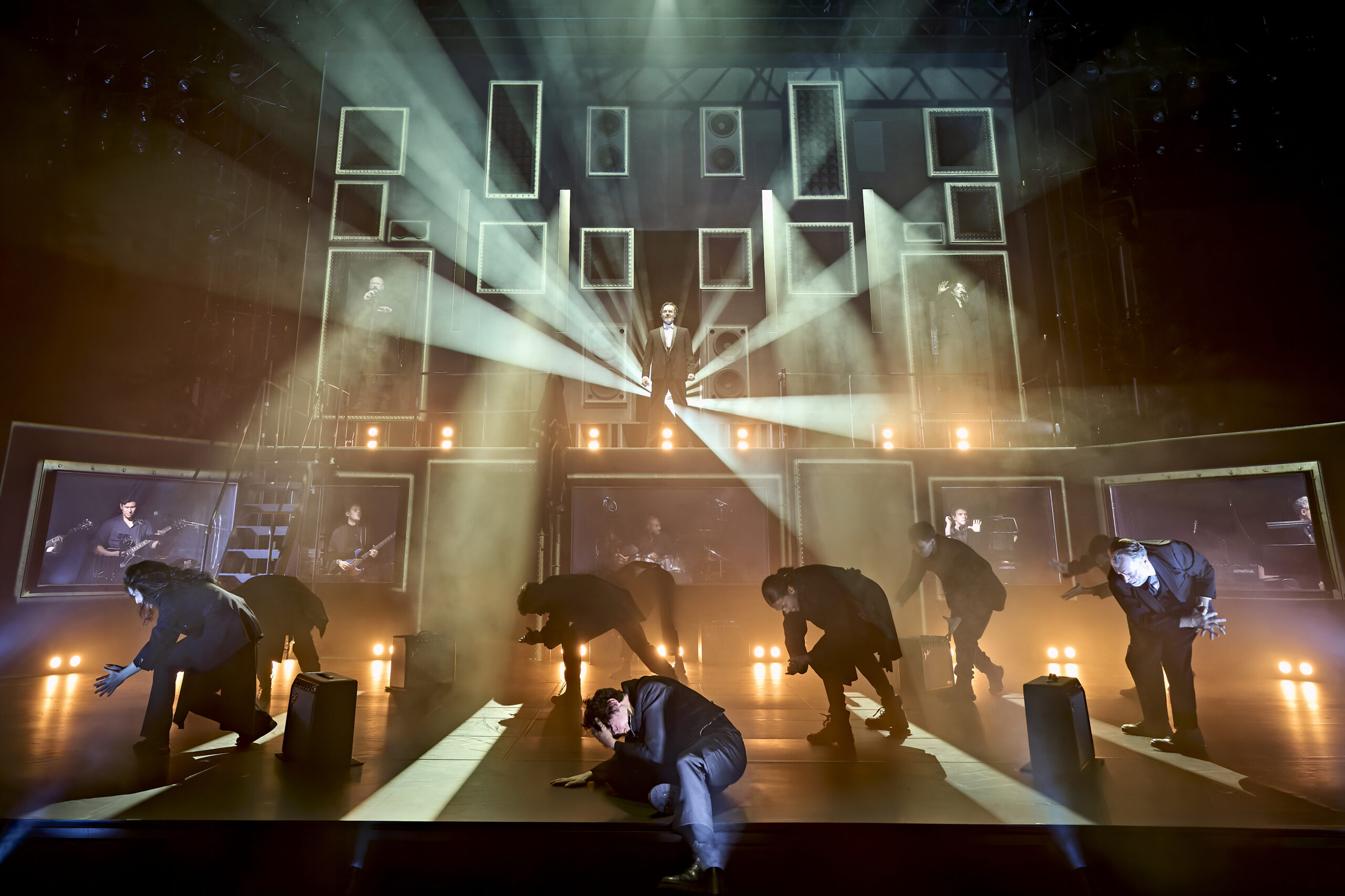
The static backdrop reveals itself to be more like a giant sound system, with the musicians occupying recording studios embedded into its structure, underscoring the importance of the music to the production. There are very few props. Instead, meaning is expressed through the ensemble, with bodies and movement doing the work that scenery and staging might in a more conventional production.  

Movement is as vital to this production as the original source material. Hoggett has collaborated with choreographer Jess Williams and the cast to create a physical language that amplifies and enriches the storytelling. And it’s relentless!

Movement conveys the overall mood, exposes the characters’ deepest feelings (sometimes untold in the words) and communicates episodes that, in Shakespeare’s original, would have been carried by lengthy speeches and dialogue that Jones has cut out. Instead, these are brought to life through expertly choreographed and executed mime sequences, all set to appropriate parts of the album. If a picture is worth a thousand words, then movement can surely stand in for the occasional soliloquy!

The continuous motion on stage creates a nervous, kinetic energy that intensifies the sense of unease and discomfort, compelling the audience’s attention throughout.

And we’ve not even got to the cast yet!

This is an exceptionally strong ensemble, with every performer playing a vital role in the production’s success. Much like the workings of a finely tuned machine, each performer contributes something essential; remove any one of them and the whole thing would feel diminished. It is a testament to how seamlessly this company works together that it was impossible to identify which character was being played by an understudy.

Three performances do, however, merit particular mention:

Samuel Blenkin (The Ocean at the End of the Lane, Harry Potter and the Cursed Child) is simply magnificent as Hamlet. He captures the character’s emotional turmoil with both passion and conviction. Combining masterful dialogue delivery, vocal inflection, facial expression and physicality, he creates an intoxicating portrait of a man on the edge, as grief, paranoia, bitterness and resentment gradually consume him. As Hamlet slowly unravels, Blenken balances moments of chaotic intensity with periods of subdued despair. The result is deeply unsettling to watch.

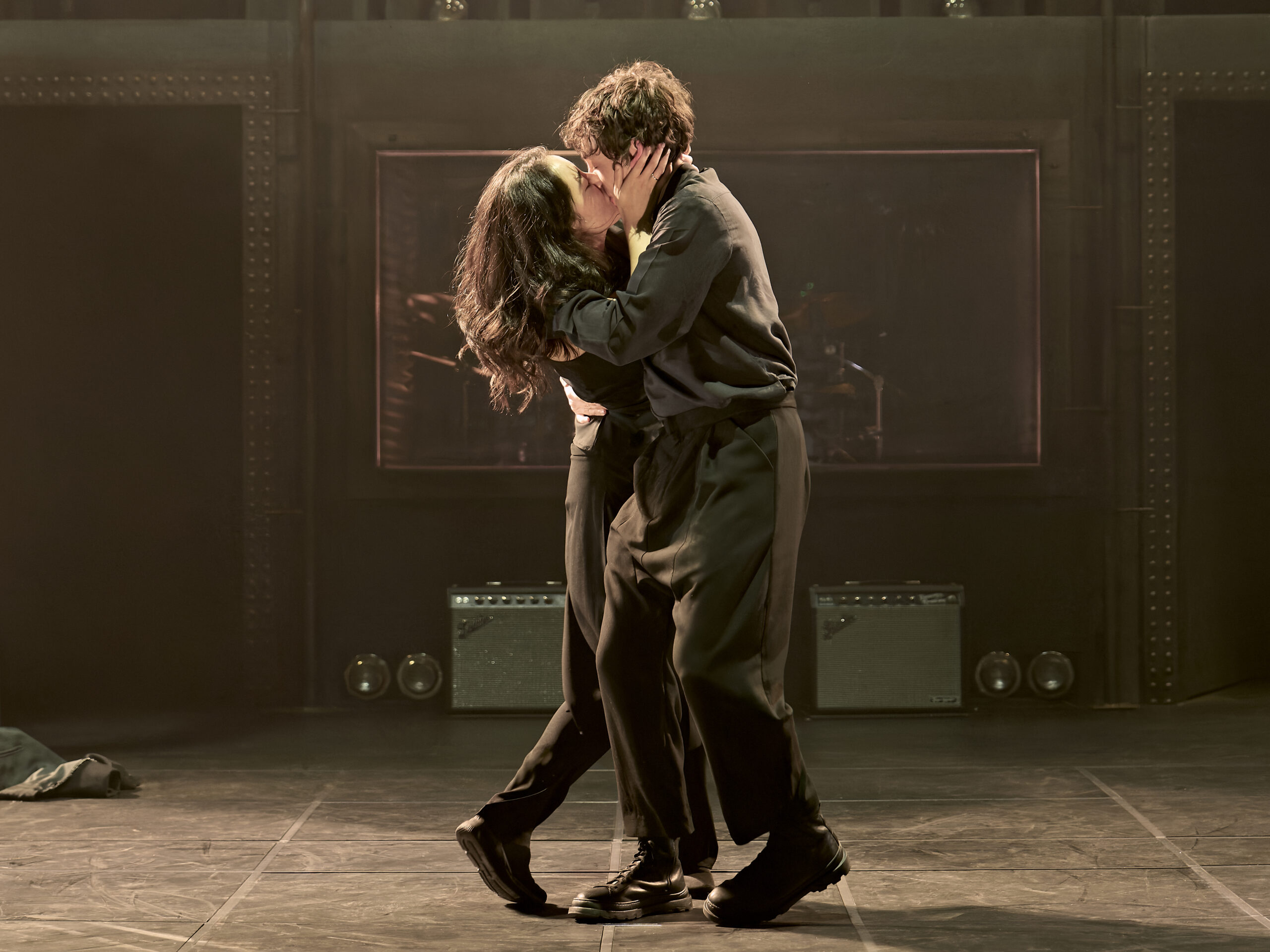
Ami Tredrea (Wendy and Peter Pan, The Crucible) has transformed the character of Ophelia. Her interpretation is powerful, passionate and opinionated, deeply invested in her relationships and unafraid to express her feelings. When Hamlet rejects her, Tredrea’s depiction of raw, ugly grief is uncomfortable to watch. Yet it’s in her final scene that she truly shines, her hauntingly beautiful voice conveying Ophelia’s desperation and despair, before culminating in a devastating conclusion

Then there is Paul Hilton (Juno and the Paycock, An Enemy of the People) as Claudius. His is a finely calibrated performance, oscillating seamlessly between charm and reason, as conveyed by his words and the menace conveyed by his movement. As he slinks and prowls around the stage, seemingly made of rubber, he creates an instinctive sense of wariness; here is a man to be avoided, even if no one can quite explain why.

As the play progresses, and the mood darkens, torment, paranoia, tension and despair are laid bare for everyone to see, through the words, the music and the movement. It’s raw, visceral and electrifying, drawing you in, before punching you in the face a few times and spitting you out at the end… moved, impressed and exhausted.

Devotees of the Bard will be delighted to know that the greatest hits of this much-loved play have survived the adaptation process. Something is still rotten in the state of Denmark, a trip to the nunnery remains firmly on the cards, Hamlet continues to ponder whether to be (or not to be) and, alas, poor Yorick still only has the bare bones of a role. But are those hidden references to more contemporary theatrical works embedded in the script that I see before me?  Or has the production’s sense of suspicion and paranoia become contagious?

Taken as a whole, this is a complex, multi-layered, multi-sensory experience: a fusion of two works from different centuries, brought together by a team of contemporary creatives to produce something entirely new. Fresh, fascinating and frantic, it embodies what the creative arts do best: collaboration in pursuit of something that could not exist without the contributions of every artist involved.

You don’t need to be a devotee of Shakespeare or a fan of Radiohead to love it. The production breathes new life into the Bard, while opening the door to Radiohead for a new audience. So, if you think you don’t like one or the other (or even both), this might just change your perception.

So, what exactly do you get if you cross one of Shakespeare’s most famous plays with a Grammy Award-winning album from one of the most experimental rock bands of this century? One of the most gripping, frenetic and visceral productions this reviewer has ever seen. And an opportunity to rediscover two iconic works anew.

Now that’s no joke!

2 + 2 = 5 Stars – ★★★★★ 5 stars

Hamlet Hail To The Thief Tickets


Hamlet Hail To The Thief will run at the Barbican until Sat 23 Jan 2027

Book Tickets

Author Profile

The Recs SW