Elektra – Theatre for a New Audience ★★★★★

Elektra’: Mourning Becomes Electric

Greek mythology’s Electra has never been an enchanted princess who lives happily ever after. Perhaps that’s why three of the great early dramatists chose to tell her story: Aeschylus, Euripides, and Sophocles. The latter’s Electra is the angriest of the three, consumed by hatred and vengeance over the murder of her father, Agamemnon, by her mother Clytemnestra, and her lover, Aegisthus.

It is Sophocles’s Electra that is now being presented by Theatre For a New Audience (as Elektra, by Sophokles), in a stunning translation by Anne Carson, who won the Nobel Prize in Literature last month. Carson’s adaptation — and it feels as much an adaptation as a translation — accomplishes the mean feat of being beautifully poetic, absolutely clear, and dramatically succinct.


                   ELEKTRA:    You are women of noble instinct

                                      and you come to console me

                                      in my pain

                                      I know.

                                      I do understand.

                                      But I will not let go this man or this mourning.

                                      He is my father.

                                      I cannot not grieve.

                                      Oh my friends,

                                      Friendship is a tension. It makes delicate demands.

                                      I ask this one thing:

                                      let me go mad in my own way.

That textual clarity is ideal because director Daniel Fish, best known for his deconstructed revival of Oklahoma!, revels in provocative choices in his stagings, often polarizing ideas for which he prefers not to provide easy answers. As he recently said in his interview with New York magazine, “The meaning is up to the audience, should they choose to interpret it.”

Images by Maria Baranova

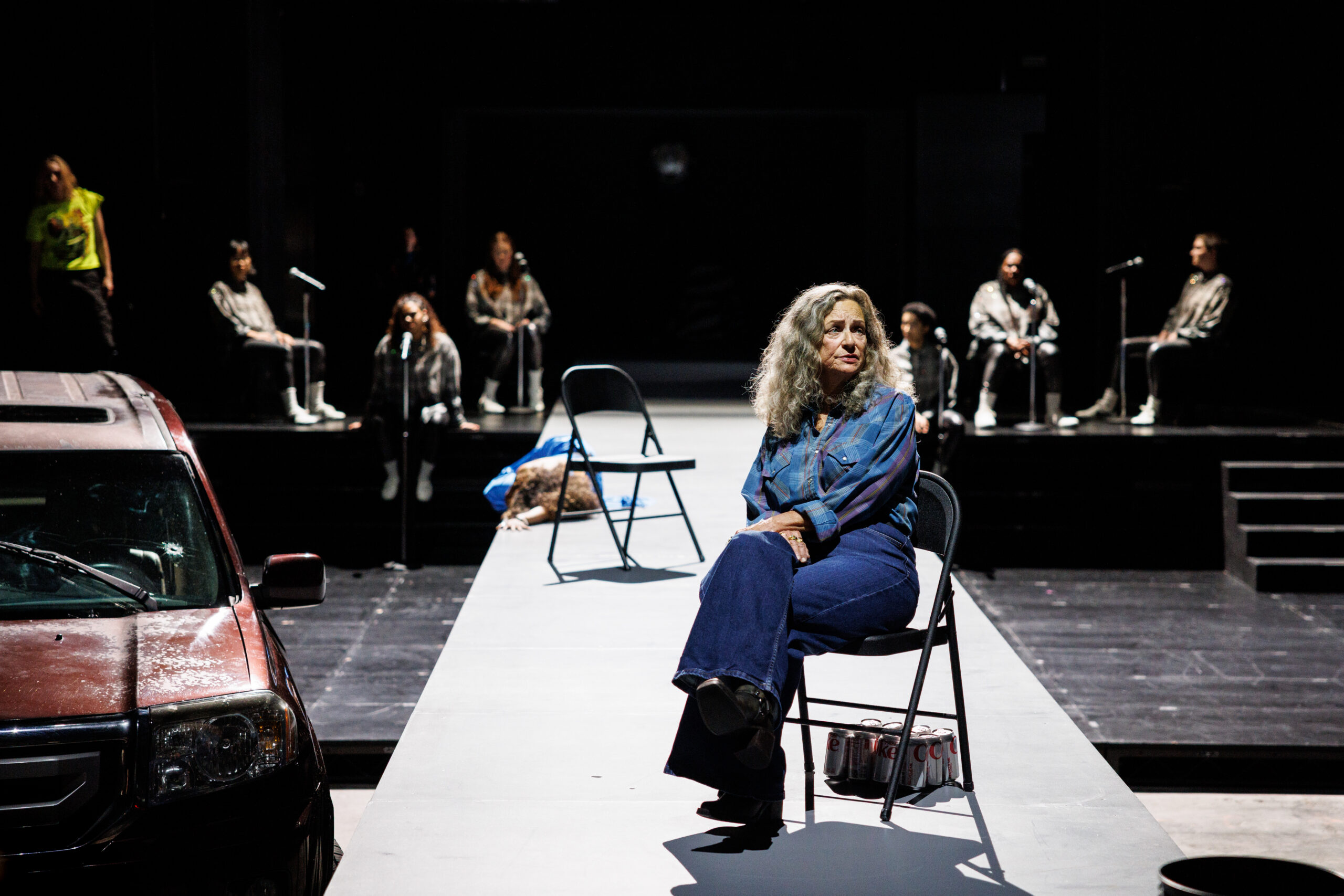
And interpret audiences will, because in this production, anachronisms are bountiful. In a moment of frustration, Tina Benko, as Elektra, pours a can of Diet Coke over her head, the soda dripping from her tousled blonde hair onto her neon-yellow Blondie T-shirt and black cargo shorts. Observing it all is the top-notch Chorus (Catherine Brookman, Sophia Rose Byrd, Mingjiz Chen, Tina Fabrique, Maya Lagerstam, and Tanner Porter), whose members harmonize their sung dialogue to Ted Hearne’s superb music, except when they unexpectedly perform Beyoncé’s “Daddy Lessons.” Wildly, Bey’s song works within the context of the story, reinforcing Elektra’s steadfast love for her father. 

More telling is the worn replica of a 2014 Honda Pilot parked next to the runway that divides the playing space in half. That’s the model of the car that Renée Nicole Macklin Good was driving in January when she was murdered in public by an ICE agent, a killing for which no justice has yet been served.

Unlike in Good’s case, there is resolution in Electra’s tale, and when she and her brother (Cricket Brown, somber and solid) kill Clytemnestra (a stellar Sally Wingert) offstage, Wingert delivers an excerpt from an article in last month’s The New Yorker detailing the botched attempted execution of Tennessean Christa Pike, an event that took place largely behind closed doors.

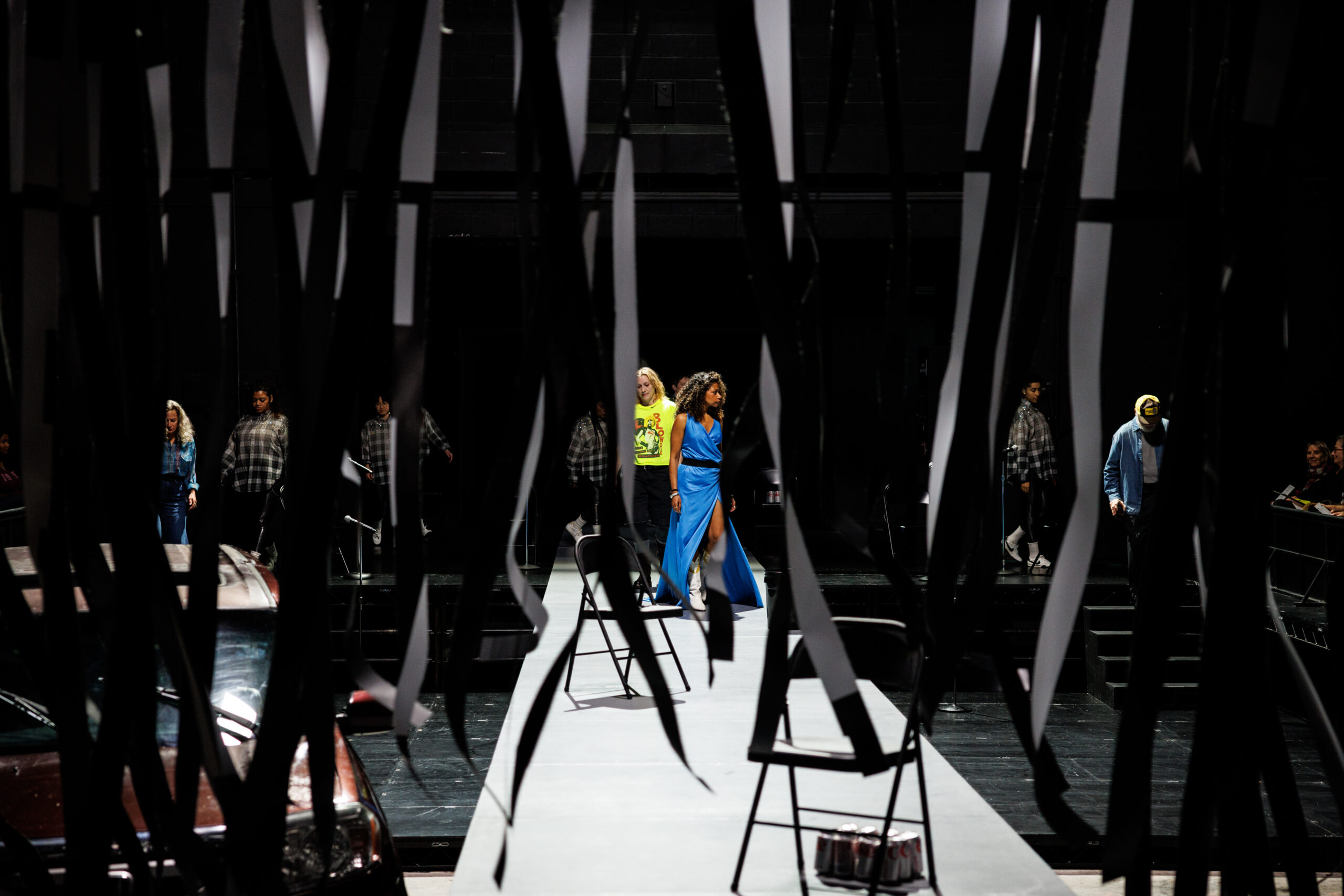
Is Fish wondering how America will eventually respond to these recent state-licensed atrocities, asking what the price of retribution will be when actual justice can finally prevail? A massive vinyl curtain of black stripes proclaiming “THE GODS THAT ALWAYS FAIL” greets audience members as they enter the theatre. Before the show begins, it slowly sweeps the stage, back and forth, as if all in attendance will be witnessing a cleansing. (Fish seems fixated on large-scale scrubbings; his superb Kramer/Fauci, seen this autumn at St. Ann’s Warehouse, featured a huge bubble machine that filled the stage with white foam.)

Classical purists may very well blanch at the current-news intrusions, but the myth of Electra — tackled over the centuries not only by the aforementioned Greeks but also by Voltaire, Giraudoux, and Sartre, among many others — has proved remarkably resilient. It can certainly withstand Fish’s vision, abetted greatly by his creative team: scenic designers Jim Findlay, Josh Higgason, and Amy C. Rubin, costume designer Doey Luthi, lighting designer Scott Zielinski, and sound designer Brendan James. This production may not be for everyone, but together, these talented artists have made this Elektra relevant, thought-provoking, and, most importantly, worthy of discussion.  

Finally, and certainly not least, kudos must be paid to the three actresses at the center of this production. Rebecca Naomi Jones, who played Laurey in Fish’s Oklahoma!, gives Chrysothemis, Elektra’s sister, a beautiful voice and powerful dignity; she may not be as stubborn and determined as her sister, but she is no wilting flower, and that inner strength makes it all the more understandable why Elektra is so frustrated with her.

As the irritated but resolute Clytemnestra, Wingert maintains a riveting air of regal exasperation, even when draped in an American flag far back on the stage, a constant looming presence. The success of any version of Elektra rests largely on the interactions between mother and daughter that come midway through the play, and she holds her own with Benko, who is a marvel as her titular daughter. Very often cast in patrician supporting roles, Benko here demonstrates why she deserves more often to be a leading lady. Her Elektra commands attention but not sympathy; the latter is of no use to her in her single-minded pursuit of justice, even when she asks: “How many times can a heart break?” 

Electrifying ★★★★★ 5 stars

Elektra Tickets

Elektra is running at the Theatre for a New Audience until 13 December, 2026

Book Now

Author Profile

The Recs RDC - Randall David Cook