
Bog Witch ★★★

Bog Witch depicts the challenge of living in the countryside.
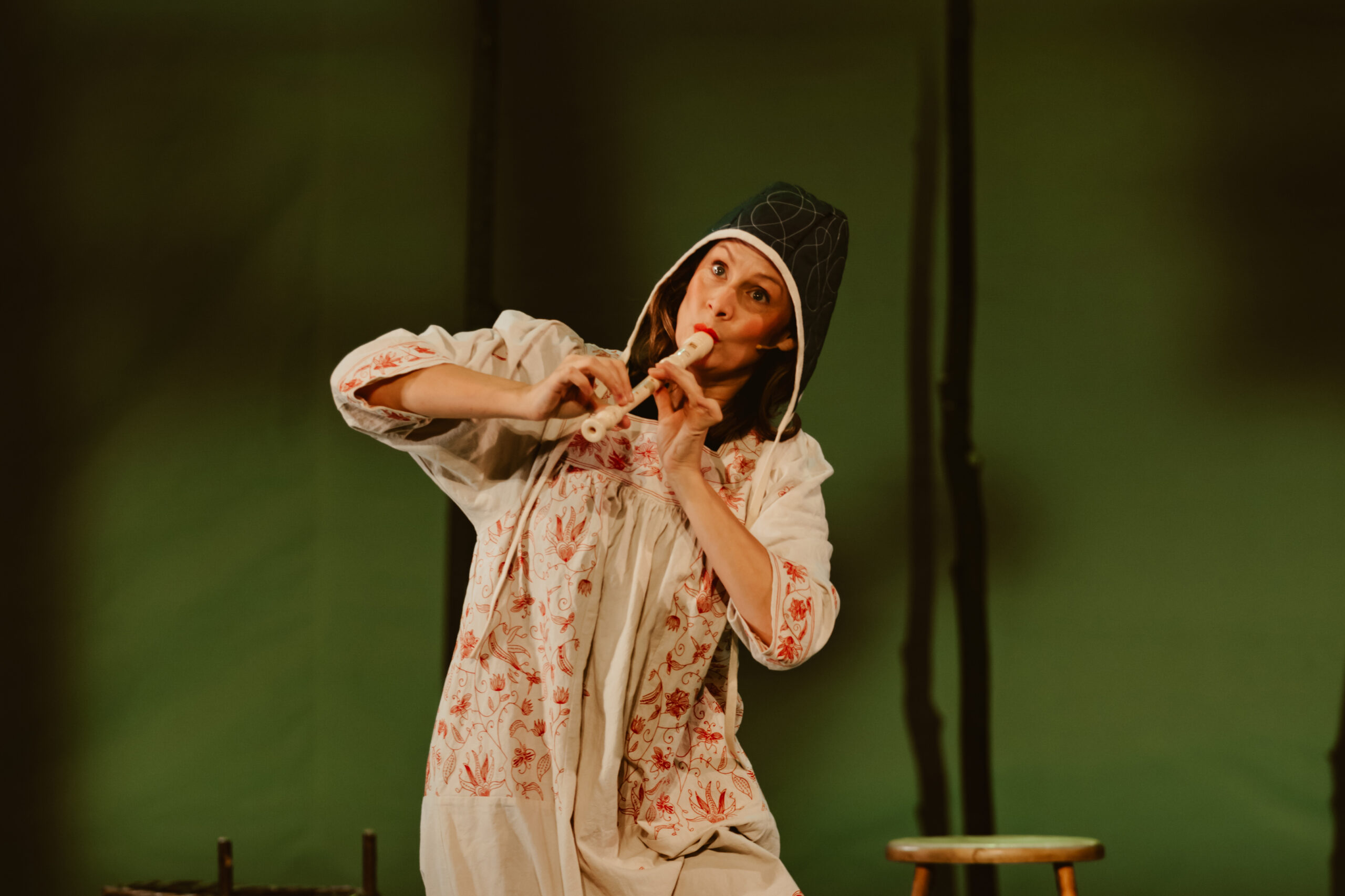
What happens when we try to shed our desire for materialism? Is life in the countryside the answer to the certain impending doom of commercialism? It is clear that solo writer Bryony Kimmings has complex thoughts about the value of life – and has an acute sense of how we try and often fail to change ourselves.

The opening section of Bog Witch is a little unimpressive. Kimmings plays a woman who finds herself constantly drifting through life, unable to fill what she describes as a “hole”; the idea that she has a hole in her soul is the backbone of the entire production, symbolised by a growing dark patch in the middle of the stage that gains size throughout the show. Kimmings presents this with the air of a stand-up routine with song and dance – a little plain and including an overload of exposition. Some structural issues make these initial scenes confusing.

She decides that her hedonistic lifestyle, herself a rampant shopaholic, is the root cause. She eventually begins dating a man who suggests that they move to the countryside together. Begrudgingly she agrees, though she can’t quite fathom how she and her son will be able to stand a uniquely traditional lifestyle. 

The play’s structure is intelligent. By using the simple choice of telling the story over a year, Kimmings’ script is generally tight. Will Duke utilises beautifully ornate projections to show the countryside in its changing seasons – while Tom Rogers’ costumes complement the passing of autumn to winter, spring to summer, etc. These are interesting aesthetic choices that render a realistic picture of the English countryside that Kimmings’ narrator lives in.

Kimmings soon realises the difficulty of trying to “fill the hole”. Without the enabling tool of a credit card, she has to turn to simple crafts, walks in the forest and eventually becomes acquainted with a community of Pagan-esque “tree huggers” that she at first despises. A tragic series of events begins to unfold in her life, causing her to be at odds with nature. She wants to cut down an oak tree that blocks her window. Her cat accidentally maims an endangered owl.

Images by by Paul Blakemore

These moments are where Bog Witch shines. Kimmings is both hilarious and deeply honest. She allows the audience into her life with ease; her direct manner of speaking creates a conversational tone that doesn’t let up – until she eventually descends into madness. The guilt of her inability to connect to nature builds up. Her life soon falls apart. But she continues to search her soul. Kimmings’ narrator spends the entire runtime trying to make sense of her life’s purpose – though there are no clear and easy answers. 

The audience’s immersion into Kimmings’ world almost works in its entirety until the end. In a potentially exceptional moment of environmentalism, the village locals meet in a “council of the spirits” meeting. Here, Kimmings asks members of the audience to come on stage to don costumes and play flora and fauna. Unfortunately, this does not land. With a show so rooted in the mechanism of the one-person show, this moment feels incredibly out of place. It breaks up the narrative flow – though the puppets created by the production company are a lovely addition.

Though the opening and ending are the weakest sections of Bog Witch, there is an undeniable charm that courses through its veins. Kimmings is a seasoned storywriter with genuine sincerity. Her fondness for rurality is apparent, as is her conviction that all life is important, sacred and special.

Filling the hole of your soul isn’t easy ★★★ 3 Star

Edinburgh Fringe Tickets


Tickets for this show and 3000+ other titles are available to buy online at the Fringe's website

Book Now

Author Profile

The Recs BK - Brandon Kiziloz