
Q&A: A Ghost Among The Living
By The Recs SCD - Steve Coats-Dennis 2 months agoRegular attendees of the Fringe will be familiar with the work of Box Tale Soup, a critically acclaimed theatre company that has been taking shows to Edinburgh since 2013. They have created unique productions, adapted from source material as varied as Wind In The Willows, 1984, Gulliver, Northanger Abbey, and many more. This year, their brand new show A Ghost among the Living delves deep into the works of Edgar Allan Poe. Artistic director, writer and performer Noel Byrne is here to tell us all about it.
Hello Noel – thanks for joining us. How many Edinburgh Fringes have you done now?
Thanks for having me! This will be our thirteenth Fringe as Box Tale Soup, although I’ve actually been coming much longer than that. I first performed in Edinburgh when I was sixteen and, apart from the pandemic year, I’ve been back ever since.
What keeps you coming back?
People ask why we keep doing the Fringe, and it certainly isn’t easy, but there’s nowhere else quite like it. You spend a month surrounded by creative people from all over the world, sharing ideas, watching brilliant work, meeting audiences who are genuinely curious, and being constantly reminded why you wanted to make theatre in the first place. Every year we come home exhausted, but also full of new ideas.
And this year, it’s a brand new show you’re bringing: A Ghost Among the Living. Box Tale Soup has such a back catalogue of shows and theatrical adaptations. How do you start with developing a new show? What pulls you to a particular source material – or do you have a long wish list that you are working through?
We definitely have a very long wish list! There are some things that we wouldn’t be allowed to do of course, and some that we don’t feel it’s quite the right time for. Then there are some that we have been asked to create, which is the case with this show – it was commissioned by the Clark Memorial Library in Los Angeles. They have a fascinating Poe collection, and wanted us to create something based on his work. The wonderful thing about being given a commission is that it often takes you down roads you didn’t expect, so this has been an enjoyable challenge.
When we’re considering a new adaptation we also think hard about what we can bring to it, how we can do justice to the source material. Just because there’s a great piece of writing, that doesn’t mean it will automatically make a great piece of theatre. Some books might be masterpieces but don’t necessarily lend themselves to theatre adaptation or to our particular style, while others immediately start inspiring images and ideas as we’re reading.
Most of our shows begin by talking about particular moments or pictures we’ve imagined, to get a sense of the atmosphere we’re looking for. Then we go to the source material and start pulling out anything and everything we think might go into a script, and build from there…
So this time you have alighted on Edgar Allan Poe – but you’re not adapting just a single work. You’re weaving several of his stories into one piece. What led to this approach and what works can we expect to be featured?
Poe wrote a huge range of stories and poems, so there was a lot to choose from, and a lot for us to get to grips with!
Although Poe’s stories are quite psychologically and morally complex, they are usually quite straightforward narratively, in line with Poe’s own literary philosophy – a sequence of events all building to a single climax. So, rather than focusing on one individual story, we thought it would be interesting to bring several of them together.
We wanted both variety and cohesion – tales with their own distinct atmosphere that could also work well together. We also wanted something to connect it all, so once we had chosen the stories, we gradually began building a narrative around them, inspired by Poe’s life and style.
It was a huge challenge, as we didn’t want to impose our own narrative voice, but rather draw out what is already there in Poe’s writing. Audiences will recognise plenty of familiar moments, but hopefully they’ll also discover a fresh twist on it all!

Poe, in all the time we’ve done Edinburgh, always seems to feature at the Fringe. What is his enduring appeal?
I think it’s because he wrote about things that don’t really go out of fashion. Fear, loss, obsession, guilt… they’re universal experiences, and he approached them in a very distinctive way.
He also understood atmosphere incredibly well, and was meticulous in crafting it. Long before anything overtly supernatural or terrible happens, his stories make you feel uneasy. It’s like hearing footsteps behind you on an empty street. That slow build of psychological tension feels just as effective today as it did nearly two hundred years ago.
And of course, aesthetically, Gothic horror has never really disappeared. We seem to rediscover it every generation.
For those who don’t know Box Tale Soup’s work, how would you describe your unique style and approach to theatre-making?
I’d probably describe it as highly visual storytelling. The two questions we always ask ourselves are, ‘does that serve our story?’ and ‘what do we want our audience to feel?’.
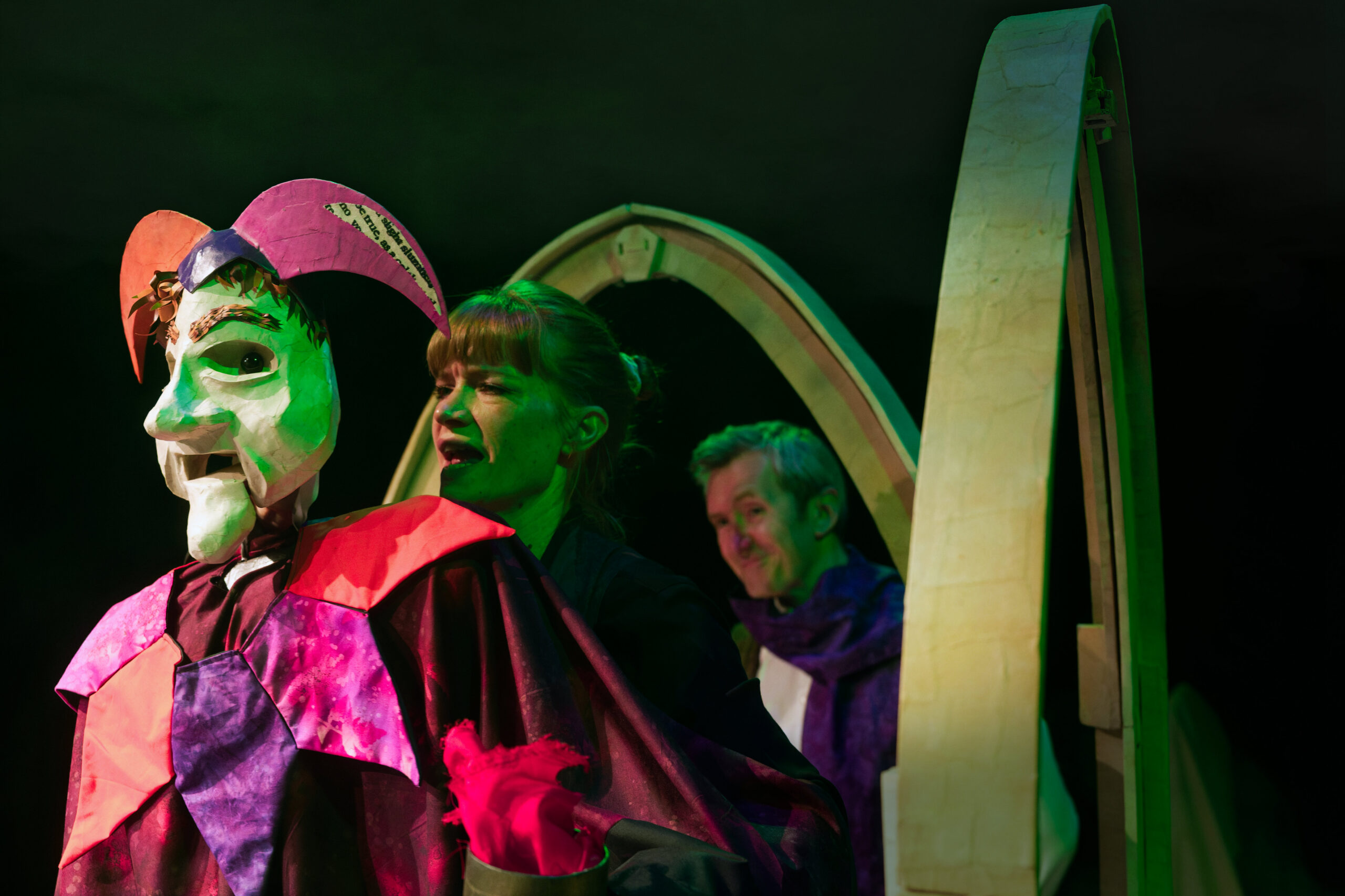
We adapt classic literature, highlight its relevance and make it feel fresh, even if you know the original work inside out. We want to create theatre that feels alive. Puppetry, original music, movement and transforming sets all become part of the storytelling, and we make everything ourselves, so there’s a real consistency of vision from the first sketch through to final work.
People often tell us they’ve never seen anything quite like our shows, which is about the nicest compliment we could receive!
Is sustainability something that you feel is becoming easier or harder? What are the big challenges in maintaining your commitment to an artisanal approach?
A little of both, really.
I think awareness has improved enormously. Audiences increasingly appreciate sustainable practices, and we’ve found that people are genuinely interested when we tell them many of our puppets and sets began life as reclaimed or recycled materials.
The harder part is time. Making things by hand, repairing rather than replacing, and sourcing reclaimed materials all takes longer. But we think that’s worthwhile. There’s something satisfying about creating beautiful objects from things that might otherwise have been thrown away, and creatively it often pushes us towards more interesting solutions.
Our unofficial motto has always been, “Don’t be wasteful, be creative,” and that still feels like a good way of approaching theatre-making.
Can I ask about including puppetry, please? What do puppets add to a show like A Ghost Among the Living? What role do they play within the show?
Puppets let us do things that simply wouldn’t be possible otherwise!
There’s something inherently uncanny about them, which makes them a wonderful fit for Poe. They can be frightening or disturbing, but equally they can be delicate, poetic and strangely moving. Puppets heighten things immediately, and for this show that works beautifully.
Perhaps most importantly, puppetry really engages the audience’s imagination. We work with puppetry in all our shows, and it’s a magical thing when they truly come to life because it requires both the skill of the performer and the belief, the permission of the audience. This show is a fun one from a practical standpoint as a puppeteer too – each story features a different type of puppet, so we get to play with a few different styles.
You’ve earned the moniker as a “Fringe veteran”. So, do you have a favourite Fringe year? And a least favourite year?
Choosing a favourite is almost impossible, partly because they’re all memorable for different reasons, and partly because after all this time they begin to blur into one!
Our first Fringe with Box Tale Soup will always be very special because it felt like the beginning of something. No-one knew who we were, our first shows were performed to three or four people. By the end of the month we had fantastic reviews, had been featured in the Times thanks to Libby Purves, and reached audiences of seventy-five people, which we thought was incredible!
As for the hardest… a couple of years ago Antonia broke her wrist during a performance of ‘Gulliver’s Travels’, right in the middle of the show. It was sold out, and I remember the silence in the room, I remember turning around and seeing her curled up on the floor, it was dreadful. But somehow after a visit to the hospital, in an amazing display of resilience she was back doing shows within a couple of days! We had to change our schedule as we had planned to do two shows a day that year, but nonetheless we were able to complete our Festival with wonderful audiences! I think every performer has years where things don’t quite go to plan, but looking back those often turn out to be the years you learn the most.
How would you say that the Fringe has changed across the years you’ve performed? If there are any first-timers going to Edinburgh this year, what’s the one piece of advice you’d give that you’ve learned?
It’s certainly become more expensive, and that’s probably the biggest challenge facing artists now. It has always taken a lot of determination to bring work to Edinburgh, but now the financial commitment is more daunting than ever, particularly for smaller companies. In many ways though it’s just a microcosm of the challenges facing the arts in the UK in general.
Despite that, the incredible spirit of the Festival is still there. It’s still a place where somebody can arrive with a brilliant idea and find an audience for it, where you can meet like minded artists from around the world.
My advice is always the same: don’t compare your Fringe to anybody else’s. It’s very easy to think everyone around you is having the perfect Festival, especially with the rise of social media. We are constantly encouraged to trumpet and advertise our successes, our good reviews, our busy shows, but if you’re struggling or having a hard time that can all be really tough to see without letting it get you down. But remember it’s not the whole truth – don’t be afraid to talk to other artists and you might be surprised by how much they can relate!
In general though, concentrate on making your show as good as it can be, look after yourself, and remember to enjoy being there. You’ll get far more from the experience that way.
You are performing at a 12:25 slot – which I think is a really great time to watch shows in Edinburgh. No Fringe fatigue for audience members. What do you plan to do with the rest of the day after the show?
I rather like the slot too. We first started taking earlier shows a few years ago, around 2017 I think, and we weren’t sure whether it would work. Happily we were pleasantly surprised! Since then I feel like more and more theatre has moved earlier in the day – I’m not saying that’s thanks to us though, I think it probably reflects the number of shows at the Festival! But I feel it’s a good time. The theatre audience are definitely up for seeing things at that time, people are fresh, and it leaves the whole afternoon and evening free to enjoy everything else the Festival has to offer.
Once we’ve packed everything away, there’ll usually be some promotion on the Royal Mile, and as I used to be a professional street performer I might do a show there if I’m lucky! Then there’s usually time to see a few other shows. Later we’ll usually catch up with friends and fellow artists over a drink before doing it all again the next day.
It’s a wonderfully exhausting and inspiring way to spend August!
A Ghost Among The Living Tickets

A Ghost Among The Living plays at Queen Dome at Pleasance Dome from 5 to 31 August, 2026
Click HereAuthor Profile

- The Recs SCD - Steve Coats-Dennis
Latest entries
- 27 August 2026Edinburgh Fringe 2026Playback ★★★★
- 27 August 2026Edinburgh Fringe 2026Kate Butch: A Kate in the Hand is Worth Two in the Butch ★★★★★
- 26 August 2026Edinburgh Fringe 2026It’s A Mystery! ★★★★
- 25 August 2026Edinburgh Fringe 2026Cathy ★★★★★