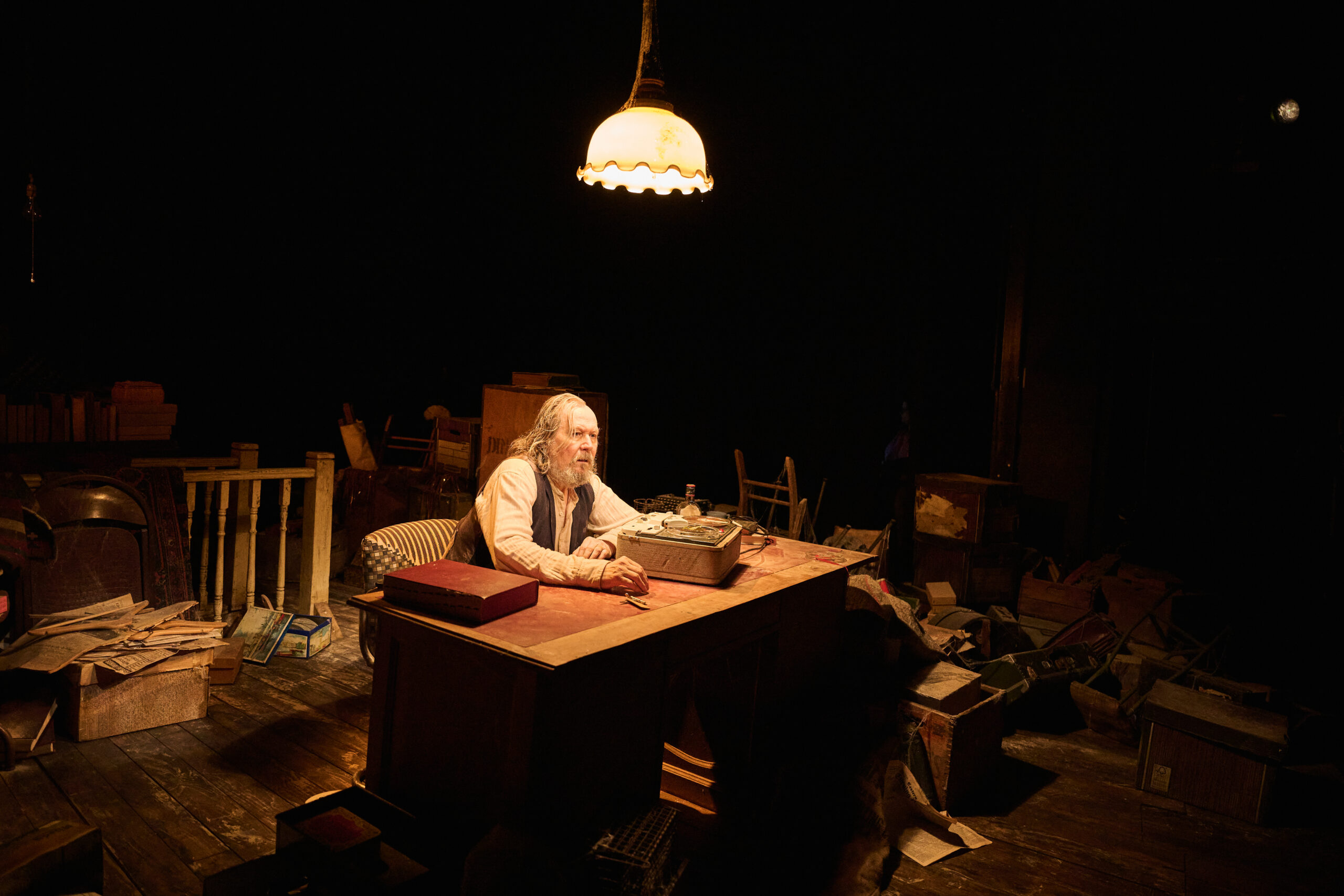
Oldman’s stage design mirrors this sense of desolation. Krapp’s attic office verges on squalor. A lone desk stands isolated in the centre. Belongings are carelessly discarded, with packing boxes in a state of chaos. A single overhead lamp casts a narrow cone of light, leaving the rest of the stage in shadow. The whole space cries neglect.
Malcolm Rippeth’s lighting is similarly stark: one light for the staircase (perfectly judged for Oldman’s entrance), one for the desk, and a faint glow at the back, when needed, to catch Krapp’s rummagings. Guy Speanza’s costume design deepens the sense of dereliction: clothes rumpled, hair unkempt, the look of a man who has long since stopped tending to himself. The effect is voyeuristic in nature, as though the audience has slipped into someone’s private unguarded space. It’s quietly unsettling.
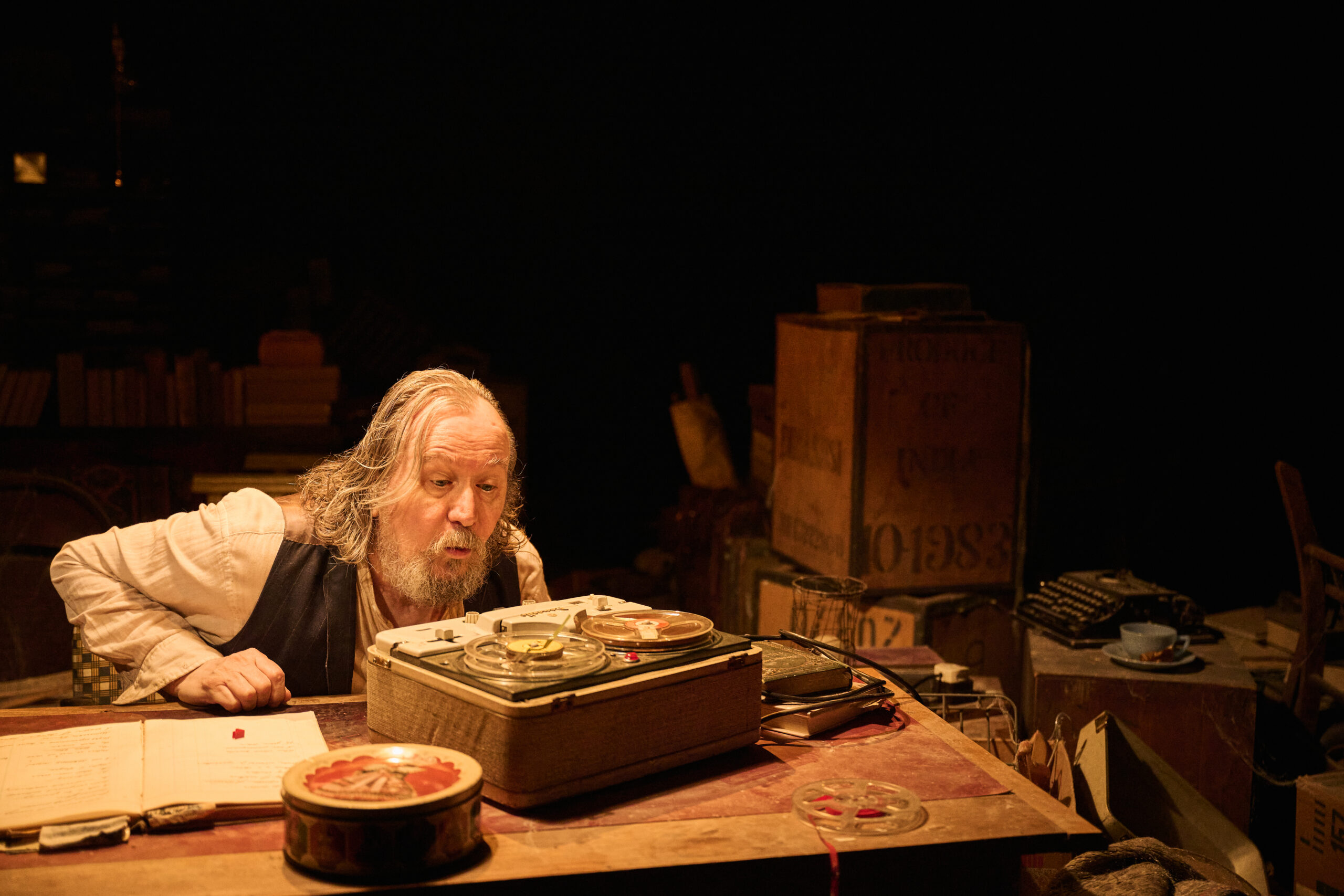
At the centre of attention sits the tape recorder, the vessel in which Krapp’s past still lives, even though it disappoints him so profoundly. In a lovely nod to the play’s own history, this very machine was used by both John Hurt in 2001 and Michael Gambon in 2010, a physical reminder times steady march, indifferent to the fate of those along its path. Given the bridge it forms between past and present, one could argue that this tape recorder is the production’s true star.
And, in the end, it’s the tape recorder that has the final word. After Krapp records this year’s reflections, he returns once more to the hopeful voice of his 39-year-old self. As the light over the desk fades, the audience is gently pulled back from its voyeurism, leaving Krapp alone with the machine and the thought of what might have been.
Oldman has chosen his return well and handles the piece with exquisite control. What could easily become a self-indulgent, ponderous meditation on futility is instead given shape and purpose. Through the profound sadness that exudes from his Krapp, Oldman shows his audience the dangers of failing to seize the moment and the slow erosion of a life left unfulfilled, perhaps even wasted. The fact that so little “happens” is irrelevant. The result is riveting, thought-provoking, and unbearably sad!