The Maids ★★★★

Who’s Cleaning Up After ‘The Maids’?
Among the elite group of 20th-century playwrights whose works are still consistently being revived today, Jean Genet was the biggest badass of them all.

 An active burglar and sex worker for almost two decades, Genet had an impressive rap sheet. He was incarcerated as a teenager at a notorious penal colony, deserted the French Legion shortly after joining it (and receiving the sign-up bonus), then prostituted himself as he traveled — and stole and smuggled — all across Europe. He would have been sentenced to an automatic life term in prison for his 10th conviction if Jean Cocteau and Jean-Paul Sartre — impressed by his literary output during one of his jail stints — hadn’t petitioned for his pardon.

To say Genet had a background unusual for a playwright is an understatement. He was the quintessential iconoclast, one who loathed bourgeois morality and traditional social hierarchies. He always thought himself an outsider, and that was the lens through which he wrote, including his 1947 play The Maids, a new version of which premiered last autumn at Donmar Warehouse in London and is now playing at St. Ann’s Warehouse.

Images by Julieta Cervantes

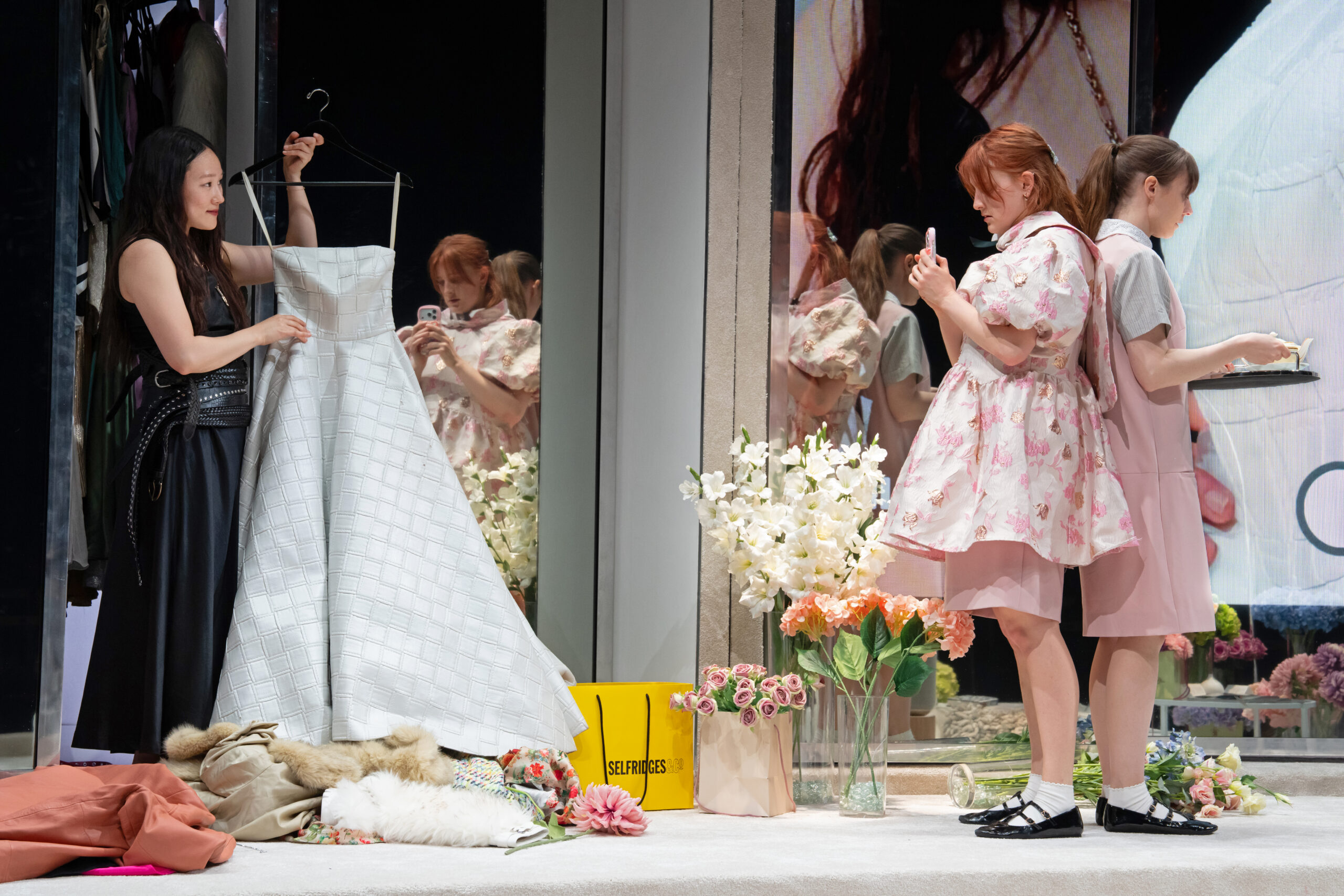
The Maids is simple in plot but dense in thematic complication. Sisters Claire and Solange are housemaids for Madame, an extravagantly wealthy woman whom they take turns impersonating when she’s out, fantasizing about killing her even as they plot to do exactly that. Noël Coward this is not.

Yet Genet balances the play’s darkness with absurdism, and this rendition of the play is often farcically ludicrous, especially in its first third, when we first see the sisters take on their roles as they clean in preparation for Madame’s return.


          CLAIRE: Oh! I’m so alone! Truly, all alone and without any friends.

          SOLANGE: Madame has thousands of friends.

          CLAIRE: No, I’m so alone.

          SOLANGE: Millions.

          CLAIRE: No!

          SOLANGE: 28.4.

          CLAIRE: Nobody loves me.

          SOLANGE: Million.

          CLAIRE: Me. ME. I can see it in your eyes. You hate me!

          SOLANGE: I love you.

          CLAIRE:“I love you”. Look how old I am! I look like I’m 30.

Funny as the dialogue often is, the star of this production isn’t Genet’s text. Nor is it any of the show’s very fine cast, which includes Phia Saban and Lydia Wilson as the titular housekeepers, and, as their oppressive, wildly narcissistic employer, Yerin Ha. Rather, it’s adaptor and director Kip Williams, whose most recent work in New York was the Tony-winning The Picture of Dorian Gray.

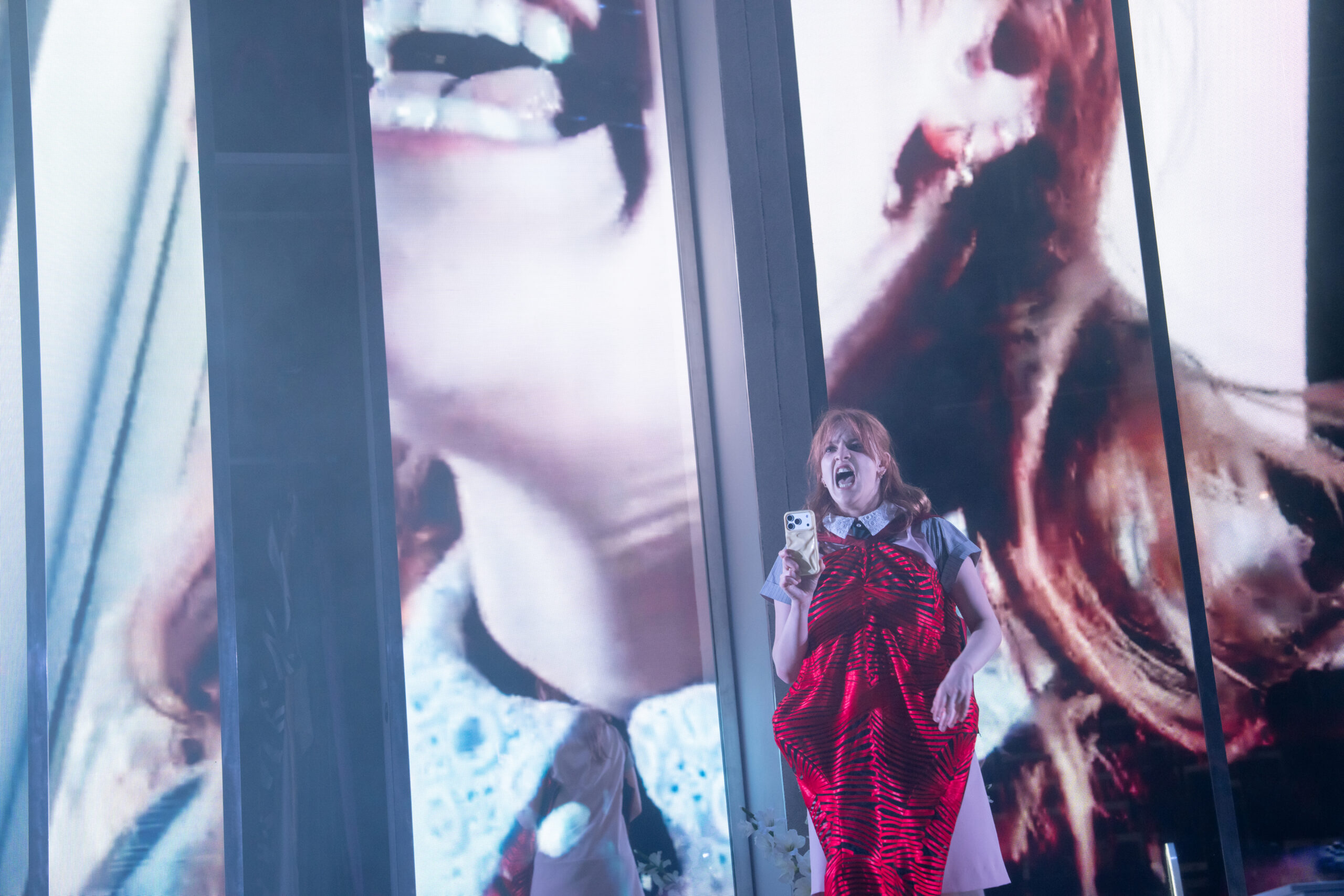
In Williams’ program bio, it’s mentioned that he continues to develop “‘cinetheatre’, a form that blends live performance with video and digital technologies.” Here the blend seems imbalanced. Once introduced, Zakk Hein’s impressive video designs come to dominate the production, eventually taking over by the play’s end as the sisters enter a digital realm that’s a social-media nightmare writ very, very large.

Alas, by succumbing so wholly to a modern-day digital sphere, the play loses its power and dramatic momentum. The hyperbolic emotions to which Genet drives his sisters are diffused, and what should land with a boom arrives instead with a soft thud. Genet wrote about people desperate to escape their station in life. By the end of this production, they’ve escaped into a screen instead.

Nonetheless, this production has more to offer than not, including Marg Horwell’s fab costumes. She must have had a blast assembling Madame’s ensembles.

Dazzles the eye more than it pierces the soul ★★★★ 4 stars

The Maids Tickets


The Maids runs at St. Ann’s Warehouse until 14 June 2026

Book Now

Author Profile

The Recs RDC - Randall David Cook