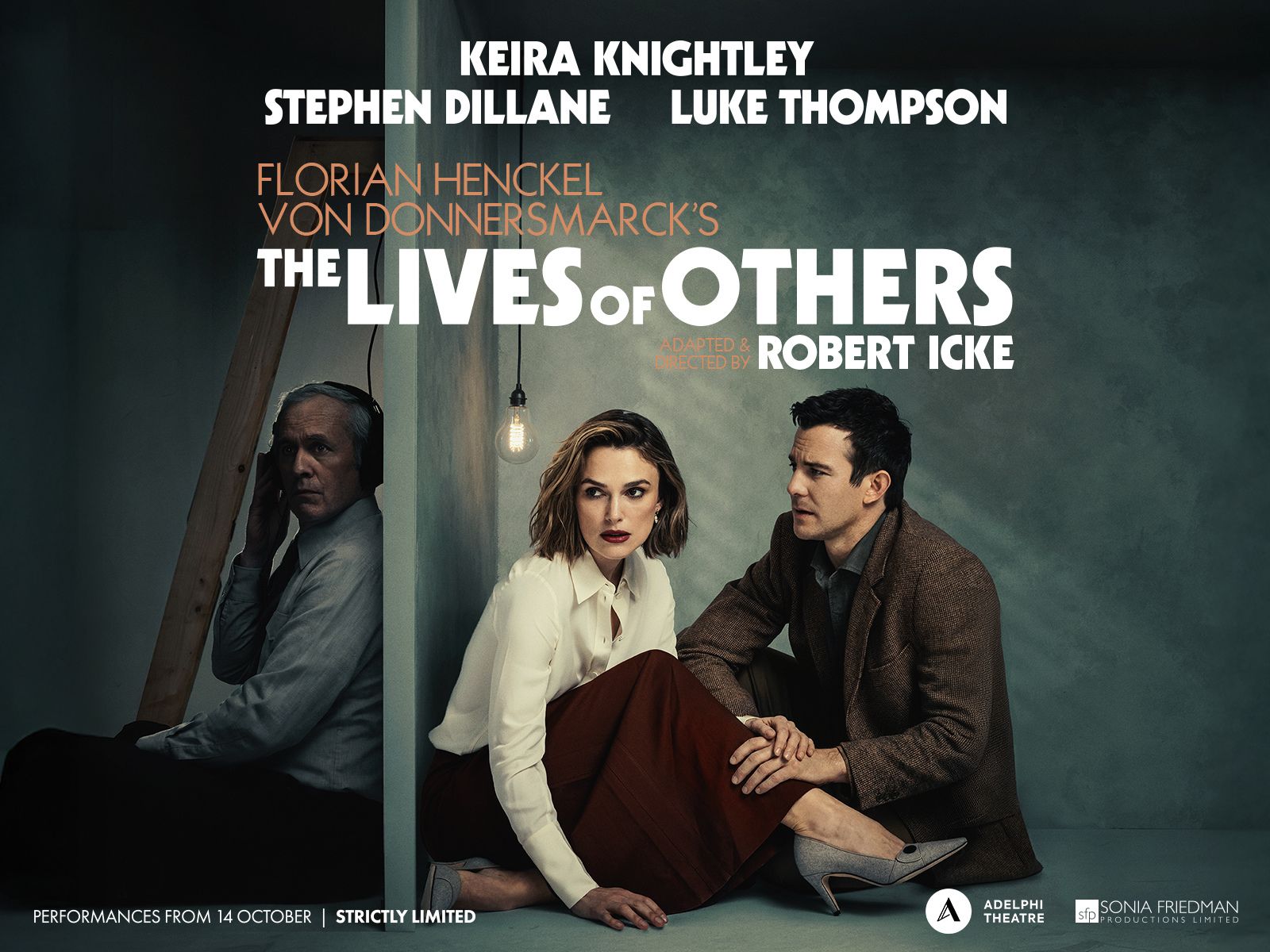
The Lives of Others ★★★★
By The Recs SW 10 hours agoOlivier Award-winner Robert Icke offers a new adaptation of Henckel von Donnersmarck’s 2006 Oscar-winning German-language film ‘The Lives of Others’. Are you ready to watch? Are you ready to be an audience?
1984. East Berlin. The Stasi, East Germany’s secret police, maintain a suffocating grip on society. Neighbours inform on neighbours. Surveillance is ever-present. Dissent is ruthlessly suppressed. Against this backdrop, The Lives of Others follows loyal Stasi officer Gerd Wiesler (Stephen Dillane) as he takes on an apparently routine assignment to spy on internationally renowned playwright Georg Dreyman (Luke Thompson).
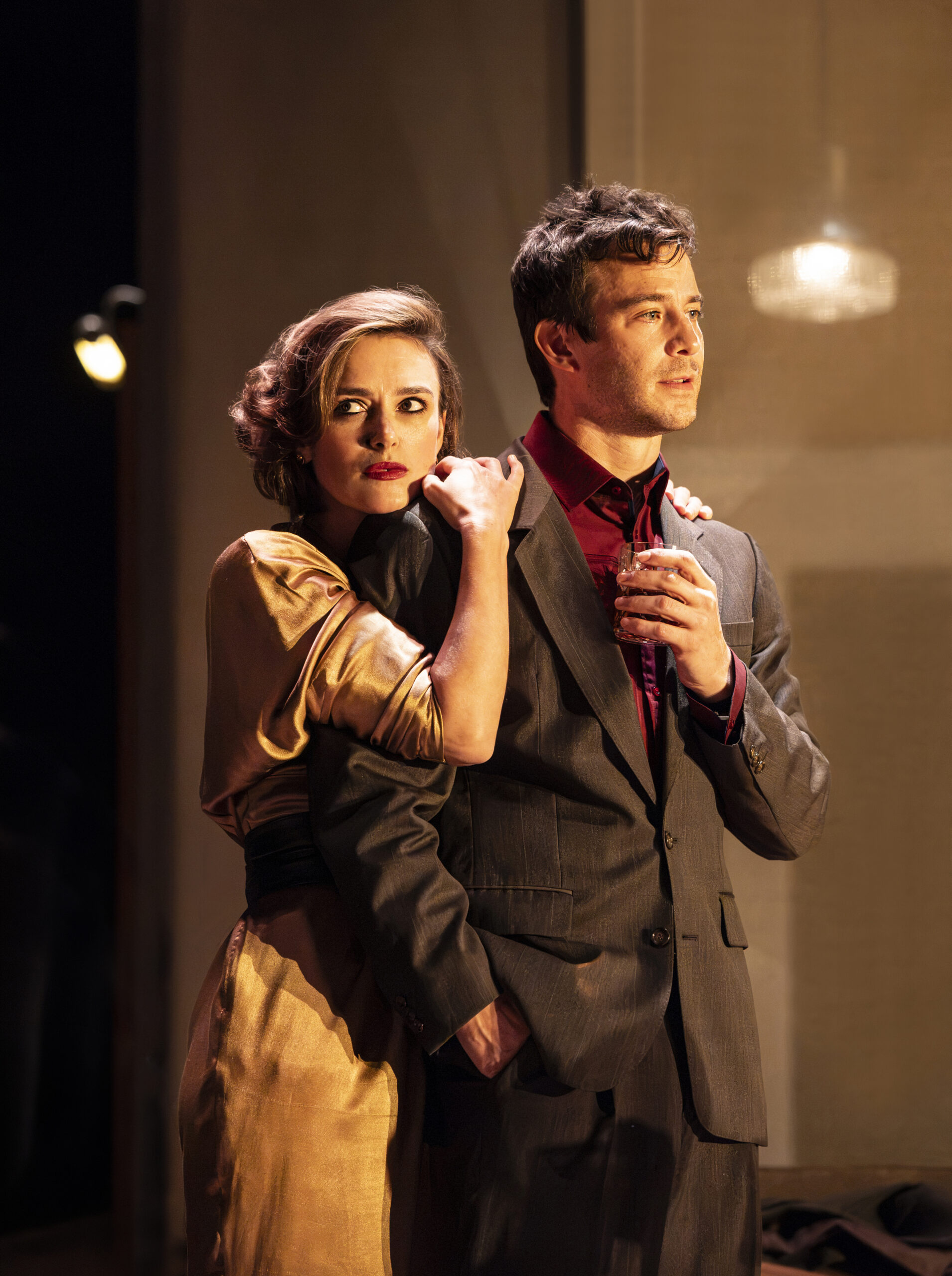
Ostensibly undertaken in the interests of the state, the surveillance has, in fact, been ordered by Culture Minister Bruno Hempf (Andrew Woodall) in pursuit of a hidden personal agenda. As Wiesler listens in on Dreyman and his actress girlfriend Christa-Maria Sieland (Kiera Knightley), he is drawn into their world, becoming increasingly troubled by the corruption and abuses of the regime he serves. When the suicide of Dreyman’s blacklisted friend, theatre director Albert Jerska (Nick Holder), prompts the playwright to expose the state’s concealed suicide statistics, Wiesler risks everything to protect the man he has been ordered to destroy, with tragic consequences.
Although entirely fictional, The Lives of Others is rooted in the very real machinery of East Germany’s surveillance state, informed by extensive research including the testimonies of people who lived under the regime. The result is a story with a profoundly unsettling air of authenticity, made all the more chilling by the fact that the society it depicts existed just 650 miles away and within living memory.
This is an accomplished and compelling adaptation by Robert Icke (Oedipus, Oresteia, Romeo & Juliet). However, it takes a bit of time to settle into its rhythm, perhaps because of a desire to remain more faithful to the film than is wise for a stage adaptation. Nowhere is this more apparent than in the scene introducing many of the principal characters. Dreyman, Sieland and several others emerge gradually at a party attended by around forty people, a surprisingly large cast for a small theatre. One can imagine the scene working effectively on film, with the camera navigating a crowded room and directing the audience’s attention towards key conversations, faces and developments. In the theatre, however, that perspective is unavailable, making it harder for the introductions to land with the same clarity and impact.
The dialogue also feels a little forced and awkward occasionally, perhaps reflecting the challenge of translating German idioms for which no natural English equivalent exists. Yet these are relatively minor quibbles and, once the production finds its rhythm, it becomes an engrossing piece of theatre, balancing its darker themes with some well-judged moments of humour.
The action centres on Dreyman’s apartment. Designer Hildegard Bechtler’s set occupies a slowly rotating section in the centre of the stage, with the living space around the perimeter and the more private areas (bedroom and bathroom) concealed behind semi-transparent walls at its centre. As the set turns, the action flows seamlessly from one space to another, creating a momentum and restless energy that a static set could not. The design is not without its drawbacks, though. Scenes that require the apartment to be removed necessitate visible scene changes, with stagehands physically manoeuvring large pieces of set off stage. While these interruptions are mercifully brief, they do momentarily undermine the building tension.
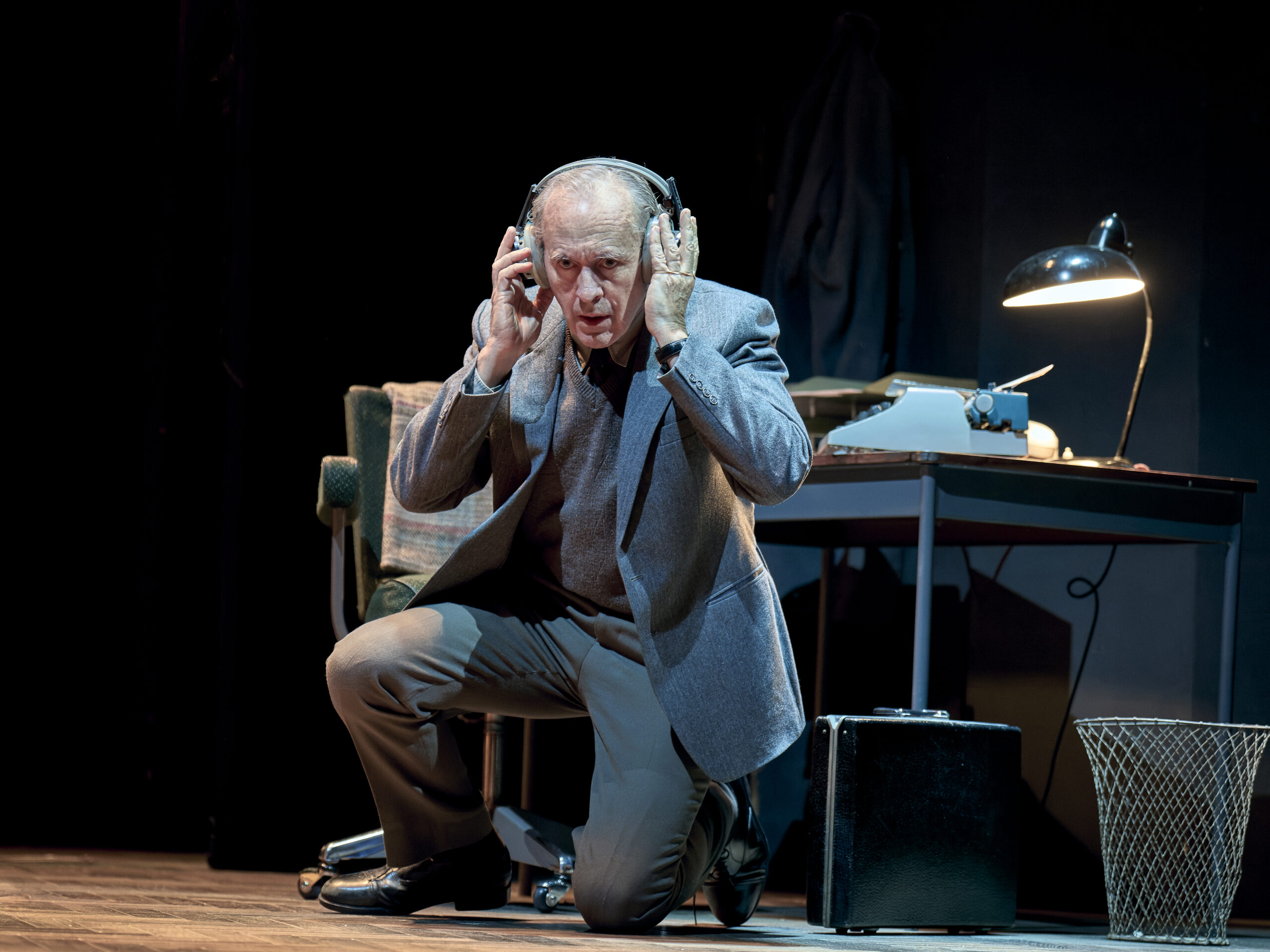
Wiesler’s surveillance post, positioned to one side, allows the audience to witness not only everything that takes place within the apartment, including moments that ought to remain private, but also Wiesler’s reaction to what he sees and hears. The effect is a persistent sense of intrusion, placing the audience in the role of both observer and accomplice.
The sense of intrusion is heightened whenever Wiesler dons his headphones. Sound designer Giles Thomas cleverly alters the quality of the voices, making them louder and more amplified, while introducing the occasional background crackle, suggesting that this is a recording rather than live speech. At times, the gentle tapping of a typewriter can be heard, a constant reminder that every conversation and action is being documented. Most tellingly, whenever Wiesler removes his headphones, the sound disappears from the entire auditorium.
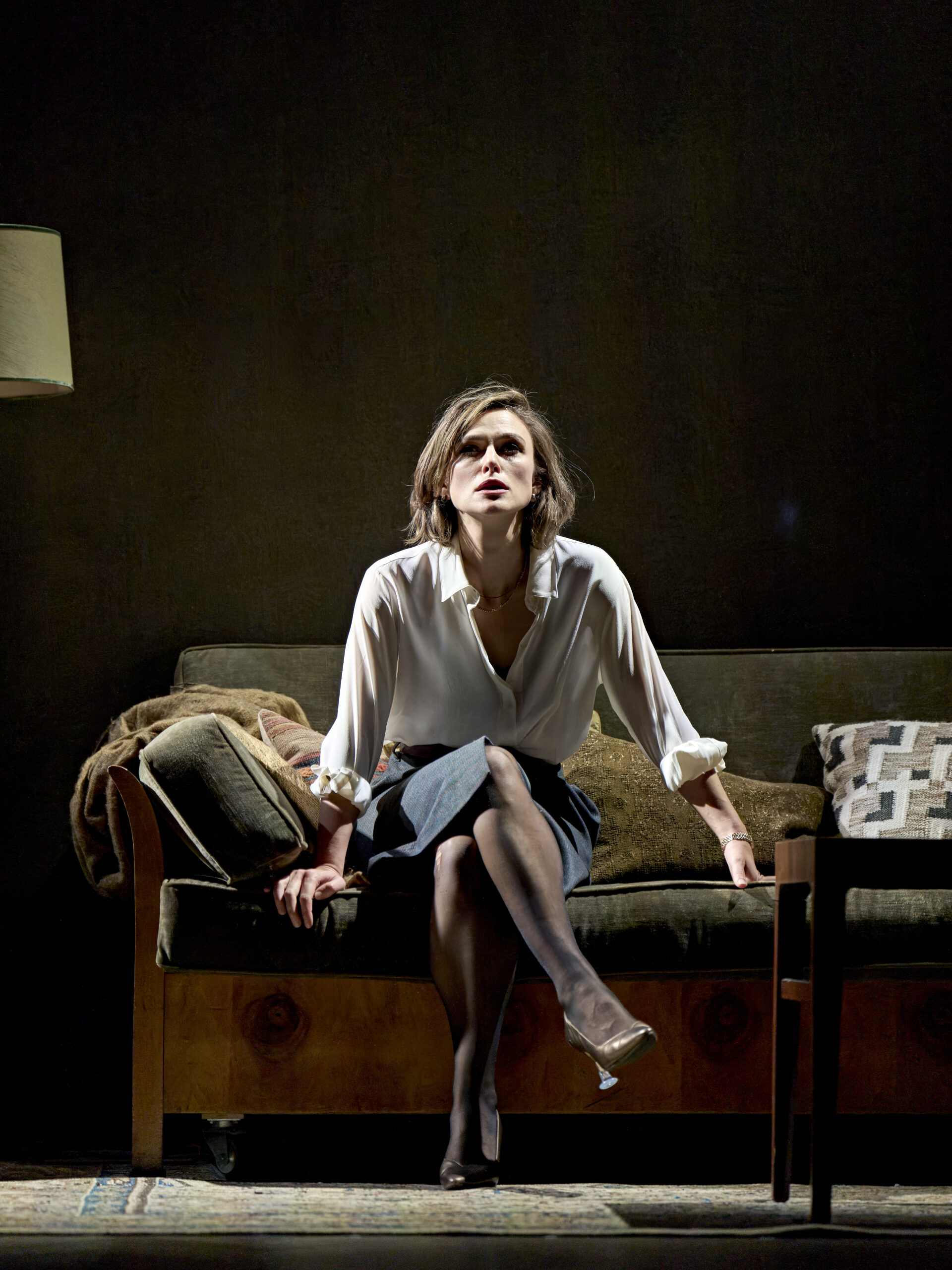
As the surveillance continues and Wiesler becomes more and more drawn into the lives he’s watching, the boundaries between observer and observed slowly blur, and Wiesler gradually moves away from the listening post and closer to those he’s monitoring until he eventually crosses into the apartment itself and shares the same physical space. He appears in the bathroom, sits alongside them on the sofa, and slowly becomes an invisible presence in their lives. It’s a powerful visual representation of the intimacy he’s developing with his subjects. At times, however, this feels slightly heavy-handed, and his increasing presence sometimes clutters the stage picture, drawing attention to the symbolism rather than the drama.
Occasionally, close-up footage captured by the on-set surveillance cameras is shown, allowing the audience to see subtle facial reactions that might otherwise be difficult to make out. Thankfully, Icke has chosen to deploy this device with restraint. As a result, the moments feel purposeful and highly impactful, rather than gimmicky, offering a vivid glimpse of the psychological toll of life under this repressive regime.
Through these dramatic devices, the audience is placed firmly in Wiesler’s position, not merely watching the watcher but becoming complicit in the act of surveillance, intruding on lives and conversations to which it should not have access. Occasionally, the symbolism feels a little over-egged and burdensome but, for the most part, it reinforces both the atmosphere and the growing sense of unease.

As well as making these staging ideas work hard, Icke has drawn out strong performances from his principal cast.
Oscar-nominated Keira Knightley (Pride & Prejudice, Atonement, The Imitation Game) is excellent as Christa-Maria Sieland. She holds the audience’s attention with apparent ease and shifts in an instant from joy and vitality to fear, despair and vulnerability, as her character’s world closes in around her. This performance is a reminder that, for all her success on screen, Knightley is a seriously accomplished stage actor too. Her finest moment, however, comes in one of the video close-ups, where fear, desperation, anger, self-loathing and eventual resignation to her fate play across her face in quick succession. It’s only a brief moment, but its impact lingers long afterwards.
Emmy Award winner Stephen Dillane (Game of Thrones, The Tunnel, Vigil) delivers a subtle and nuanced performance as the world-weary Wiesler, conveying a profound air of loneliness and quiet despair. He handles the production’s moments of humour with dry wit and impeccable timing, engendering sympathy where none should reasonably exist. And when Wiesler breaks down over something he hears through his headphones, Dillane commits fully to the moment, creating a key turning point in the character’s development.
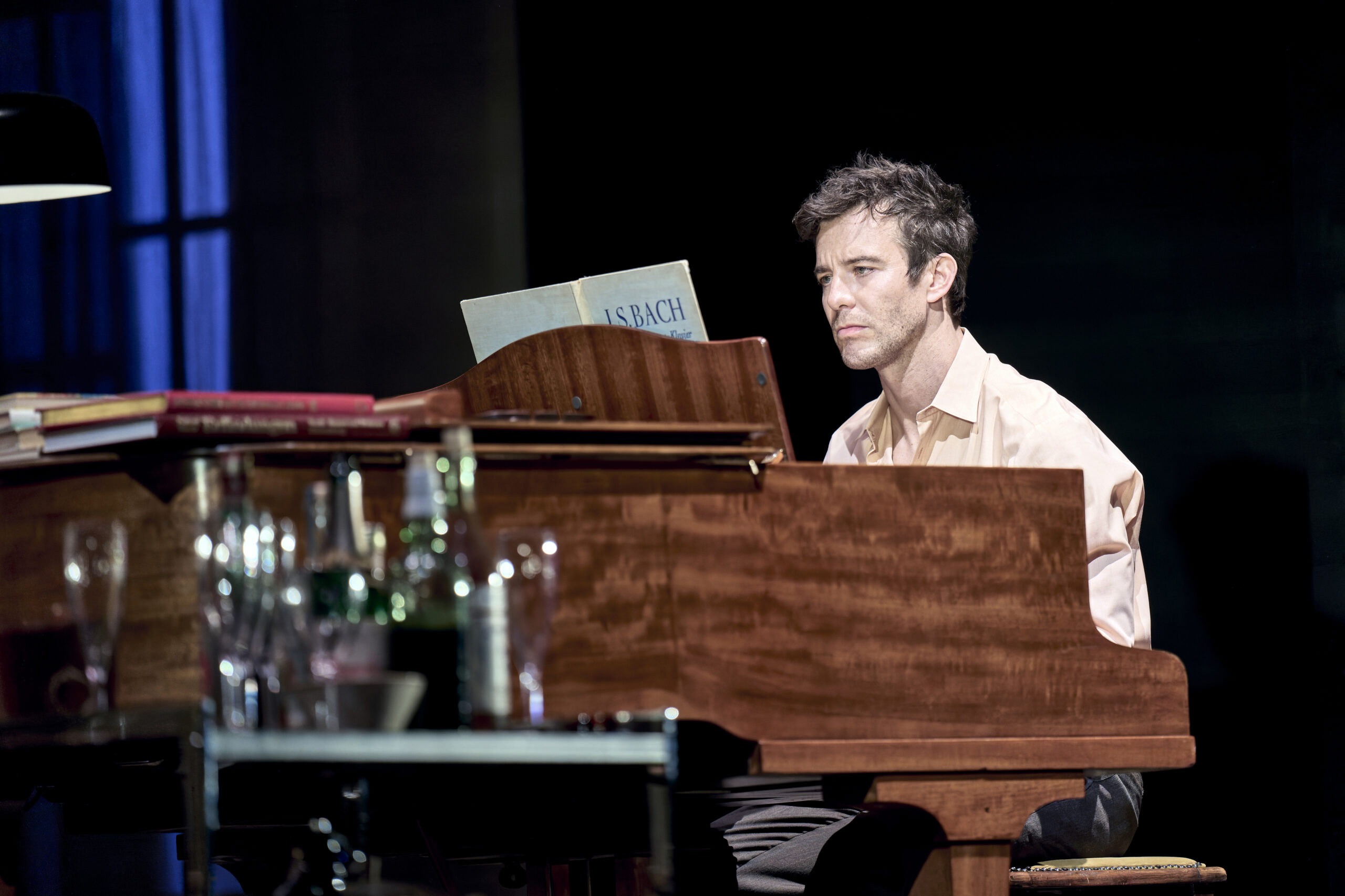
Olivier Award nominee Luke Thompson (Bridgerton, Dunkirk, Oresteia) makes a fine fist of the naive playwright Georg Dreyman, conveying the character’s warmth, humanity and optimism. However, the lightness he brings to the role occasionally sits at odds with the reality of his character’s situation, particularly as the personal cost of living under the regime becomes increasingly apparent.
Finally, Andrew Woodall (Antony and Cleopatra, RSC and Great Britain, NT and Theatre Royal Haymarket) is chillingly effective as Hempf, conveying with quiet menace the disconcerting combination of charm, entitlement and cruelty that makes his character so dangerous, and provoking a visceral sense of revulsion without ever raising his voice. In the final act, after the fall of the Berlin Wall, Woodall beautifully captures the irony of a man who has prospered under capitalism yet continues to sneer at it, delivering Hempf’s disdain with obvious relish.
Overall, this is an intelligent and absorbing study of manipulation, abuse of power, conscience and trust, which holds the attention throughout. However, it does so at an intellectual level, rather than an emotional one. There is much to admire, and even more to think about, but surprisingly little that truly moves.
That’s not to say it’s not worth the price of a ticket and two hours of your time. It most certainly is. In an age of pervasive CCTV, unprecedented data collection and increasingly sophisticated forms of digital monitoring, the questions posed by The Lives of Others feel anything but historical. The production serves as a timely reminder of how easily privacy can be eroded, and disagreement marginalised through the blacklisting of those with unpopular views, the policing of acceptable opinion, and the exclusion of those who challenge currently fashionable ideas. It’s also a riveting watch, with the two hours passing in what feels like half the time.
Yet, despite everything it has going for it, the audience, unlike Wiesler, remains one step removed from the action, observing events rather than becoming emotionally invested in them.
There is a moment towards the end of the play when it feels as though the story is building towards a definitive ending, but the action peters out before the conclusion is reached. Rather than feeling satisfyingly ambiguous, it creates a sense of anti-climax and a story unfinished. Perhaps this is intentional, a reminder that the questions it raises about surveillance, freedom and the use of state power remain unresolved and that our society may be less far removed from the one depicted on stage than we like to think.
Can you resist the temptation to watch the lives of others? ★★★★ 4 stars
The Lives of Others Tickets

The Lives of Others has a strictly limited run at the Adelphi Theatre, London until 9 January only
Book NowAuthor Profile
- The Recs SW
Latest entries
- 1 November 2026London DramaThe Lives of Others ★★★★
- 29 October 2026London MusicalsCeilidh The Musical (touring) ★★★★
- 28 October 2026London DramaGirls – Young Vic ★★★★★
- 24 October 2026London DramaThe Pianist – Park Theatre ★★★★★