The Cherry Orchard – The Harold Pinter Theatre ★★★★

London’s West End welcomes a worthy new adaptation of Anton Chekhov’s ‘The Cherry Orchard’ to the Harold Pinter Theatre

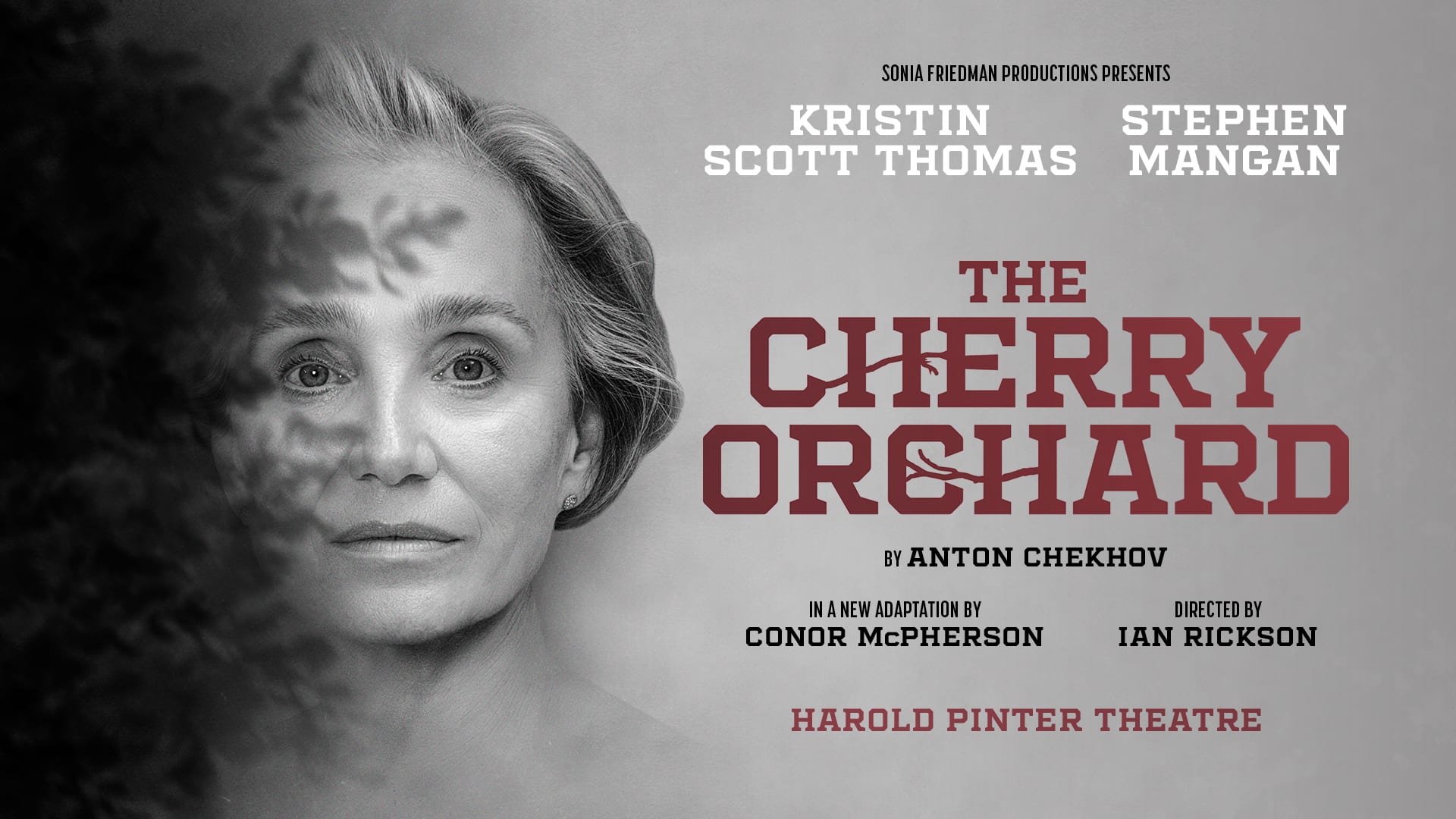
It’s only been a few months since the RSC’s production of The Cherry Orchard played The Swan in Stratford-upon-Avon, and now we have a different adaptation gracing the stage in London for the remainder of the year. There’s been a lot of excitement about this show because it has a terrific cast list and is driven by the creative partnership of award-winning director Ian Rickson and writer Conor McPherson, who previously brought us their interpretation of Chekhov’s ‘Uncle Vanya‘ to great acclaim. Sonia Friedman Productions also backs it, the company behind so many current West End hit shows. That pedigree brings with it a lot of expectations. So does this new adaptation by McPherson into English manage to capture the essence of Chekhov’s original writings and live up to all those expectations after the highs of Vanya? Is it bringing anything new to the party? Well, the play’s universal themes of love, loss, money anxiety and unwelcome change all chime with today’s audiences as much as they did when Chekhov first saw his play performed in Moscow in 1904.

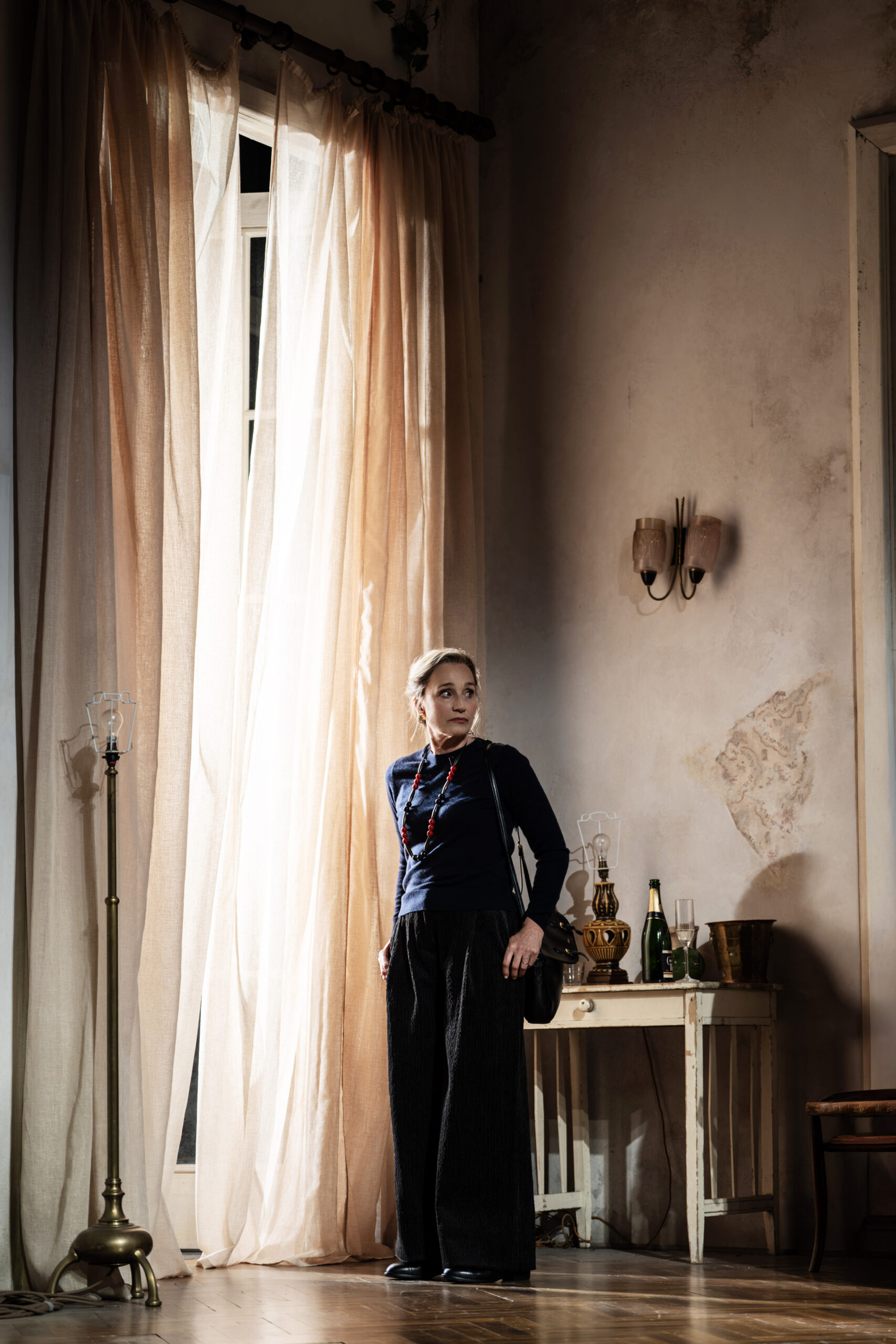
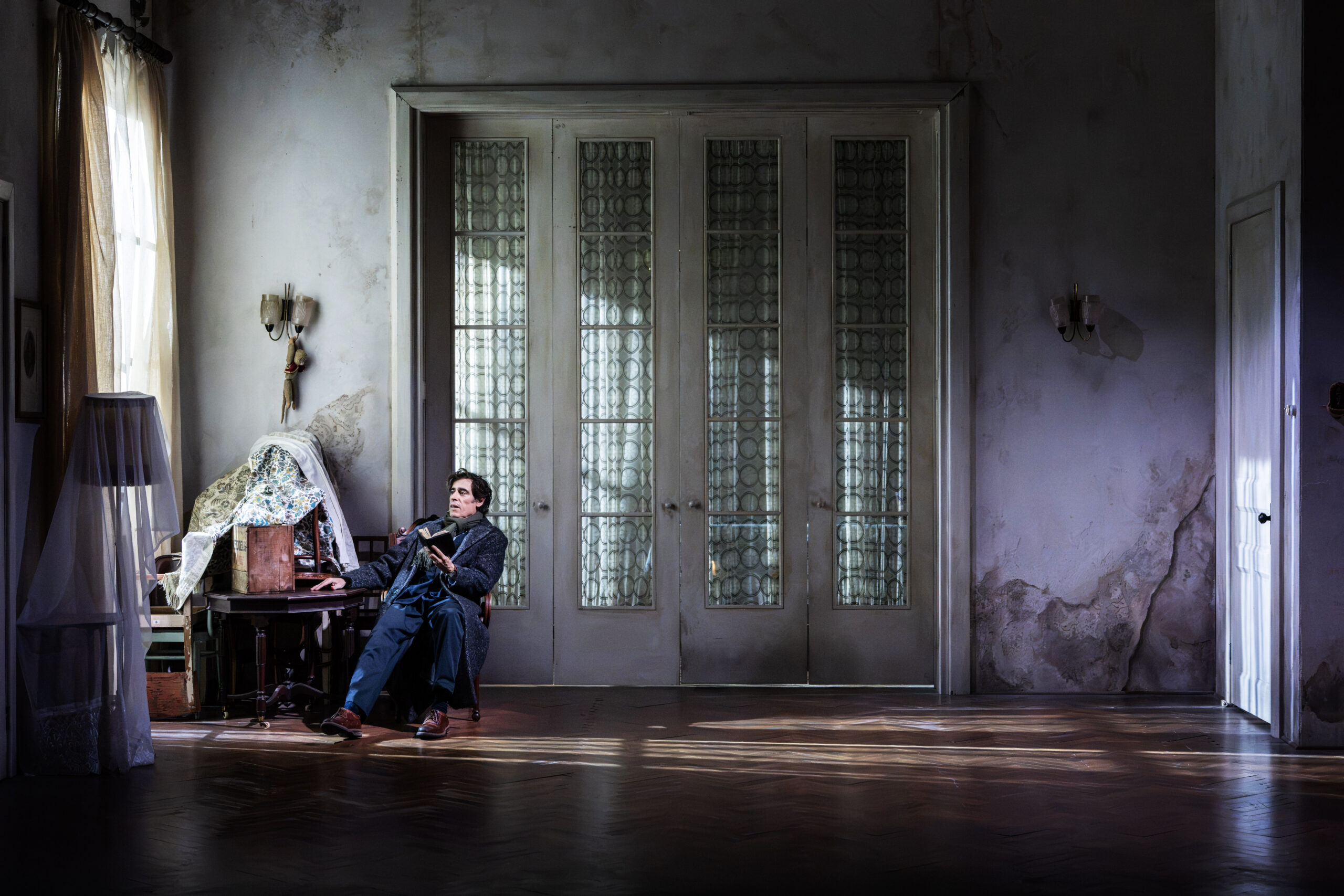
McPherson and Rickson have placed all the action in the same room of a large, dilapidated house situated somewhere near Kharkiv – an area well-known to us now because of the Ukrainian/Russian war. The costumes don’t give much away, but we have to assume that we are going back to the time when Chekhov was alive and when, just as now, the people of Europe and Russia were struggling with economic and social inequalities, the possession of money meaning choice and power, and the young feeling disadvantaged by the older generation. The set designed by Chloe Lamford is subtly off-white with allusions of damp and decay. Towards the rear, there are French doors that open up to reveal a billiards room behind. To the right is a wooden dresser-cum-bookcase stuffed with pots, bottles, books and framed photos. Next to it is a small stove inadequate to heat the room. In the corner are two doors and a small high altar. The lighting, by Bruno Poet, is pale amber and low-level, providing a suitably dingy atmosphere.

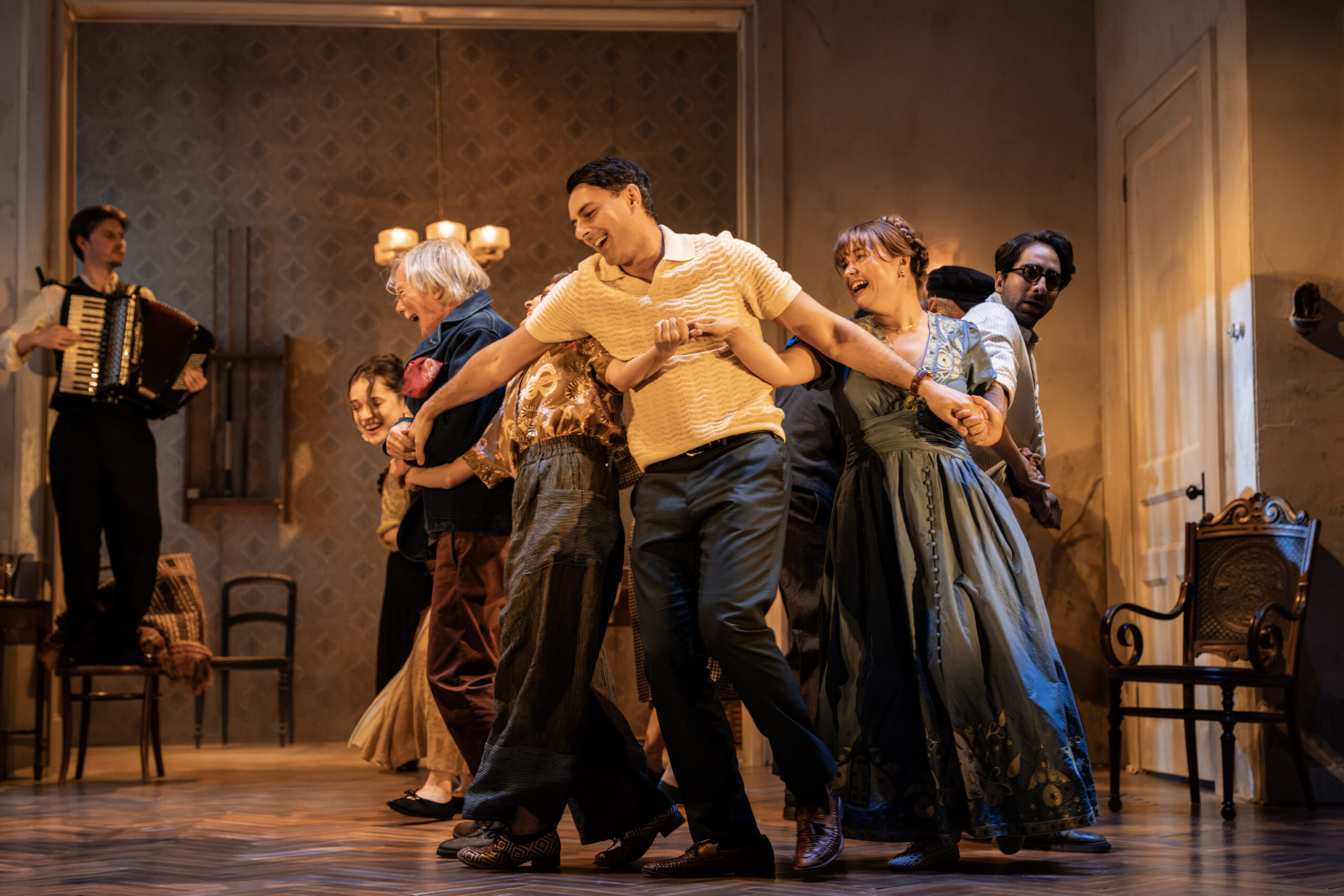
Into this empty room comes a man, unspeaking, waiting for an arrival, who we later learn to be called Yermi by the incumbent family. He comes from peasant stock and has worked hard to become someone in the eyes of that landowning family. He is an entrepreneur with a business brain and an unrequited love. The person he is waiting to see is Ranevskaya, referred to within the play as Luba, who is returning from Paris with her daughter Anya following a failed relationship and the removal of all her wealth. Back in her family home, in the room that overlooks the estate’s cherry orchard, we come to understand the effect of her many personal losses, her helplessness and refusal of help, and how she lives in denial of reality. She is supported by her ineffectual and pompous brother Leo and his hope of securing further funds from their aunt in order to fulfil their wish of keeping the estate in the family. We meet the people who love and depend on her generous nature, such as lovelorn adopted daughter Varya, cunning servant Yasha, bankrupt neighbouring landowner Boris, and Firs, the ageing, forgetful valet. The story reveals her family’s failure to live within its means and the impact of that on those who rely on them for their livelihoods. McPherson also gives us glimpses into the lives and struggles of peripheral characters such as Yepikhodov, a young bookkeeper with an artist’s soul and love of housemaid Dunyasha, Sharlotta the redundant governess, and Petya the student with a revolutionary zeal. Through McPherson’s adaptation and Rickson’s experienced direction, we explore the feelings of each character, the hardship of their lives, their yearnings and their human frailties, all mixed together with light-hearted moments of joy, whimsy and comic lines, right until the house of cards collapses.

Images by Johan Persson

The new and old moneyed property-owning bourgeoisie are wonderfully encapsulated by the contrasting acting styles of Stephen Mangan as Yermi and Kristin Scott Thomas as Luba. Mangan, largely recognised for his television work, is superb as the abused, unprivileged, agonising outcast. His energetic characterisation, informed by his innate comic timing, brings sympathetic understanding to the situation Yermi finds himself in. His performance is a standout amongst many other fine ones in this show. Meanwhile, Scott Thomas brings a serene quality to her Luba, exuding confusion about what is happening to her and her beloved family home. She seems embarrassed about why she is so loved by others, and ashamed of her impoverished situation and how she has lost the things she loves. Uncle Leo is played as puffed up and foolish by Peter Wight, and neighbour Boris sees Jeff Rawle deliver a lovely and gentle comic turn as the perennially impecunious guest. The younger generation, left with all the consequences of their elders, are also performed by gifted actors. Vinette Robinson is an unhappy, flustered, uptight Varya, exuding shame and uncertainty through every pore. Anastasia Martin is a young and hopeful Anya, full of determination and concern about the family’s circumstances.

Meanwhile, the proletariat are portrayed with all types of accents when we are introduced to the estate’s servants. Irish actor Megan Cusack is a lively, skittish Dunyasha with some classic facial expressions as she tolerates her suitors. Scottish actor Noof Ousellam is well-cast as easy-on-the-eye manservant Yasha. Ousellam confidently talks and walks around the stage in a way that convinces us that his character is only self-interested; he knows what he wants and knows how to get it. Ruby Bentall as Sharlotta gives her character a playfully wild weirdness with a hint of Germanic endeavour. She also offers us some very convincing magic tricks to add levity to the proceedings. Jack Riddiford earnestly plays the haunted student Petya, dishevelled and determined to make the world a better place for his generation. Shubham Saraf has a difficult character with which to grapple, as Yepikhodov is a disturbing conundrum. This clerk is difficult to read: one minute mooning over Dunyasha, then having depressive thoughts and even making his potential suicide into something comical. Finally, Karl Johnson plays the older man, the valet Firs, losing his memories and with no happy retirement in his future. Johnson gives a dignified and poignant performance till the last.

This production is certainly enjoyable, leaning more towards the comedy than the tragedy of Chekhov’s work. There is some very fine acting, particularly from Mangan, who is outstanding as needy Yermi, and Scott Thomas as kindly, naïve Luba. It’s a large cast to fit onto the Harold Pinter’s compact stage, and McPherson’s adaptation contains so many characters dealing with their own life challenges and changes that a couple of hours is not enough time to give us the chance to empathise with everyone’s plight in the end. The Harold Pinter is a lovely little theatre tucked away just off Leicester Square, but its sightlines are not particularly good at the sides and rear of the stalls, so be careful when choosing your seats for this show if you want to see everything. Having said that, if you are planning a trip into London before Christmas, this pleasing production is well worth catching whilst you are there.

Magnificent Mangan puts the theatrical Cherry on top of this Russian classic

★★★★ 4 stars

The Cherry Orchard Tickets

The Cherry Orchard will play at the Harold Pinter Theatre, London until 9 January 2027

Book Now

Author Profile

The Recs JDH