Ahead of the show’s run at the Edinburgh Festival Fringe, we caught up with writer Vivienne Franzmann and choreographer Frauke Requardt to chat about the inspiration behind their unique collaboration on Anatomy of Survival and how a very relatable modern encounter opened the door to timeless questions about human nature.

Hello Vivienne and Frauke, thank you for joining us. Let’s plunge in with a very obvious question: can you give our readers a sense of what Anatomy of Survival is about?

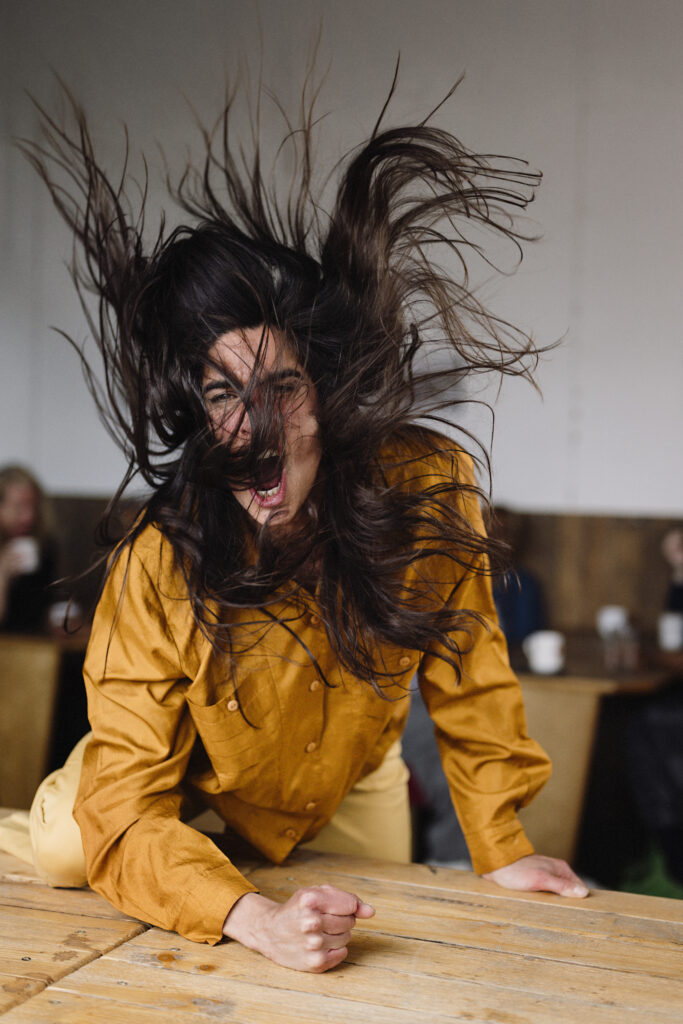
Frauke: It is a theatre/dance show with drumming that revisits an interaction gone wrong in a coffee show where a woman loses her shit.

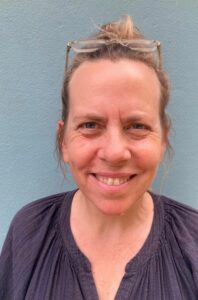
Frauke Requardt

The spark for the piece is something I think most of us can relate to: someone completely losing their temper over what seems like a minor interaction. What was it about that very modern, everyday moment that made you think, “There’s a much bigger story here that needs to be told”?

F: It is interesting that it is considered an ‘everyday’ moment. And sure we see it all the time. The physiology of that moment is extreme though-this is a person in a survival state. When you enter fight/flight/freeze there isn’t capacity to relate in a calm, thoughtful manner. The discrepancy between the mundane nature of the event and the felt experience of it as a bystander is also intriguing to us. For that person the minor interaction is lost and something else is happening. What that is and how to understand this is what the piece is about. 

Vivienne, the show revisits the same incident through 22 different perspectives. What excites you about exploring how unreliable our memories and perceptions can be?

F: I wanna jump in here: Yes, our memories are unreliable but that is another show. In this show it is more about the proposal that everybody’s reality has merit. You can have yours and perhaps at the same time let in someone else’s reality too. To get a fuller picture.

Frauke, you are both a choreographer and psychotherapist. Did both these disciplines shape the way you approached creating the work?

Yes, and I would say that everything I know about life informs both choreography and psychotherapy-what fuels my engagement with both fields is an interest in the nature of reality. Which seems to me is fairly unreliable.

Vivienne Franzmann

One of the show’s central ideas is that our brains are still operating with Stone Age wiring in a very modern world. Can you give an example of this?

Vivienne: Flight or fight is the one most people know. When faced with threat, our brains go into ancient survival mode. In the Stone Age, that might have been a Wooly Mammoth.  Today it might be someone jumping a queue in a post office when you’re late to pick up your kids. Stress and trauma inform how well you cope with these everyday events. 

F: Well, by now everyone will probably have heard about The Nervous System and how it is responsible for bringing activation when needed as in: I need to run for the bus-and just thinking that will probably already mobilise something. As well as settling for rest and digest. 

When stress get too high or there is trauma which there is plenty of in modern life we might get pushed out of our window of tolerance in something closer to survival states: The urge to run away hits, to fight or to be very still (as well as appeasement-an often overlooked and probably most common survival response). In these states the capacity for social engagement goes off-line- all energy is directed towards survival. The task from the stone age has prevailed in modern life: we still just want to survive and in survival mode the same mechanisms are at work. 

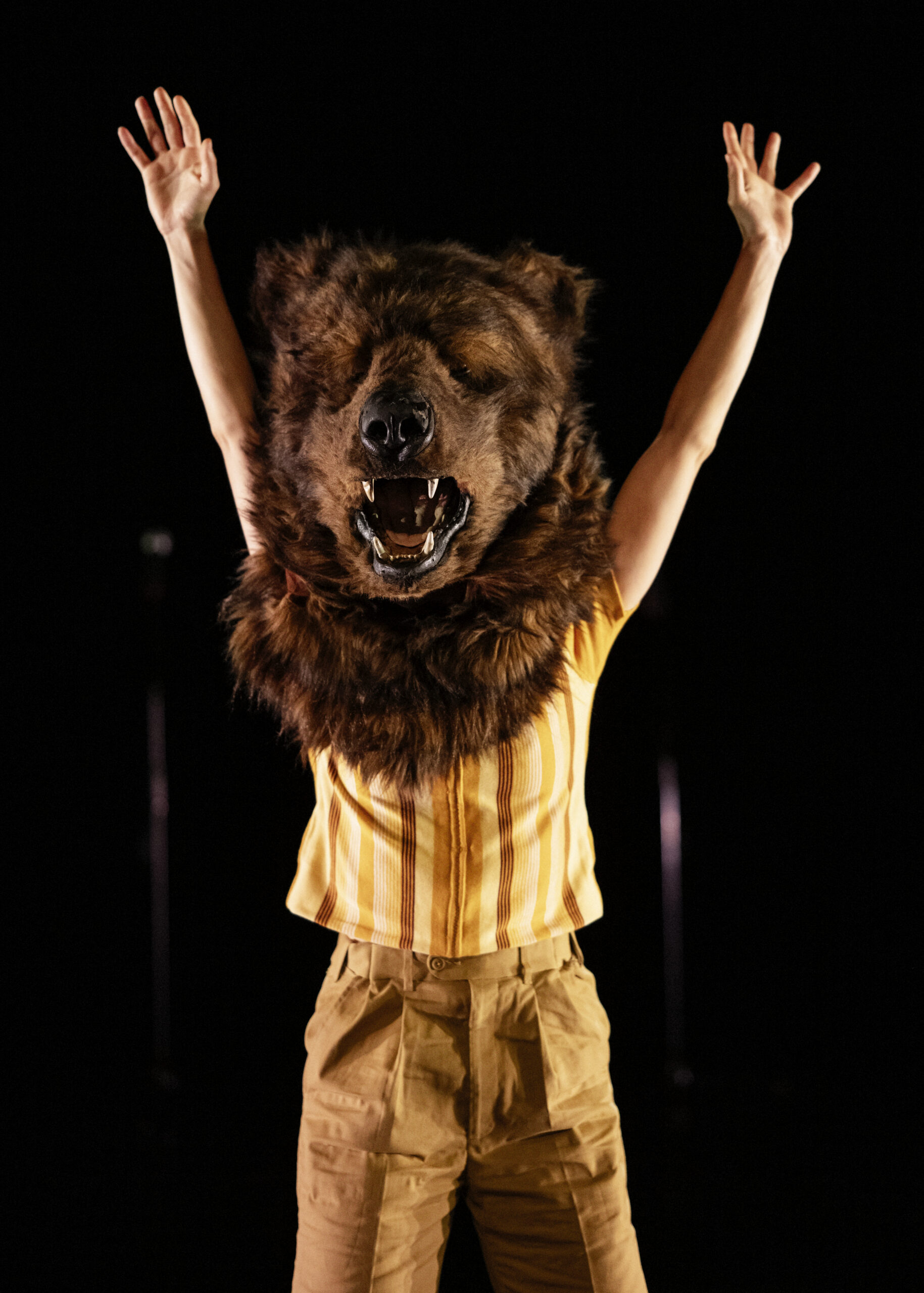
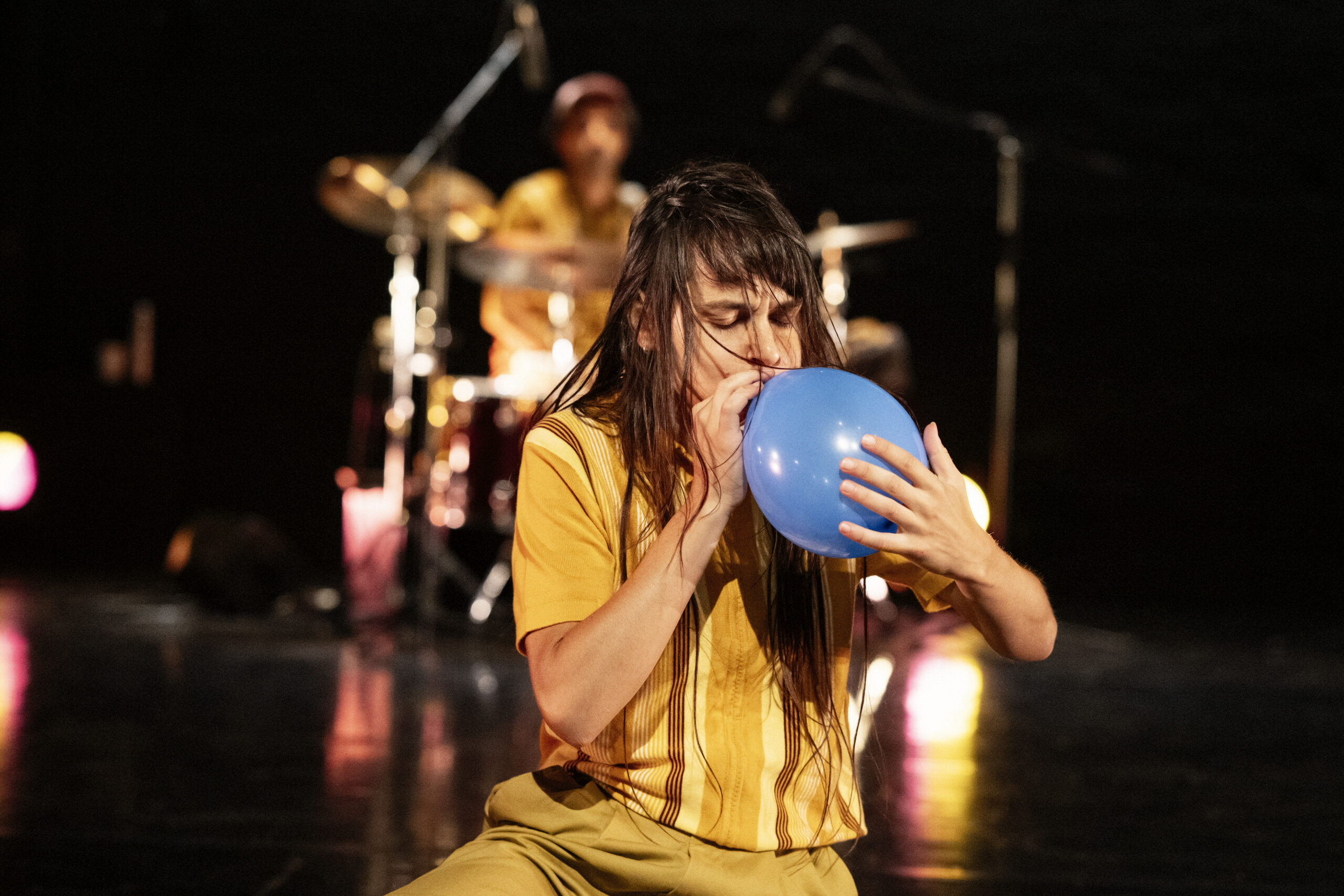
Production Images by Camilla Greenwell

Anatomy of Survival blends text, movement, live drumming, lighting, and (spoilers) even a person in a bear costume! Was it always clear that this story needed to be told through multiple theatrical languages rather than conventional drama?

F: I imagine that there are many ways in which to address the subject matter.  We like drumming-it hints at the nervous system ticking away at any given moment and dance which brings particular energies that can be felt in the body before it moves into cognition. Viv’s text offers clarity, context and it’s extremely beautiful. This mixture is the language of our collaboration. 

V: We’re from different disciplines so the piece was always going to have dance and text. Everything else happened organically through the making process.  We want to make work that we want to see, that has energy and wit and is visually exciting and sounds great.  

How do you weave these elements together to make a cohesive whole?

Maybe come and find out?

Working together as playwright and choreographer, how did that partnership evolve, and what surprised you most about each other’s creative process?

F: I became more aware of my desire to withstand the urge for meaning making and to go and see what things will become as late as possible- that is probably more part of a movement creation process anyway. For Viv as a writer meaning is essential and comes earlier in a creative process. 

V:  And equally, I had to hold my desire for meaning more loosely. I was surprised how we were still changing things right up till the last minute – my nervous system was definitely activated by that!

Vivienne, did working so closely with Frauke and her choreography influence the way you wrote the script? Were there moments where movement said more than words ever could?

V: I wrote the text so we could incorporate dance and movement into it without being illustrative or jarring, always looking for moments in the text that could be dance based.  The last section is a monologue, which I understood would be a challenge movement wise, but feels completely necessary to the piece. I knew Frauke would find a beautiful creative solution. I’ve often thought the body speaks more eloquently, more profoundly than words do. Some of the most emotional moments in the piece come from the movement.
And, Frauke, equally, were there moments where Vivienne’s writing changed the way you thought about movement or the emotional journey of the piece?

F: All the time. When one element changes it ripples through the whole show and things need to be adjusted in some way. 

While the show deals with psychology, trauma and perception, there’s also humour and surrealism running through it. How important was it to find those lighter moments alongside the deeper themes?

F: Very. When I can laugh about something that is also upsetting it becomes somehow more fully formed for me and I find I can have it in a more meaningful way.

V:  Essential. We wanted to make a piece that interrogates big ideas, but we also wanted to make a show that is a ride.  

Anatomy of Survival has already had a life before Edinburgh. What are you most excited about sharing the show with Fringe audiences this summer?

F: I have never brought a show to the Fringe before so I am excited to be presenting our work within the energy of this massive festival. I hope the part of the Fringe audiences that are dealing with nervous system disregulation know they are not alone. And that we can look at this behaviour anew without excusing it. I wish that people can consider moving from: from ‘what’s wrong with this bitch’ to ‘I wonder what is most needed in this moment’.  It’s probably a bit of a big step. 

V: I love the energy of the fringe. I love that some people buy tickets half an hour before the show, that the audiences take risks and they never quite know what they’re going to get. The festival is magic and open and creative.  And I feel like our show walks hand in hand with that spirit.

What are your hopes for the show during your Edinburgh run, and beyond?

F: that it goes down well and might have a future life. I love talking Nervous System with people.

V:A sell out and then a big tour. 

Anatomy of Survival Tickets

Anatomy of Survival is at DB3 at Assembly @ Dance Base, 25 – 29 Aug

Book Now

Author Profile

The Recs SCD - Steve Coats-Dennis