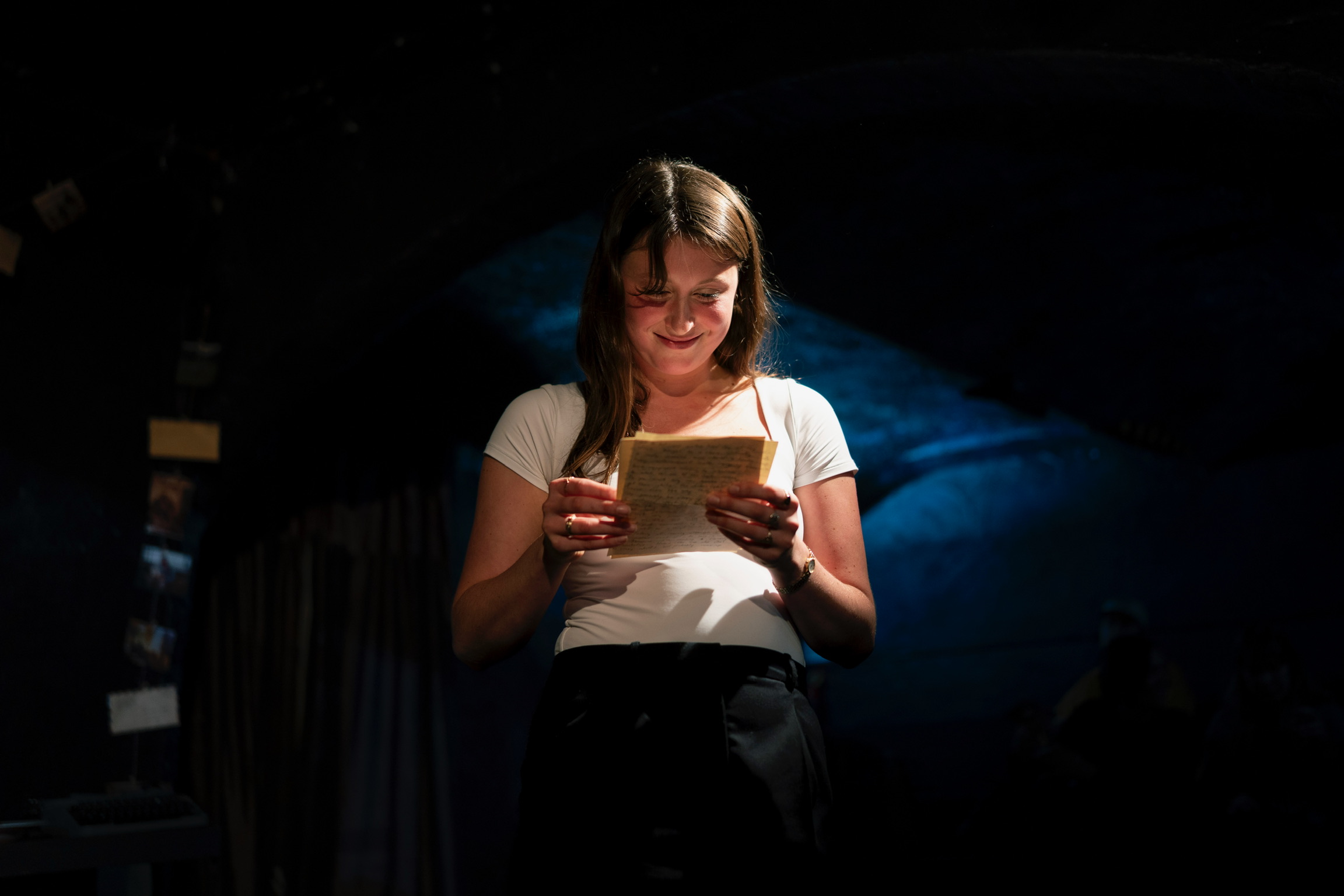
Streit uses the scene cleverly as a double metaphor near the end, when she calls out to the audience, asking for her grandmother to come out, to explain why so much of the darkness in her life was obscured and hidden. The letters reveal very little of Joan’s inner life, rather showing her passing dreams and devotion to Lenny.
This is clearly a well-thought-out production. Streit has a riveting stage presence, her enthusiasm for the letters, and the thoughtfulness she brings to scenes with Cahill all show that she has a bright future ahead of her as a performer. As a playwright, her ability to switch from moments of nostalgia to hard-hitting reality is commendable, if a little jarring.
The show runs into pacing issues when we digress from Joan’s story – the structure becomes a little unclear as the timeline jumps around from far-past, present, and near-past. The audience is left wanting to hear more about Joan’s life, rather than her husband’s.
Perhaps the pacing is all by design. We grow frustrated by the lack of a clear recollection of Joan, echoing Streit’s frustration when she realizes how much of their past has been kept under wraps. This is a story that can last for hours, with hundreds of letters that could say so much more, or say very little – such is the care that Streit has for the mundane, for the fleeting confessions of love that would otherwise be generic and insignificant.
Unobtrusive direction by Jessica Whiley ensures that the conversation between Streit and Lenny is free-flowing and naturalistic, despite a shocking reveal of Lenny’s character that takes the show from the grounded into the cerebral. These choices ensure Streit’s tribute is straightforward and, more importantly, heart wrenching.
At the end, surely to Streit’s delight, the audience are left thoughtfully pondering what their next written letter should be.