It’s November 30, 1993. The eve of the sixth annual World AIDS Day and the first year of Bill Clinton’s first term in the White House. Clinton has promised a more proactive response to the AIDS epidemic than predecessors, Ronald Reagan and George H.W. Bush, whose policies on treatment left the U.S. lagging behind countries like the U.K.
And that sets the scene for Kramer/Fauci, the Daniel Fish play written from the transcript of a live C-SPAN call-in discussion between Dr. Anthony Fauci and activist Steve Kramer. Fauci was then the director of the National Institute of Allergy and Infectious Diseases at the National Institutes of Health. Kramer, who died in 2020, was a writer, Tony-winning playwright, and an activist who co-founded ACT UP (AIDS Coalition to Unleash Power), a political group to challenge government inaction and the stigma around AIDS.
Images by Maria Baranova
Kramer and Fauci had a complicated relationship at the time of their C-SPAN confrontation. Kramer had previously called Fauci “a murderer”; Fauci said he was warned that Kramer was someone to be avoided. (“I ignored this advice.”) Nonetheless, their heated discussion is tempered by moments of the mutual respect and affection that was to result in a long-term friendship.
Kramer: “Tony, if you start that business about science isn’t done that way, I’m gonna come on there and slap your face.”
Fauci: “All right, Larry, hang on for a sec. I love you, Larry.”
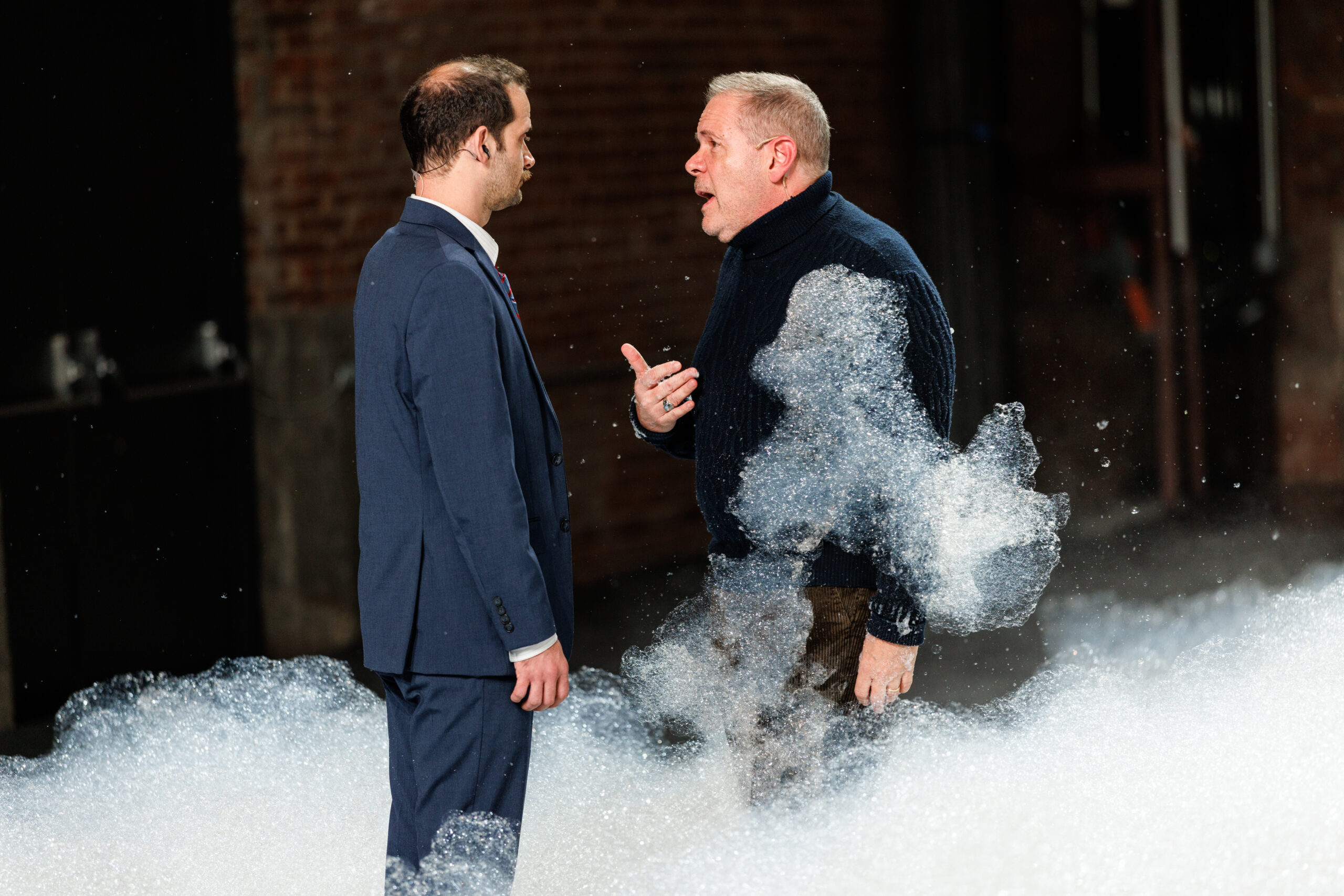
Actors Will Brill (Tony Award winner, Stereophonic), and Drama Desk Award winner Thomas Jay Ryan (Henry Fool) deliver compelling performances as Fauci and Kramer respectively. Greig Sargeant, as moderator Steve Scully, also skillfully hits the right tone, combining measured questions with restrained silences to maximize the drama of the protagonists’ exchanges.
Jennifer Seastone is equally solid as the portrayer of the various callers-in to the broadcast. Rollerblading around the stage, her presentation of the wide range of questions – and sometimes homophobic comments – from callers around the nation provides an informative backdrop to the AIDS politics of the era. (When Kramer is too outraged to respond to a caller recommending that those with HIV be identified and sequestered, Fauci – with an unusual display of passion – jumps in to tell the caller that enforced isolation is “a terrible idea from a public health standpoint or any standpoint.”
Award-winning director and play creator Fish (Oklahoma!, among others) deftly stays faithful to the transcript of the original broadcast, his dramatization maintaining a smooth narrative pace while keeping the play’s running time to the original 1-hour C-SPAN show.
Unfortunately, this careful adherence to the script proves both a strength and a weakness. Verbatim text is great for anyone wondering about the accuracy of the exchanges, but it can also lead to extraneous staging elements – presumably intended to lend some excitement to an otherwise stark set – feeling a little flat. Why, for example, does Seastone need to a) skate and b) wear an inflatable chicken suit to ask her call-in questions? It’s distracting at best; discordant at worst.
Similarly, what exactly is the meaning of the giant blower that spews mountains of bubbles to encase the actors? Does the phallic-like soap dispenser represent a burst condom? Or, as some have suggested, does the foam symbolize the tidal wave of the lives lost in the devastating years of what Fauci calls an epidemic and Kramer insists is a plague. Whatever the metaphor, the foam-bath-on-steroids backdrop is more redolent of children at play with soap bubbles than an ominous sign of grief.
That said, Kramer/Fauci is a gripping production. It raises political, health, and social issues that feel neither dated nor remote – especially given that Fauci is again back in the news following the recent vote by a U.S. Senate committee to hold him in contempt of Congress for refusing to answer questions about the Covid-19 pandemic.
Fish’s faithful adherence to the 1993 script also wisely precludes any overt nods or winks to more contemporary times. Instead, it shows a discourse that is a lesson in respectful, substantive, political debate between two powerful protagonists who are divided on strategy but united in their desire to beat HIV. In an era where political discourse has devolved in meaningless sound bites, influencer garble, and fake AI images, that alone makes Kramer/Fauci worth the trip to the theater.
A timely and poignant look at politics, art, and AIDS activism ★★★★ 4 stars
Kramer / Fauci Tickets
Kramer / Fauci plays at St. Ann’s Warehouse until 24 October 2026