Blue / Orange ★★★★
By The Recs JDH 15 minutes agoOSO Artistic Director Lydia Sax directs ‘Blue / Orange’, the ground-breaking satire on the NHS
As the darling buds of May spring forth along the banks of the Thames in Barnes, southwest London, the nearby OSO Arts Centre is putting on a short run of its own production of Blue/Orange by Joe Penhall. This taut and satirical drama was originally performed by three male actors at the National Theatre in 2000 and went on to win numerous awards, including an Olivier for Best New Play the following year. The writing grapples with a failing NHS, systematic biases and racial iniquities. Now producer Jamie Rycroft and director Lydia Sax have taken Penhall’s insightful script and, with his blessing, cast a woman in the role of the junior psychiatrist, adding an extra dimension that highlights the troubling power dynamics when an older male consultant exerts control over his female junior. A generation away from the time this play was first staged, can it deliver on its promises of exploring and illuminating our country’s continuing problems with mental illness, community care, institutional racism and patriarchal power? Well, this show delivers something that is just as relevant in a Starmer-led Britain as it was back when Tony Blair was in charge.
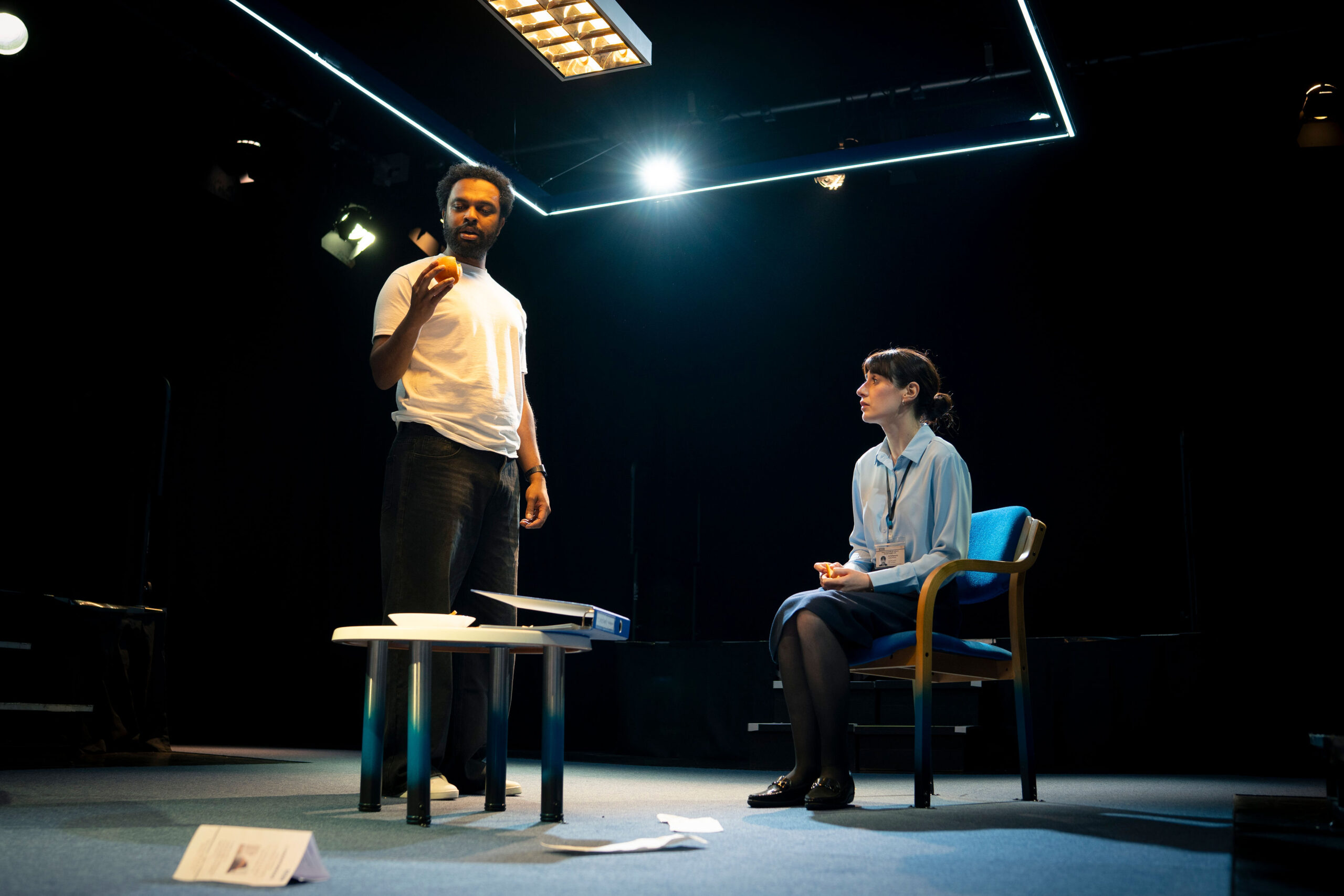
The drama consists of three snapshots during 24 hours of interactions in a psychiatric consultation room. Inpatient Christopher has a day left before his sectioning is due to end, and he is eager to get out and away from his old life in London’s White City. He dreams of living in Africa, where his parents grew up, but his future lies in the hands of two competing doctors who have widely differing views about what is best for him. His primary physician, Dr Flaherty, is a young female junior psychiatrist who has been treating him since he has been on the ward. She strongly believes that he should continue to receive her treatment in the hospital setting because she feels it would be unsafe to release him based on her recent observations. She tries to get the support needed from her supervisor, senior consultant Dr Smith, using the example that Christopher thinks that the oranges in front of him are blue in colour. Smith is laconic and supercilious, believing himself to have all the right answers due to his training, experience and academic research; plus, he has an eye on the costs of keeping patients in a hospital setting. He believes that Christopher’s issues all stem from his background, race and colour and that he would be better served being back in his community. Smith and Flaherty verbally tussle with each other over his diagnosis and the best course of treatment, with Smith using his power and authority to undermine his junior, to the possible detriment of their patient.
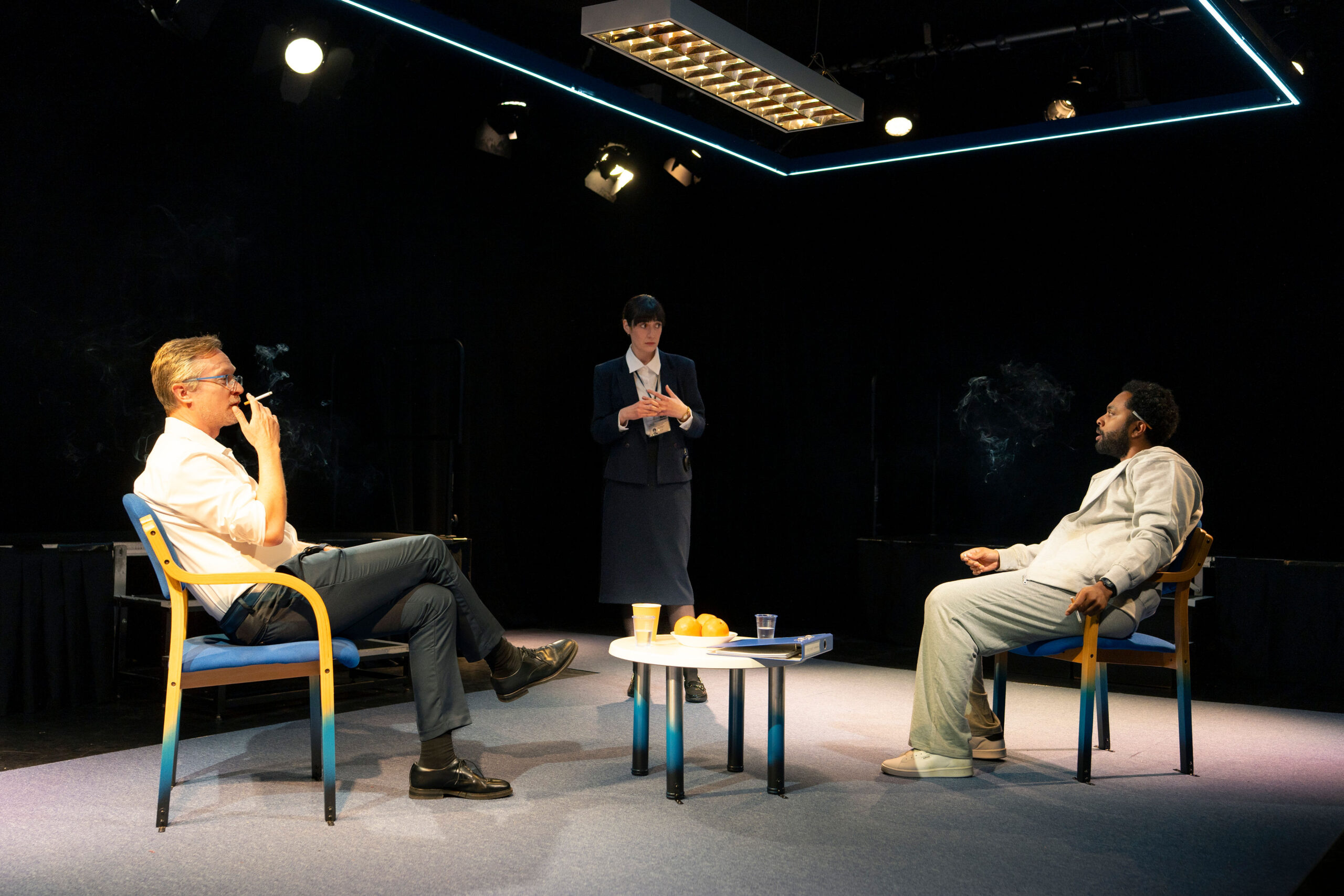
For this provocative production, the OSO’s compact theatre is organised with the audience seated on all four sides of the auditorium, meaning that the three characters are surrounded and scrutinised at close quarters. Nasty, tinny music is played over the speakers as we take our seats. These smart decisions by the creative team immediately intensify the feelings of pressure and foreboding. Lighting designer Gabriel Burns‘ stark, cool white spots illuminate the central area. There is a rectangular frame hanging above the stage floor containing LED strip lights that buzz into action as the show opens. Meanwhile, set designer Raphaé Memon delivers a simple, functional placement of furniture in order to convey the authentic starkness of the consultation room in an NHS psychiatric ward. There are two blue chairs facing each other with a low circular table between them. The eye is immediately drawn to the white bowl containing three perfectly orange oranges. Everything is screwed down to the carpeted floor, and the furniture legs appear to have been dipped in ombréd blue paint. Into this world burst Christopher, animatedly played by Andre Bullock (Once Upon a Bridge, The Talented Mr Ripley), and his institutionally naïve medic Dr Flaherty, performed by Irish actor Muireann Gallen (A Question of Duty, Once Upon a Bridge). Bullock is a wonderfully naturalistic actor who is able to immediately convey his agitation and confused mental state through his expressive body language. One moment, he is wide-eyed with spasms of energy, and the next, he is thoughtful and struggling to comprehend what is being said around him. Gallen initially complements his performance with stiff, contained and awkward movements. You feel her uncertainty and nervousness as she treads around Christopher’s mental health issues, shocking racist language, and delusions that might be rooted in being a lonely Black Londoner. Then enters Ciaran Corsar (A Midsummer Night’s Dream, The River) as the manipulative and condescending Dr Smith. Corsar offers a smug, narcissistic, stuttering and somehow whimsical portrayal of Smith, giving his lines their sinister undertones, particularly when he arrogantly threatens his junior with her job if she doesn’t see things his way. He is uncomfortable to watch as he reveals his character’s biases and true intentions. All the actors engagingly bring to life the current debate about care in the community and its efficacy. How patients can be let down by the treatment they receive and a system that is constrained by its available resources.
OSO’s artistic director, Lydia Sax, directs this play with the surety that comes with having venue-familiar actors, a great script and a strong creative team. She has actively chosen to emphasise its themes of institutional failure and a health service in crisis, perhaps at the cost of the funnier moments. Penhall’s satire doesn’t have much room to breathe in the first half, as the lines are played fast and the audience doesn’t have time to process them and to get any laughs out. The pace slows after the interval, allowing the audience more room to join in with the characters’ claustrophobic and challenging worlds and to consider Penhall’s thought-provoking dialogue while the two doctors spar and jab away at each other, each one convinced that their view is the right one.
This challenging and intense production mostly works as well today as the drama did when it won awards around the turn of the millennium. The original satire is largely displaced by the discomfort that keeps on building throughout the show as we watch the power plays, biases, and nastinesses roll out in front of us. It’s a tight and uncomfortable watch that fulfils its central promises and is well worth catching before its run ends if you live near this lovely Barnes village venue.
Penhall’s play returns not as a period piece, but as an ongoing case file
★★★★ 4 stars
Author Profile
- The Recs JDH
Latest entries
- 2 May 2026London DramaBlue / Orange ★★★★
- 25 March 2026London MusicalsSIX The Musical – West End ★★★★★
- 22 March 2026DramaHadestown ★★★★★
- 18 March 2026DramaGlorious! ★★★★
Tags: theatre reviews