RSC’s The Tempest ★★★★

Stars align and applause is thunderous as Richard Eyre makes his directorial debut at The RSC
The Tempest is understood to be the last play Shakespeare wrote on his own, circa 1610. Subsequent plays were collaborations; the old master handing his baton to the next generation of playwrights, perhaps. He wrote nothing after 1613 and died in 1616. Thus, as Prospero mulls that “our revels now are ended”, “our little life is rounded with a sleep” and “every third thought shall be my grave”, it seems Shakespeare is musing on his own mortality and bidding farewell to the theatre, preoccupied with thoughts of power, control, forgiveness and reconciliation.

Some twelve years prior to the events unfolding on stage, Prospero, rightful Duke of Milan, betrayed and usurped by his brother, is shipwrecked on a Mediterranean island with his young daughter. Here, he hones his magic arts and enslaves the native inhabitant Caliban and the spirit Ariel.

Now, as the action opens, Prospero conjures a tempest which brings his brother and his cohort to the island for a showdown. The newly shipwrecked characters meander across the island. Prospero manipulates Ariel with promises of freedom. Prospero’s daughter, Miranda, meets other humans for the first time and falls in love. Caliban conspires with the new arrivals to secure his freedom from Prospero’s tyranny. Finally, the usurped and the usurper meet.

On a superficial reading, it’s a simple plot. There is less psychological intensity here than in many of Shakespeare’s plays and fewer dramatic confrontations. To the extent that those are weaknesses, though, they are weaknesses of Shakespeare’s making, not of this production.

Images by Johan Persson

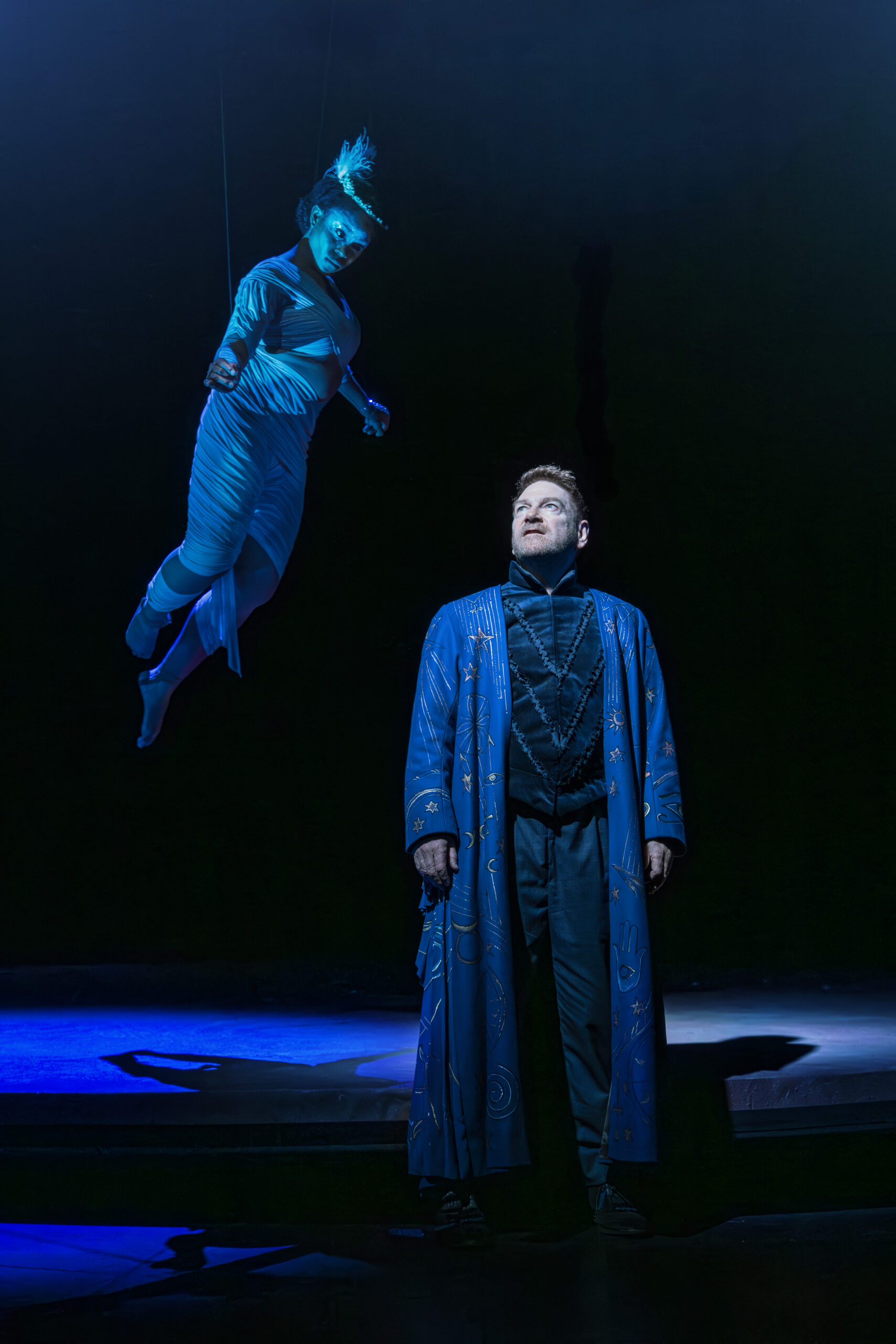
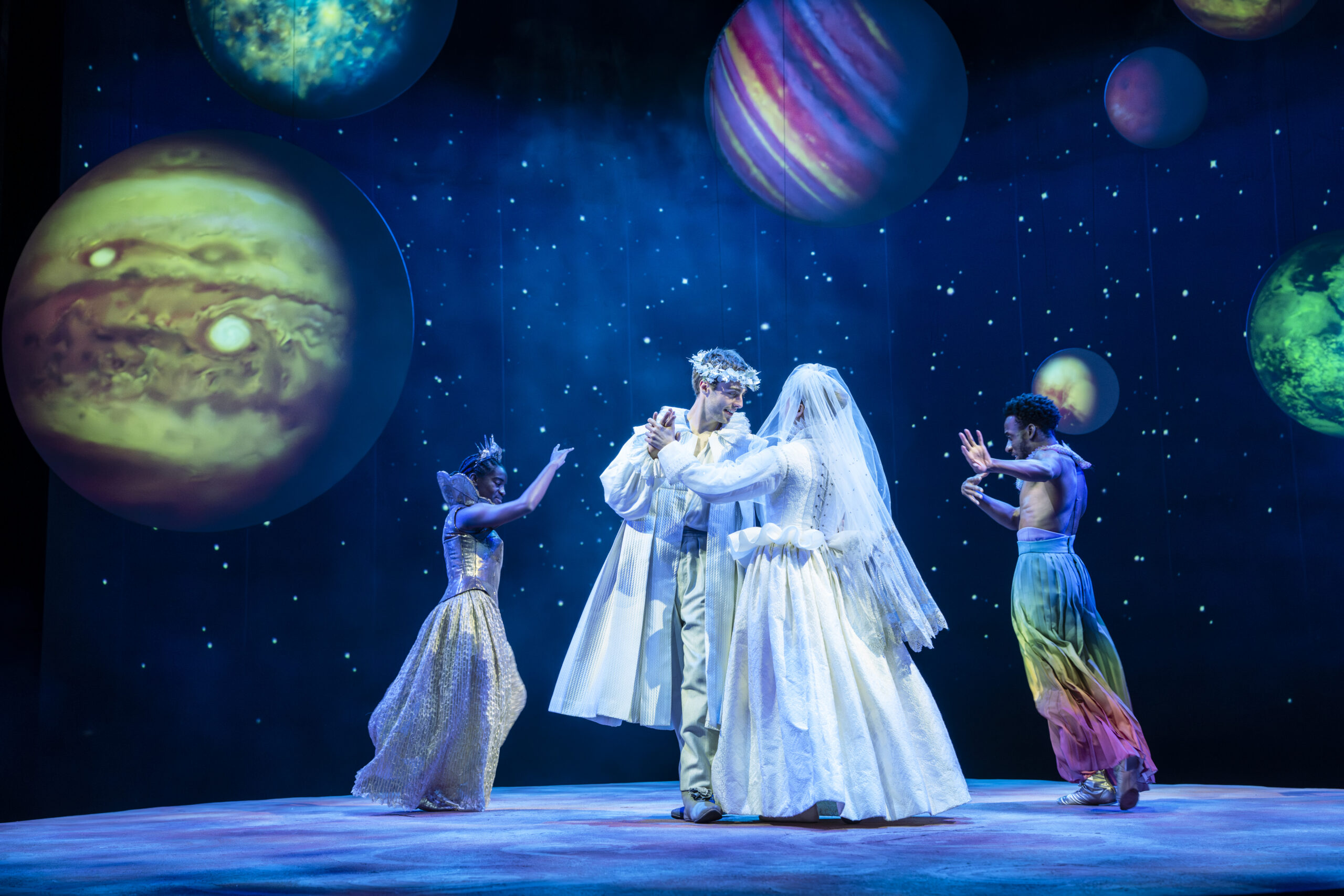
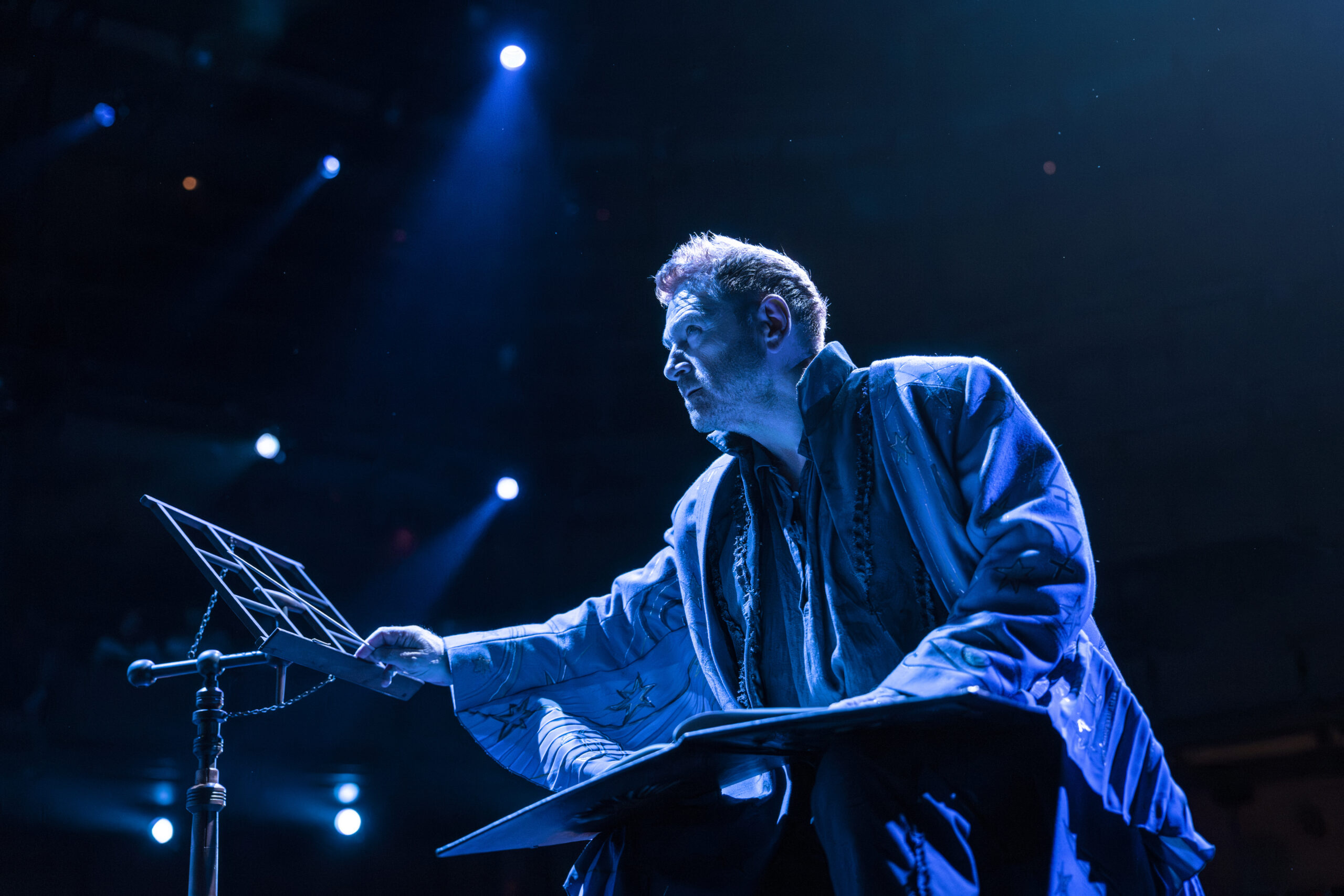
Kenneth Branagh takes the stage alone, in a rich costume (Fotini Dimou, costume designer) that nods to a classic doublet and hose but has a richness and simplicity that are hallmarks of this production. Donning a stunning robe of deep blue with glistening stars and moons, Branagh becomes magician and conductor, conjuring and conducting the powerful tempest that will bring his brother to the shore. The music and lighting are suitably dramatic, but Bob Crowley’s set design is the linchpin of this production. Here we have the tempest-tossed boat transporting Prospero’s brother and collaborators to their appointment with destiny. But it is the island’s interior, a lush, verdant, Henri Rousseau-styled backdrop, where the travellers grapple through the undergrowth, that transports the audience to the island.

The clarity of Branagh’s diction makes it easy to understand the longest and most complex of Prospero’s musings. In Prospero’s interactions with Ariel (Amara Okereke, who has the voice of an angel) and Caliban (played with thoughtful humanity by Ashley Zhangazha), Branagh’s words are mean, but the delivery seems a little light. Perhaps it is deliberate, to create an ambiguity in the relationships. With Ariel suspended above the stage, swooping and turning like a fairy, when her hands occasionally touch his, is that love we see from Prospero? There are echoes of Michelangelo’s Creation of Adam in the imagery, but who is empowering whom?

In Prospero’s scenes with his daughter Miranda (beguilingly played by Ruby Stokes), the lightness is less ambiguous. There is clear love. The pair work well together, their comic timing being particularly pleasing.

It’s not a perfect production. Branagh is indisputably an immensely talented actor, so when Prospero lacks a certain depth and gravitas, it is unclear whether it is the performance or the direction. There are issues, too, with timing. The whole play takes place over something akin to a single day. The ramblings (physical and oral) of the characters, enjoyable though they are (and a special mention is due to Guy Henry, whose drunken butler, Stephano, is a comic delight), seem disproportionate to the denouement. The speed with which Miranda falls in love is improbable, though, when Ferdinand is played so charmingly by Fred Woodley Evans, channelling a little Hugh Grant (the bashfulness of Charles from Four Weddings and a Funeral, the shirt-rippling of Daniel Cleaver from Bridget Jones’s Diary), it becomes understandable. The speed with which the final showdown between brothers is resolved feels much less satisfactory. These issues of timing are mostly of Shakespeare’s doing.

Notwithstanding a few shortcomings, there is much to enjoy in this rich, colourful, musical and thoughtful production. The relative simplicity of the surface plot and the simplicity and clarity Richard Eyre (director) brings to this production of The Tempest make this a light, comprehensible and enjoyable event. Nonetheless, particularly viewed through a post-colonial lens, the play offers up many themes to consider after viewing. The closing scene is Ariel and Caliban, released from their slavery. Ariel is unsteady on her feet; Caliban, back in control of his island, reaches out to support her, and they embrace. The image lingers long after the lights come back up.

This Tempest is going down a storm ★★★★ 4 stars

The Tempest Tickets


The Tempest runs at the Royal Shakespeare Theatre until 20 June 2026

Book Now

Author Profile

The Recs NB - Nicola Berry