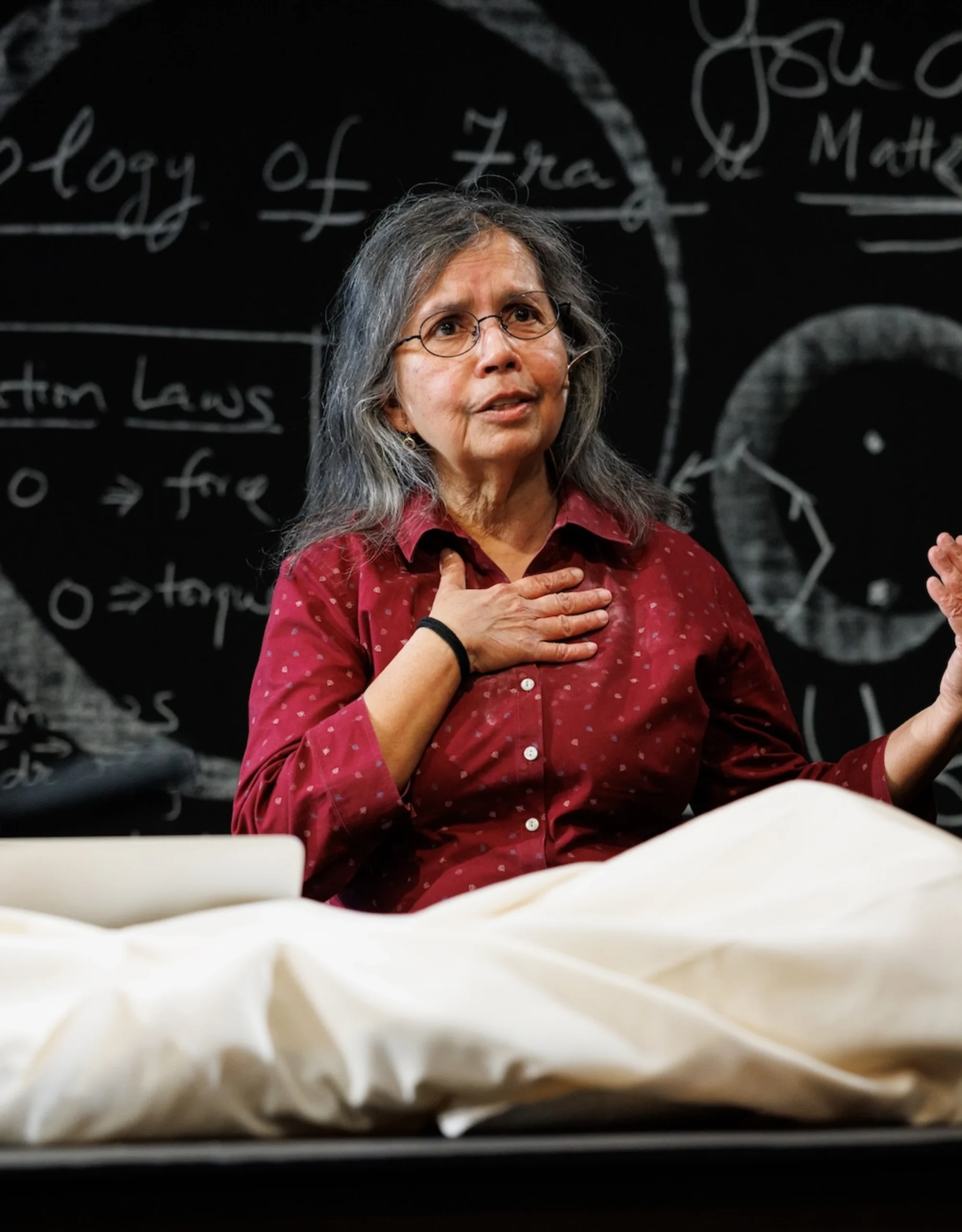
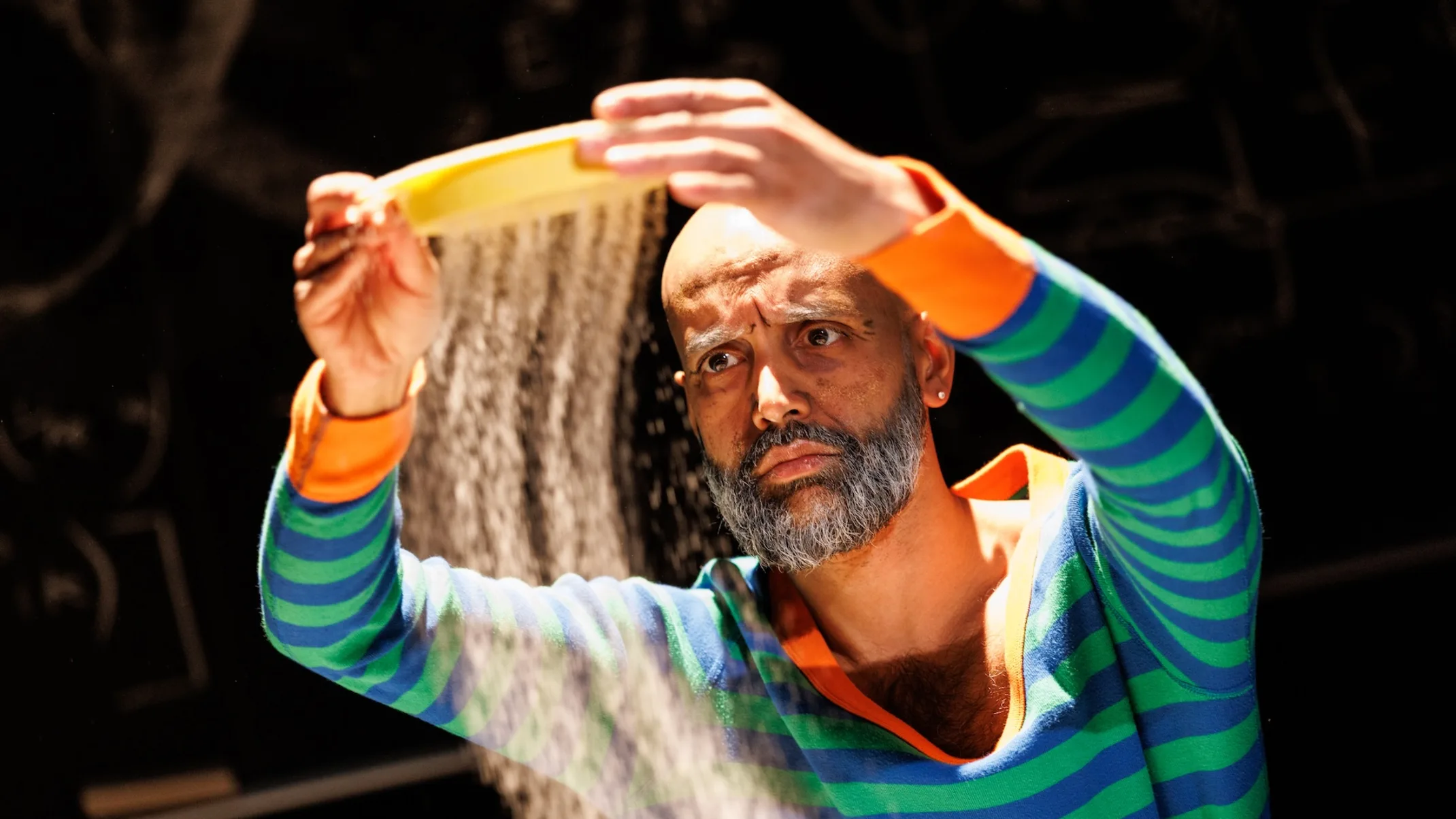
That second perspective comes from Chowdhury’s mother, Bulbul Chakraborty, a theoretical physicist. Now retired as a professor at Brandeis University, at her son’s request she finds herself performing Off-Broadway, and as a performer, she is radiant and truly unique. How many theoretical physicists do you know who’ve won Obie Awards for performance?
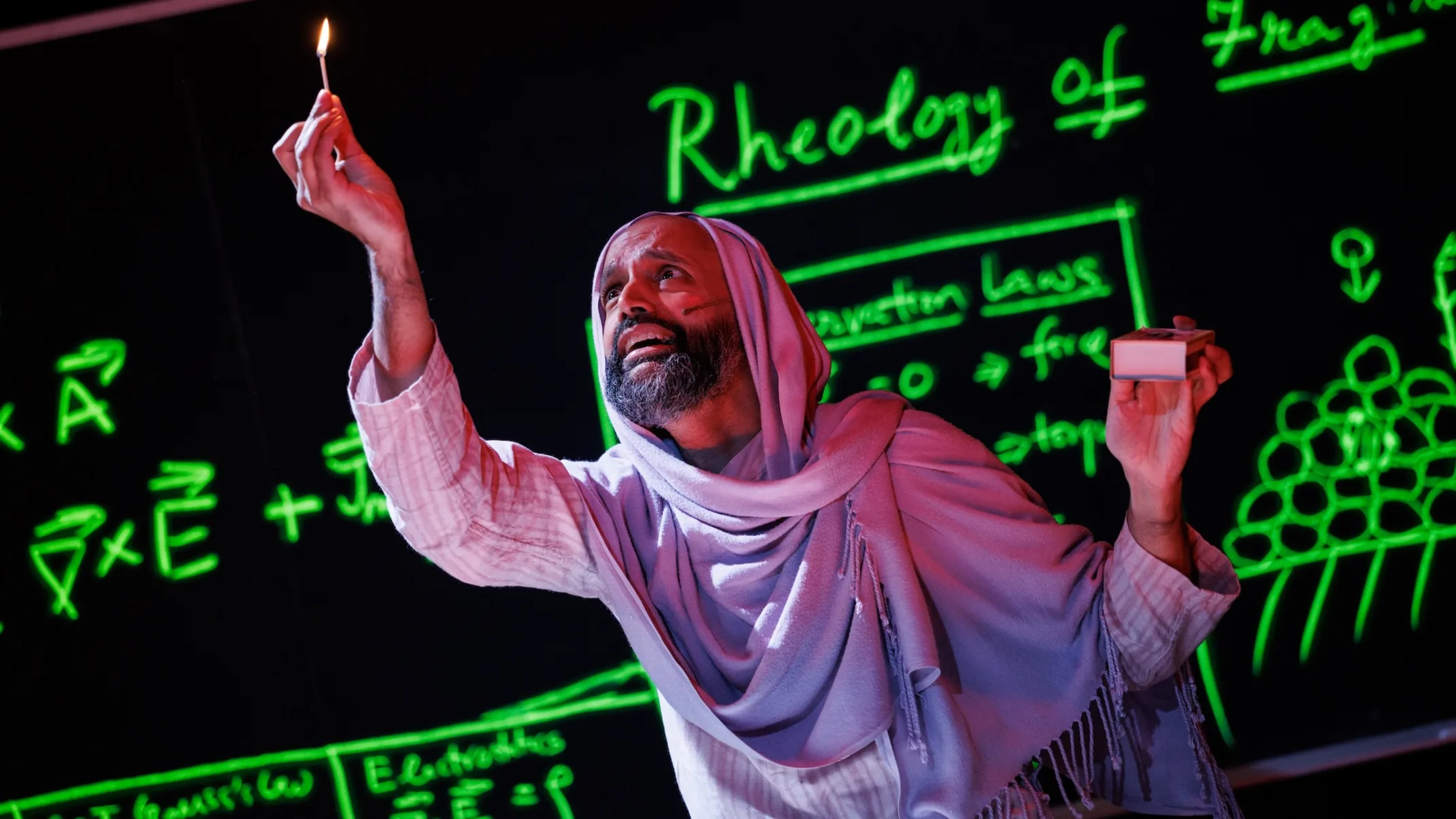
Chakraborty opens the show giving a physics lecture, and those years of teaching — ease talking to large groups, chalk stains on the sides of her jacket — are in clear evidence, abetted by Krit Robinson’s fantastic, recognizable set: a long blackboard filled with equations, a science lab table, a laptop, a coffee mug, and materials for demonstration. In clever juxtaposition with all the aforementioned is a center screen with a photo taken in 1987 of mother and son sitting on a sand dune in Denmark, a reminder that what the audience is witnessing is a mix of the professional with the personal.
For a full 20 minutes, Chakraborty lectures about sand as a “capricious matter” from a theorist’s perspective, how sand hides many mysteries. And then Chowdhury, sitting in the audience, interrupts her and proceeds to give her directorial notes. The coughing and choking she was doing at the end of a demonstration of the properties of sand weren’t convincing enough, so she needs to do that part of the scene again.
And so she does, at which point the blurring of science and theatre takes flight in a way that would likely thrill Tom Stoppard, the late, acclaimed British playwright who integrated complex mathematics and physics to his dramas Arcadia, Hapgood, and The Hard Problem. But whereas Stoppard was often accused of being too cerebral, Chowdhury is all heart: He fiercely loves his mother and dreads the day she will die.
To come to grips with that eventuality, Chowdhury has created a meta show that will serve as exposure therapy that he hopes will help prepare him for the inevitable. Once that is revealed, and once Chowdhury joins his mother on stage, the second half of this superb 75-minute production slackens its tight momentum a bit, perhaps unavoidably so in a work that then focuses on the biological processes that occur to the body upon death.