Double Indemnity (touring) ★★
By The Recs NB - Nicola Berry 2 days agoDoes ‘Double Indemnity’ pay out or is it just murder to sit through?
In 1927, a sensational murder trial gripped America. Fifteen hundred people packed the courthouse every day, with up to two thousand more in the streets outside; hawkers sold fake tickets while street sellers sold souvenir pins featuring the murder weapon (a window sash weight).
The facts were thus: Ruth Snyder persuaded her husband to take out insurance and, aided by an insurance agent, added life insurance to pay out extra (double indemnity) in the event of an act of violence. She arranged for the postman to ring twice so she could intercept the insurance documents to avoid her husband discovering the policy. Snyder then conspired with her lover, a married door-to-door corset salesman, to murder her husband and make it look like death during a robbery. Investigating detectives found little evidence of a break-in and discovered the stolen items hidden within the house. Ruth Snyder and her lover turned on each other at the trial, each blaming the other. Both were convicted and executed by electric chair at Sing Sing Prison. The insurance salesman was fired and went to prison for forgery.
Inside the courtroom, reporter James M. Cain was intrigued both by the details of the case and the dynamics between Snyder and her lover. In 1934, he wrote a novel, The Postman Always Rings Twice, about a woman conspiring with her lover to murder her husband. In 1936, he returned to the Snyder case for Double Indemnity, published as an eight-part serial in Liberty magazine in 1936 and as a novel in 1944.
Set against the backdrop of the Depression and the Hollywood Hills, Walter Huff, an insurance salesman, visits the Nirdlinger home to get payment for Mr Nirdlinger’s car insurance. Mr Nirdlinger is out, but his wife, Phyllis, invites Walter in and toys with him. When she enquires about taking out a life insurance policy on her husband (secretly paid from her own finances), Walter is quick to work out why. He explains that a successful murder has three elements: 1. Help (an accomplice); 2. Advanced Planning (time, place and method all worked out carefully); 3. Audacity (it has to be bold). He also explains that some insurance policies offer double indemnity – a clause that pays double for a train accident. To get a share of the money (and, of course, to get the woman), Walter offers his assistance. The two hatch their audacious plan. First, Walter will get the husband to take out the policy, to which Phyllis, in front of a witness, will object. Then they will kill Mr Nirdlinger and leave his body near the train tracks. Walter will board a train, disguised as Mr Nirdlinger, before jumping off (safely), enabling the police to conclude that Mr Nirdlinger fell to his death. The perfect murder. Or is it?

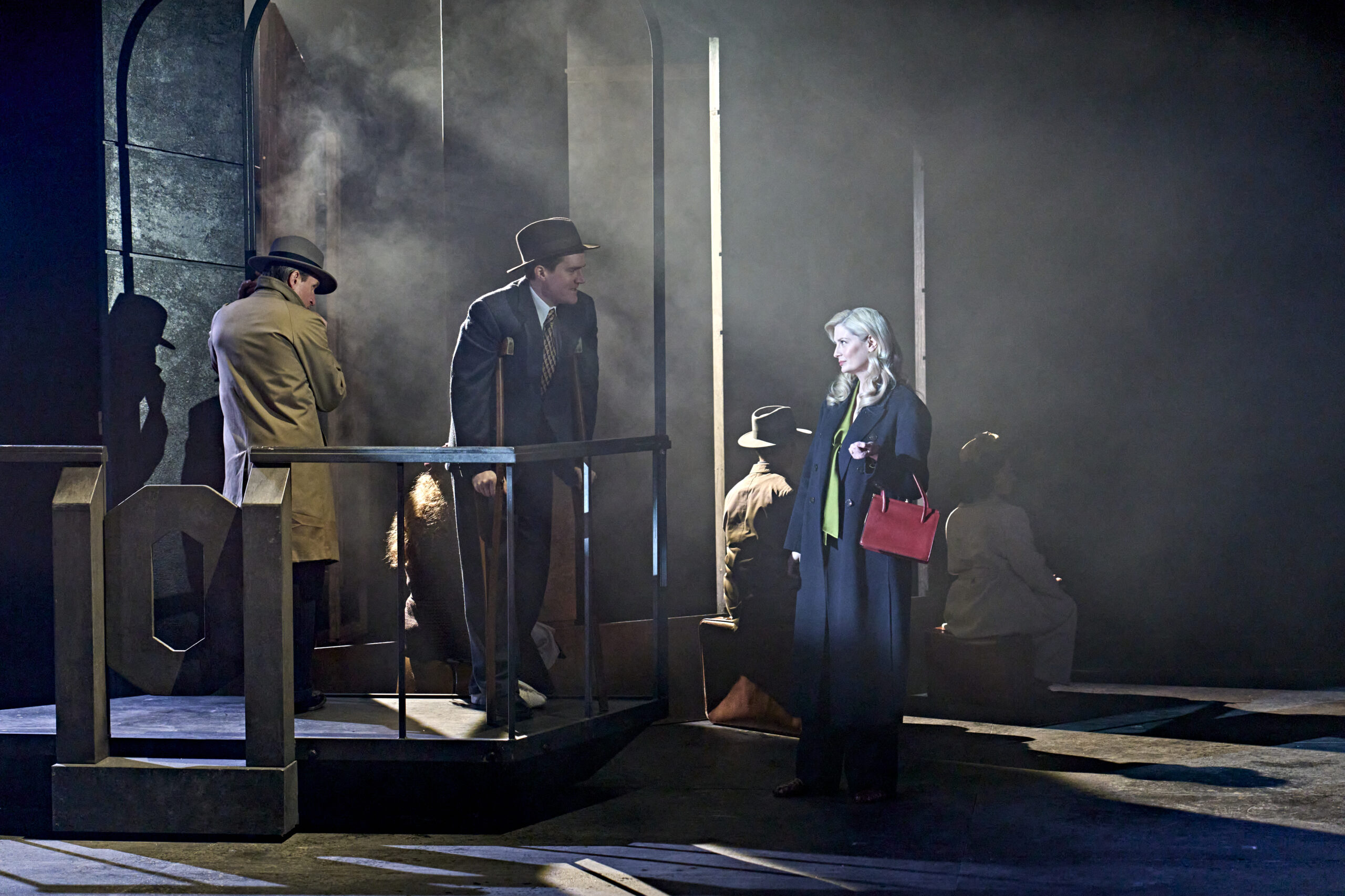
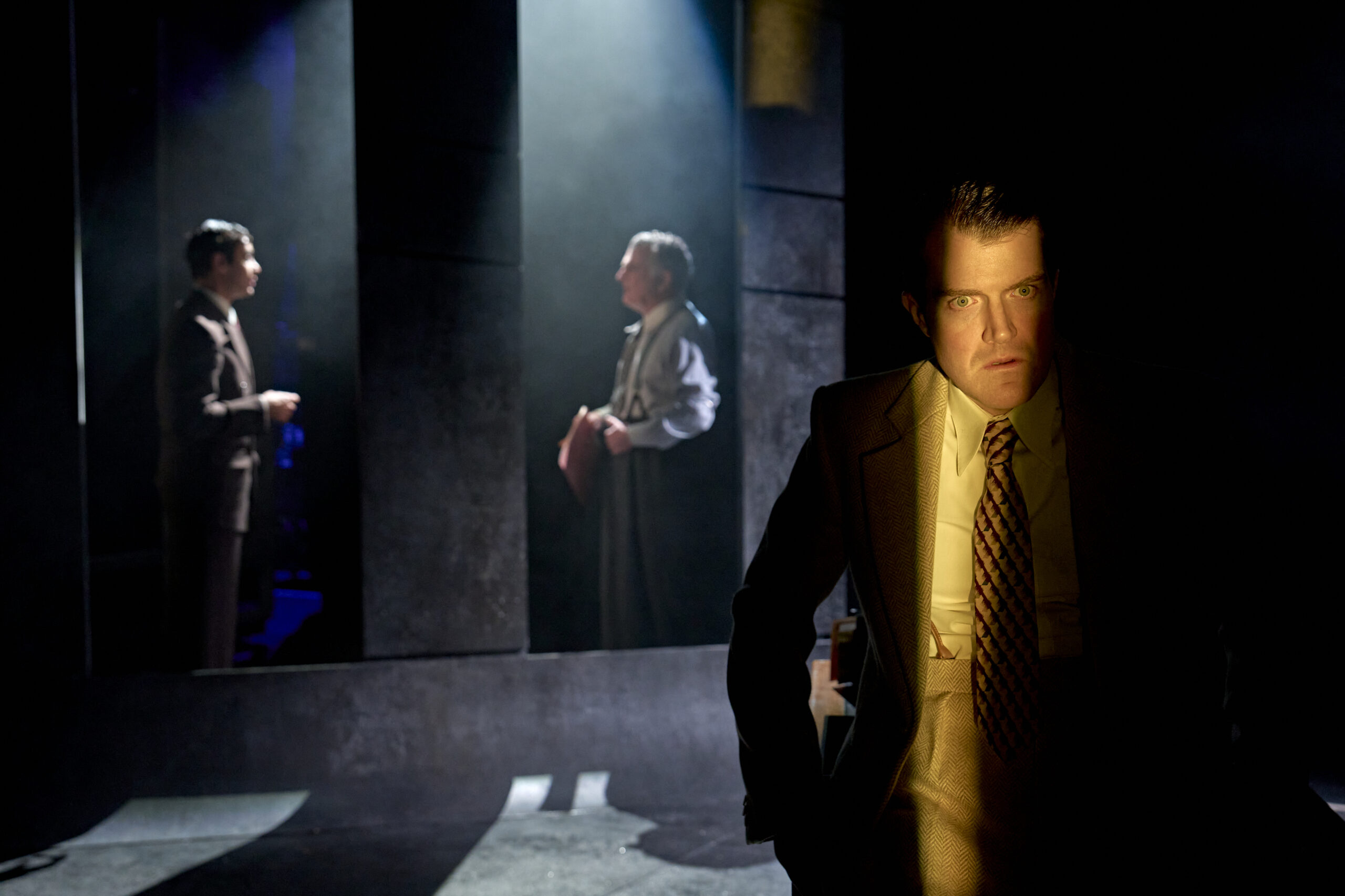
The set (Ti Green, set and costume design) is simple but effective. The city is clearly described by a glimpse of the Hollywood letters in a space where a wall or ceiling might have been expected. Otherwise, the action is contained within a simple, grey, concrete-effect box. The Nirdlinger house has no fittings or furnishings when Walter and Phyllis first meet, though it later acquires a chair. The insurance office has a desk and chair; Nirdlinger’s office has the desk in an entirely different position. Walter’s home is almost cluttered in comparison, with an armchair and a cocktail trolley. Later, there is a bench for a clandestine meeting, a car that transports Phyllis, Walter and Mr Nirdlinger to the train station, and the outdoor observation carriage of a train, from which Walter must jump in the guise of a falling Nirdlinger. In fine film noir tradition, light and shadows from a slatted aperture grace the stage almost throughout, and there is judicious use of smoke (Josh Gadsby, lighting design).
Walter Huff (Ciaran Owens) strides onto the stage first, a man in control, addressing the audience directly, in the required Phillip Marlowe-esque drawl, and drawing them into the intrigue. It is a promising start. Walter is an expert in his field of insurance and spotting insurance scams. Personified by Owens, he is charismatic and likeable, eyes and voice twinkling. It would be easy to understand Phyllis (Mischa Barton) falling for him.
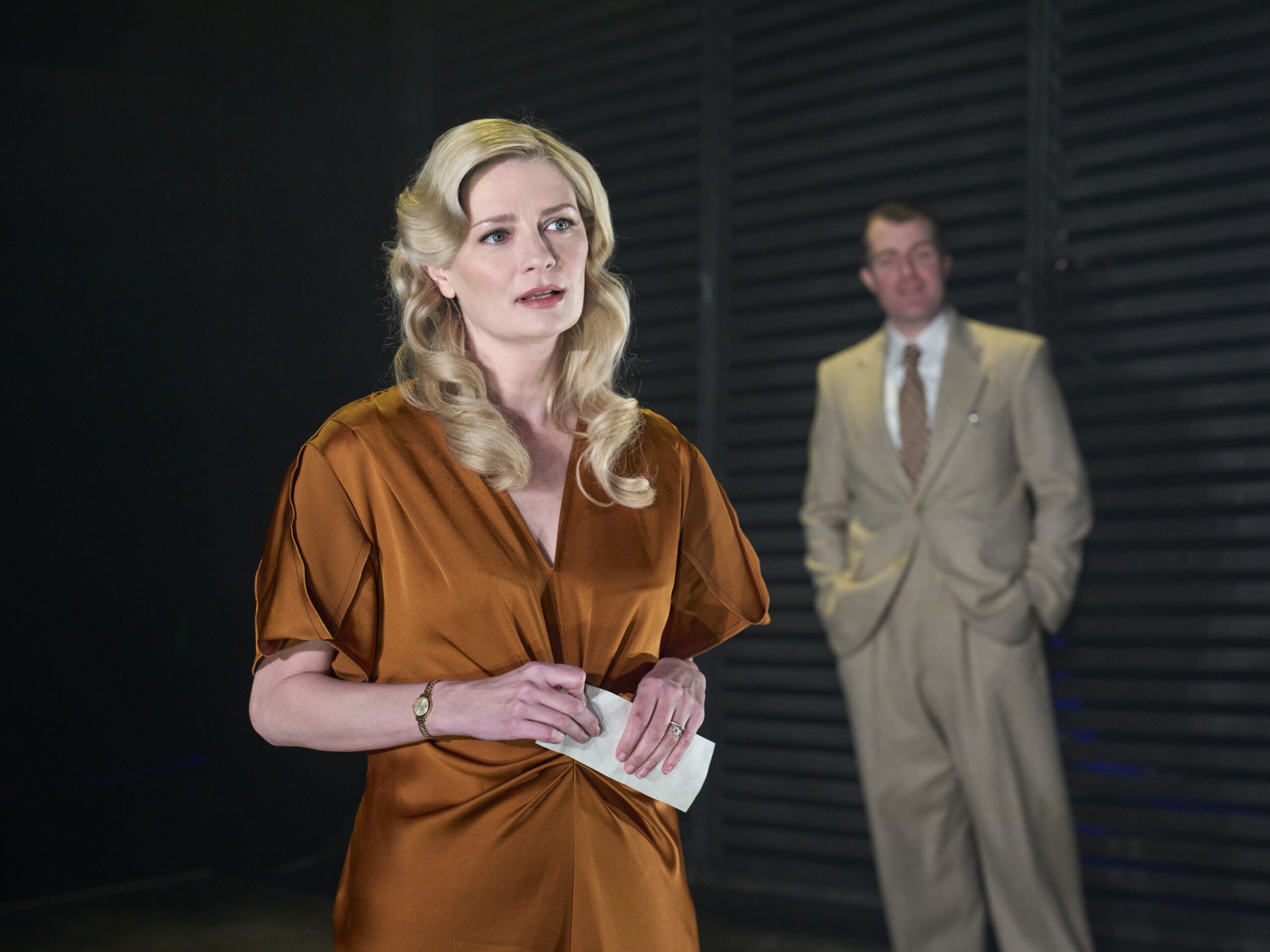
It’s much harder to understand why Walter would fall for Phyllis. She is aloof, snobbish and rude at their meeting, with no hint of twinkle in her eyes or flirtatious cheek behind her words. In the hands of Barton, Phyllis is a cold fish with dead eyes. Arguably, this is a great portrayal of a psychopathic killer, but it is not a portrayal of an irresistibly beguiling and dangerous woman for whom a man might realistically fall so fast and so hard that he’d be willing to kill. The lack of chemistry between the leads means this production has more fatal flaw, less femme fatale.
Owens sparks well, however, with Martin Marquez (his immediate boss, friend, and supporter Keyes), with Gillian Saker (as Nettie, the efficient secretary), and with Sophia Roberts (Lola Nirdlinger – Phyllis’s stepdaughter). Of those, only Marquez has a well-developed character to play, and, with his trousers practically up to his nipples, he imbues canny Keyes with a warmth and humanity that has the audience rooting for him to get to the bottom of the mystery.
This adaptation is by Tom Holloway, directed by Oscar Toeman. The plot is easy to follow. There’s something off in the pacing of the action, though. Walter is seemingly barely through the Nirdlinger’s door before he is canoodling and plotting murder with the wife, while it takes several protracted scenes for him to get the paperwork and finances in place with the husband, and poor Lola is given moments to describe a complex history between her mother (dead before the play begins), Phyllis and Lola’s ex-boyfriend Nino (Joseph Langdon). Aside from Walter and Keyes, the characters are one-dimensional. Nettie is incidental to the plot, yet Saker successfully conveys a bubbly, confident, modern woman who knows she is much more intelligent than the man for whom she works. Nirdlinger (Oliver Ryan) shouts to show he’s not very nice. Mr Norton (Langdon again) shouts to make it clear that this payout would be fatal to his firm. At least it provides a strong contrast to his monosyllabic Nino. Lola appears little more than a plot device to convey that Phyllis has a suspicious track record, but Roberts still manages to give Lola a touching fragility. Pivotal moments like shootings and train exits rely on a quick stage blackout. This is a lightweight production that manages to feel both rushed and overly long at the same time.
With its origins in a sensational true crime, based on a work by a master of hard-boiled American fiction, and with a stylish set and some good acting talent on the stage, Double Indemnity has a lot of promise.
The scene is set for some smouldering femme fatale action – sadly it never catches light. ★★ 2 stars
Author Profile
- The Recs NB - Nicola Berry
Latest entries
- 16 April 2026DramaDouble Indemnity (touring) ★★
- 3 April 2026DramaUnder Milk Wood – Theatr Clwyd ★★★★★
- 25 February 2026DanceMatthew Bourne’s The Red Shoes ★★★★★
- 11 February 2026DramaMan and Boy – National Theatre ★★★★
Tags: Double Indemnity, theatre reviews