The Lady Doth Protest ★★

Mark Blankenship’s ‘The Lady Doth Protest’ offers a present-day battle of wits
It’s difficult to write a show about William Shakespeare. Yet, there are hundreds of shows about William Shakespeare. Maybe thousands. Even millions. It’s really, really hard to find new ways to reframe the works of the Bard. In the final moments of The Lady Doth Protest, this becomes glaringly apparent.

Credit must be given to the effort it must’ve taken for writer Mark Blankenship to invent a play that analyses Shakespeare’s works in two different interpretations. Indeed, what The Lady Doth Protest does demonstrate is that we still have much to discover in our reading of Shakespeare in the context of his gender politics.

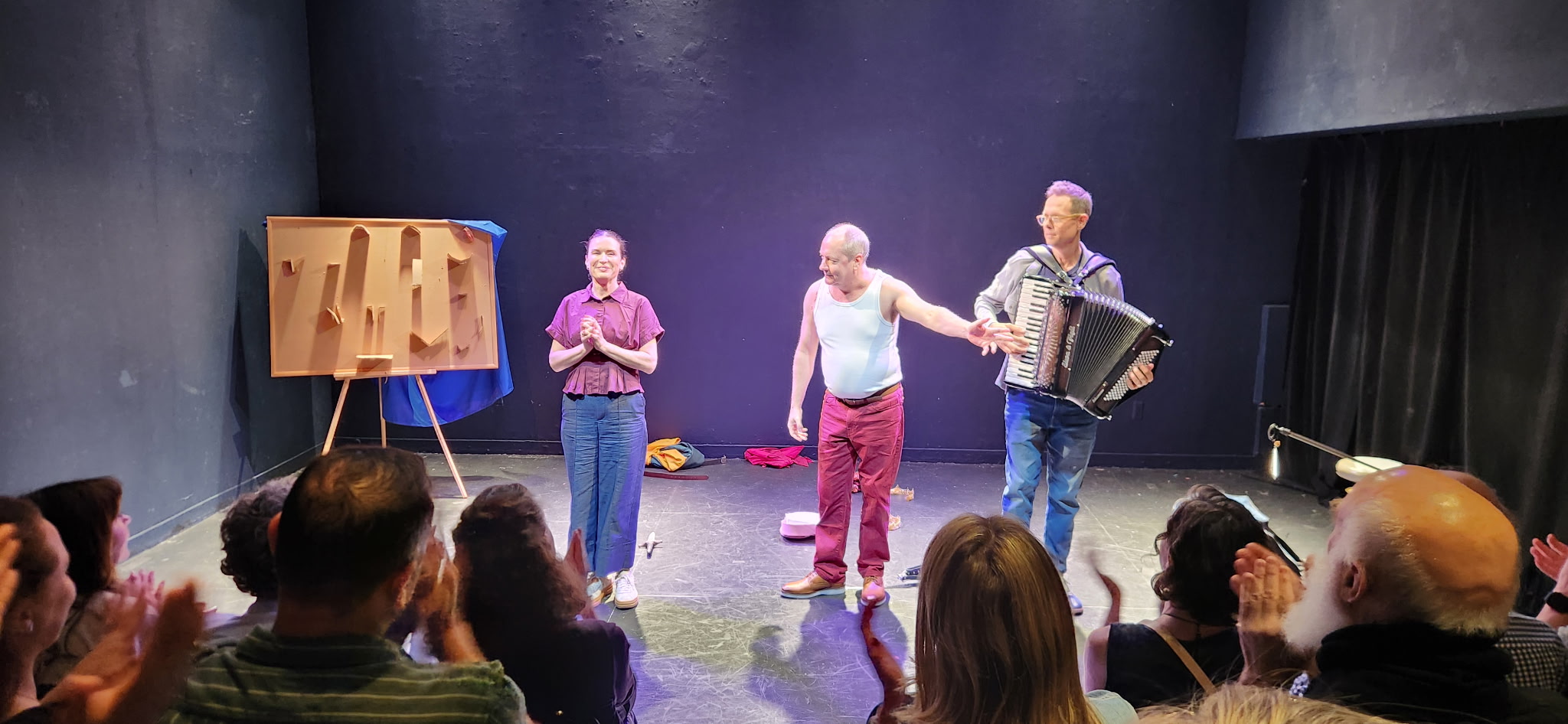
The play opens with a man dressed as a fool. He is not necessarily the Fool of King Lear, but a fool – a glaringly obvious symbol for what his character represents. Liam Craig inhabits the fool, who begins by teaching the audience about his interpretation of Shakespeare – a by-the-books reading that preaches traditional ideas of love and devotion. He cycles through iconic moment after iconic moment using a board of props, guiding the audience through “to be or not to be” and “tomorrow and tomorrow and tomorrow”.

We are seemingly on board – until the Fool’s indulgent monologues are interrupted. When Nealy Glenn begins questioning the validity of his argument and posits her own, the show shifts into a two-hander about the nature of the role of women in Shakespeare’s plays, with a verbal debate at the heart of the show’s structure.

The opening twenty minutes promise an interesting debate – and yet, Blankenship fails to deliver on that promise. What starts off as an intriguing concept soon descends into something strange and rather unexpected, ill-fitting really, and unfortunately, confusing. The debate turns violent, both mentally and physically. It veers to sexual violence.

The tonal shifts have the smoothness of the Coney Island Cyclone; it jumps quite bafflingly from an intellectual conversation to a fight scene to a moment of intimacy, then an educational fourth-wall break – without much linking these moments together. One is left wondering why these were included in the play – it drags down the pacing, especially for a fringe show.

The sexual violence in question is viscerally depicted. In a suitable context this could work, but it doesn’t in this production. There simply is no point in including something so explicit in a show about the implicit readings of Shakespeare – it adds nothing to the overall message and betrays the concept of the show. By taking away the intellectualism of the original premise, Blankenship turns debate into warfare – the show even ends with a moment of body horror.

It isn’t all difficult to watch. There are genuinely interesting moments where Blankenship’s academic understanding of Shakespeare shines through – especially with how he incorporates the Fool’s personal socio-economic background into his perspective. Will Holshouser is sublime as an accordion player who is constantly onstage; his facial expressions provide the perfect foil to the action.

Ultimately, however, The Lady Doth Protest alienates when it should intrigue, attacks when it should compromise, and doesn’t come to a satisfying end – its central thesis is answered by even more violence when a reasoned conclusion could’ve been reached by the two opposing characters. Perhaps this story could’ve been handled with more care.

This production was reviewed in preview ahead of the Fringe at 59E59

An intellectual debate about Shakespeare turns violent ★★ 2 stars

Edinburgh Fringe Tickets


Tickets for this show and 3000+ other titles are available to buy online at the Fringe's website

Book Now

Author Profile

The Recs SCD - Steve Coats-Dennis