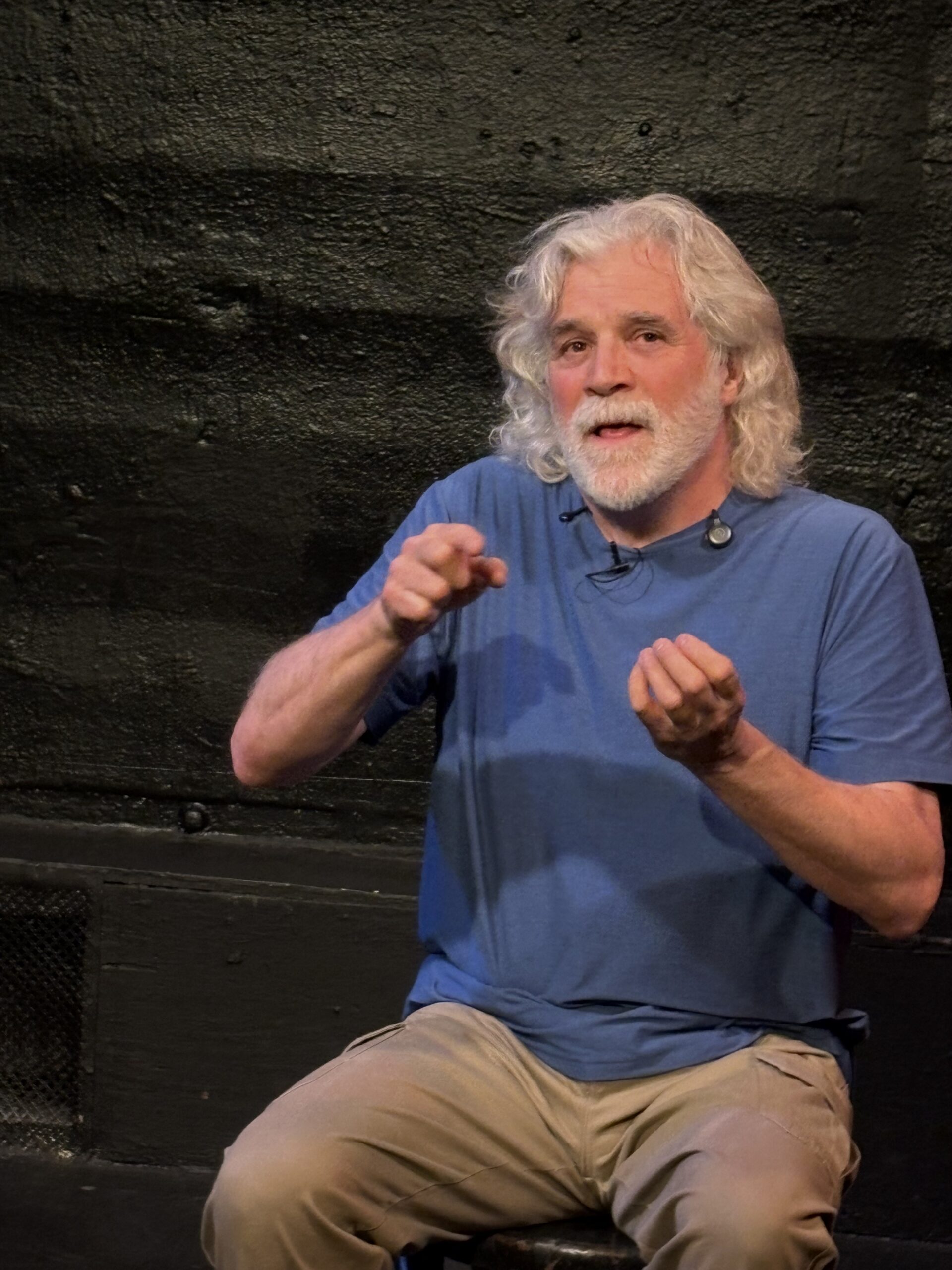
So Tom, A Cat in a Box, I believe is a story – in fact, your story – that you’ve wanted to tell for such a long time. Can you give us a sense of what it’s about?
It’s about growing up in a chaotic, dysfunctional family and what that does to a child. It’s not stand-up. It’s a solo play. There’s humor in it, but it’s a very different kind of storytelling. It’s about realizing I wasn’t defective. I was affected by childhood trauma, and once I understood that, things began to change.
You’ve said that you felt ‘defective’ for so many years. How did you discover that all of that was poor programming in your upbringing and none of it was your fault?
A lot of it came from studying early childhood development when I became a teacher in my 50s. I learned how much of who we are is shaped in the first years of life. In the play I say, “I wasn’t broken. I was poorly programmed.”
I believe that from an early age, you were thought of as “the funny one”. Was this a defence mechanism growing up within dysfunction? Or a route through it?
It was completely a defense mechanism. As I got older, it just became my default. People told me I was funny. Then I saw comedians and heard them telling the truth, so I thought, let me do this.
Your journey as a creative performer started with stand-up. What drew you to that genre? Was it a way of telling your truth about addictions in a safe way?
I was drawn to comedians like George Carlin and Richard Pryor because they were honest. They were telling the truth about things people didn’t always want to hear. My way of dealing with trauma and pain was to make a joke out of everything, so comedy gave me a way to say what I believed was true. And if people got upset, I could say, “It’s just a joke.”